 BUY WEBSITES
 BUY DOMAINS
 LOGIN
LOGIN
 SIGNUP



Domain Authority: The Moz link-graph metric explained, calculation methodology, and how aged-domain buyers read it
Domain Authority is the Moz link-graph metric that predicts the relative ranking strength of any website’s domain on a logarithmic scale from 1 to 100.
Moz introduced Domain Authority in 2012 as the first widely-adopted third-party predictive ranking score after Google deprecated the public PageRank toolbar.
The metric is calculated by a machine-learning model trained on dozens of link-graph signals plus the Moz Spam Score adjustment.
The SEO Domains analytical position: Domain Authority is one of four cross-validated link-graph proxies that aged-domain buyers read alongside Domain Rating, Trust Flow, and Citation Flow before any acquisition decision.
SEO Domains operates the curated marketplace with a 220,000+ pre-screened catalogue from $100 entry-level domains through $1.5 million premium acquisitions, ICANN-accredited transfer, and Managed Account expert support; every listing surfaces Domain Authority alongside the multi-metric screening framework that filters link-spam patterns at inventory ingestion.
What does Domain Authority measure?
Domain Authority measures the relative ranking strength of a website’s domain on a logarithmic scale from 1 to 100. Moz designed Domain Authority as a comparative predictor: a domain with DA 60 is, on average across the test query population, more likely to outrank a domain with DA 30 than the reverse.
The metric does not predict a specific SERP position; it estimates the probability of stronger versus weaker ranking outcomes when other factors are held equal.
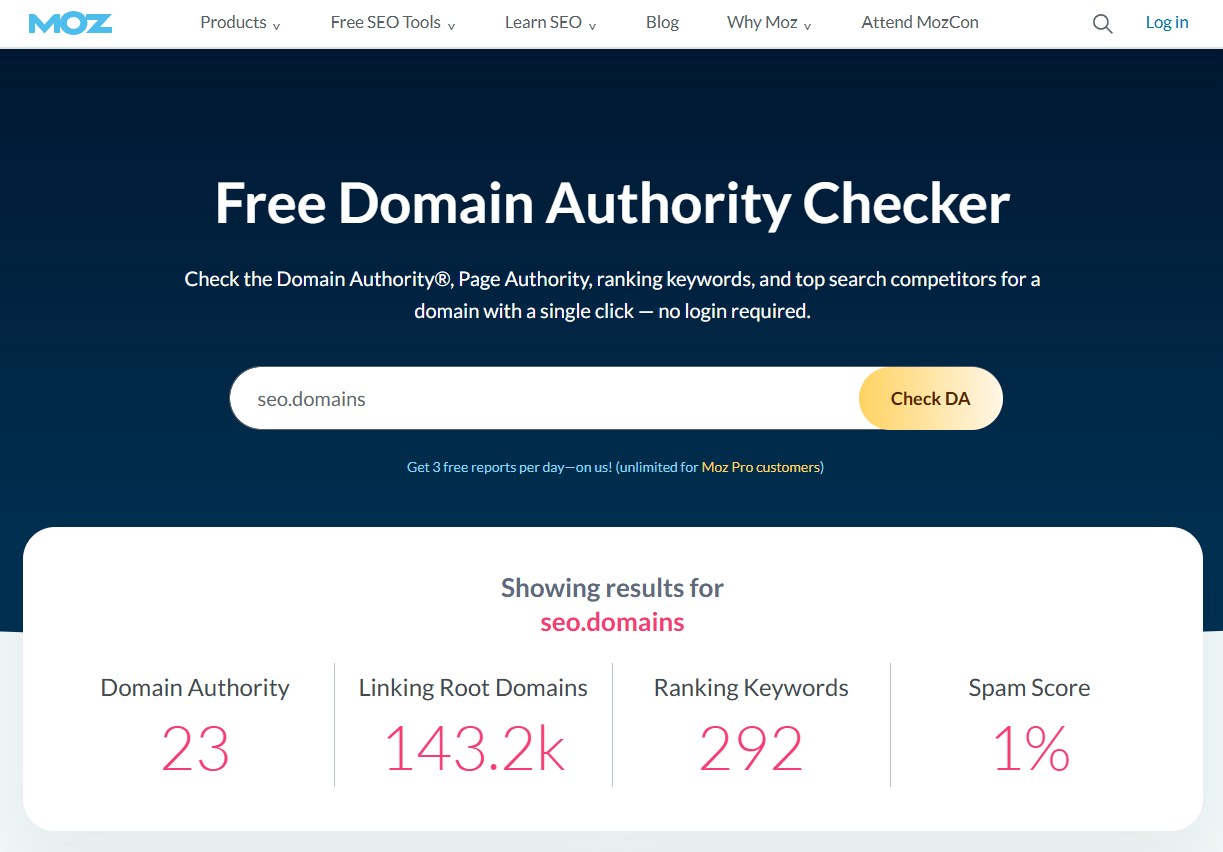
Domain Authority is a comparative predictor, not a ranking-position estimator.
Moz designed Domain Authority as a comparative tool. The score answers “which of these two domains is more likely to rank stronger” but does not predict the exact SERP position either domain will occupy on a specific query.
Practitioners reading Domain Authority as a ranking-position predictor misuse the metric; practitioners reading it as a comparative link-graph proxy use the metric correctly.
Domain Authority aggregates link-graph signals across the entire domain.
Moz publishes Domain Authority for an entire domain and Page Authority for individual URLs. Domain Authority aggregates link-graph signals across the whole domain. Page Authority isolates the signals for a single page.
Aged-domain buyers acquiring a domain check both: a domain with high Domain Authority and weak Page Authority on key URLs signals that the link equity concentrates on a small subset of pages.
Domain Authority is a third-party predictive proxy calculated by Moz.
Domain Authority is calculated by Moz on the Mozscape link graph. Moz operates an independent crawl of the public web and applies a machine-learning model to the link-graph signals it observes.
The score reflects Moz’s calculation methodology and Mozscape index state; it is independent of any search engine algorithm. The SEO industry standard treats DA as a cross-validated proxy alongside Domain Rating, Trust Flow, and Citation Flow.
Moz launched Domain Authority in 2012 as the first widely-adopted predictive ranking proxy
Moz introduced Domain Authority in 2012 as part of the Mozscape API release. The 2012 launch positioned Moz as the first major SEO toolset to publish a third-party predictive ranking score based on independent link-graph analysis.
Before 2012, SEO practitioners relied on Google’s own PageRank toolbar value, which Google deprecated and eventually removed from public visibility. Domain Authority filled the gap by offering a public-facing predictive score based on Moz’s proprietary crawl.
The 2012 launch filled the gap left by Google PageRank toolbar deprecation.
Google began deprecating the public PageRank toolbar value through 2011-2012, removing the only public-facing predictive ranking metric the SEO industry had.
Moz launched Domain Authority in early 2012 as the replacement: a Mozscape-calculated, publicly visible, predictive ranking proxy.
The market timing of the 2012 launch is one of the reasons Domain Authority became the industry-standard reference metric for the next decade.
Moz surfaces Domain Authority across Link Explorer, Pro tools, and the MozBar.
Domain Authority appears in Moz Link Explorer for single-domain audits, the Moz Pro tools suite for ongoing tracking, the MozBar browser extension for in-browser quick reads, and the Mozscape API for programmatic access.
The single metric is consumed across the Moz product line, contributing to its industry adoption among SEO teams using Moz as their primary toolset.
How Moz calculates Domain Authority: 6 algorithm inputs
Moz calculates Domain Authority through a machine-learning model trained on 6 factor categories. The training target is correlation with Google search rankings across a large sample of query-result pairs.
The model outputs a 1-to-100 score normalized to the logarithmic scale. The 6 factor categories below describe what the machine-learning model evaluates; the precise weighting is closed-source and updated through periodic model retrainings.
The machine-learning model is trained on documented ranking outcomes.
Moz trains the Domain Authority machine-learning model on a sample of query-result pairs with documented ranking outcomes. The training target is correlation between the score and the observed ranking position.
The model adjusts factor weights to maximise correlation across the training set. The trained model then predicts new domains’ scores based on the same factor categories.
This is the methodology Cyrus Shepard has documented through his time at Moz and subsequent independent writing on link-metric correlation.
The Moz Spam Score adjustment penalizes link-manipulation patterns
The Moz Spam Score adjustment is the structural feature that separates Domain Authority from raw link-count metrics. Moz Spam Score evaluates 27 documented spam-pattern flags across the link profile and the on-page content.
High Spam Score reduces Domain Authority below the raw link-count signal would suggest. The adjustment limits the gap between honest authority and link-spam manipulation.
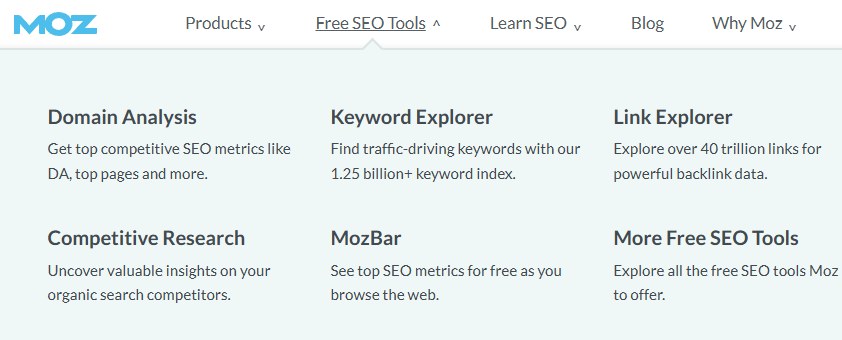
The Spam Score evaluates 27 documented spam-pattern flags.
The 27 Spam Score flags cover patterns like high link count from low-quality referring domains, anchor text over-optimisation, thin content on the target domain, mismatched language signals, and unusual outbound link profiles.
Moz publishes the flag list in its Learn Center materials. Each flag adds to the cumulative Spam Score; high cumulative scores trigger the Domain Authority reduction.
Charles Floate documented Spam Score manipulation detection through PBN A/B testing.
Charles Floate documented the Spam Score detection mechanics through PBN A/B testing across 2018-2024.
The testing demonstrated that link-farm referrers and pattern-injected referring domains trigger the Spam Score flags and produce the Domain Authority reduction in observable timeframes.
The Spam Score adjustment is one of the strongest single signals that a domain’s link profile has been manipulated, which makes the Domain Authority-versus-raw-link-count gap a high-leverage pre-acquisition audit signal.
Domain Authority 2.0 retraining and the model update cadence
Moz launched Domain Authority 2.0 in March 2019 as a major model retraining that improved correlation with Google rankings. The 2.0 retraining incorporated improvements to the Spam Score adjustment, the anchor text distribution analysis, and the machine-learning architecture.
Subsequent model revisions are deployed without version-number announcements at irregular intervals. SEO practitioners observe Domain Authority shifts of 5-15 points when Moz refreshes the model, even when the underlying link profile has not changed.
The 2019 DA 2.0 retraining improved correlation with documented ranking outcomes.
Moz announced the Domain Authority 2.0 retraining on 5 March 2019 with documented correlation improvements over the original DA 1.0 model.
The 2.0 retraining was the largest single update to the Domain Authority methodology since the 2012 launch.
Practitioners running historical comparisons across the 2019 transition account for the model retraining as a separate variable from any underlying link-profile change.
Subsequent model revisions ship without version announcements.
Moz refreshes the Domain Authority model at irregular intervals without version-number announcements. The refreshes typically occur 2-4 times per year.
Practitioners observing unexpected Domain Authority shifts cross-check against the Moz announcements page and the Domain Rating value from Ahrefs: if DR is stable while DA shifted, the cause is a Moz model refresh, not a link-profile change.
Domain Authority compared to Domain Rating: scope and methodology differences
Domain Authority and Domain Rating both score domains on a 0-to-100 logarithmic scale but the methodologies, index sources, and refresh cadences differ. Domain Authority (Moz, 2012) incorporates the Spam Score adjustment that Domain Rating does not apply.
Domain Rating (Ahrefs, 2014) uses recursive referring-domain weighting that Domain Authority handles differently through its machine-learning model. The two metrics agree on link-profile-strong domains and diverge on the link-manipulation edge cases.
| Dimension | Domain Authority (Moz, 2012) | Domain Rating (Ahrefs, 2014) |
|---|---|---|
| Calculation methodology | Machine-learning model on 6 factor categories | Recursive referring-domain weighting |
| Spam-pattern adjustment | Moz Spam Score reduces DA on manipulative profiles | None applied at metric level |
| Index source | Mozscape link index | Ahrefs proprietary link graph (2011-launched) |
| Refresh cadence | Roughly monthly with model recalibration events | Continuous near-real-time |
| URL-level companion metric | Page Authority (PA) | URL Rating (UR) |
| Strongest single use case | Spam-pattern detection on candidate acquisitions | Near-real-time link-profile change tracking |
Wide DA-DR gaps signal link-profile manipulation.
A domain with significantly higher DR than DA shows one of the strongest single signals of link-profile manipulation that aged-domain buyers can audit pre-acquisition.
The Domain Rating calculation does not apply a spam-pattern penalty equivalent to the Moz Spam Score. The DA-DR gap measurement is the operational audit shortcut that practitioners apply on every candidate domain.
For the full comparison framework see Domain Authority vs Domain Rating.
Domain Authority for aged-domain evaluation: pre-acquisition link-profile screening
Aged-domain buyers read Domain Authority as one input in a multi-metric screening framework alongside Domain Rating, Trust Flow, and Citation Flow. Single-metric reliance on Domain Authority produces blind spots that the multi-metric cross-check surfaces.
The Spam Score adjustment built into Domain Authority makes DA the strongest single-metric signal for link-manipulation patterns; the multi-metric cross-check completes the audit.
Domain Authority is the strongest single-metric signal for link-manipulation patterns.
The Spam Score adjustment built into Domain Authority makes DA more sensitive to link-spam manipulation than Domain Rating, Trust Flow, or Citation Flow taken alone.
Practitioners running pre-acquisition audits start with Domain Authority and the DA-DR gap, then cross-check against Trust Flow and Citation Flow for the multi-angle confirmation.
The screening framework is documented across the Backlinko link-correlation studies and the Authority Hacker affiliate-site case publications.
Aged-domain Domain Authority targets vary by niche competition level.
A good aged-domain Domain Authority depends on the niche competition.
Finance and insurance verticals require DA 70+ for competitive entry; mid-competition niches like SaaS or technology accept DA 50+; long-tail niche-content sites compete at DA 30-50.
For the niche-relative benchmarks see Domain Rating scoring benchmarks which applies the same SERP-relative read across the metric family.
Cyrus Shepard has documented Domain Authority correlation analyses across enterprise SEO programmes.
Cyrus Shepard, formerly at Moz and now at Zyppy, has documented Domain Authority correlation analyses across enterprise SEO programmes through 2015-2024.
The analyses demonstrate that Domain Authority predicts ranking probability at scale across query populations but does not predict specific SERP positions on individual queries.
Practitioners applying the comparative-probability interpretation make correct acquisition decisions; practitioners applying a ranking-position interpretation misuse the metric.
5 frequently asked questions about Domain Authority
The 5 top Domain Authority questions practitioners and aged-domain buyers ask. Answers reflect the SEO Domains analytical position alongside documented industry-leader interpretation.
Q1What is a good Domain Authority score?
A good Domain Authority depends on the niche. As a general guide: DA 30-50 indicates established link-building presence, DA 50-70 indicates well-established authority sites, DA 70-100 indicates top-tier media and enterprise domains.
Niche-relative comparison against top-3 SERP competitors is more useful than the absolute number for acquisition decisions. Finance and insurance verticals require DA 70+ for competitive entry; niche content sites compete at DA 30-50.
Q2How is Domain Authority calculated?
Moz calculates Domain Authority through a machine-learning model trained on 6 factor categories: linking root domains, total links, MozRank, MozTrust, Spam Score adjustment, and anchor text distribution.
The model is trained on documented ranking outcomes across a large query-result sample. The 0-to-100 logarithmic scale normalises the output. Moz refreshes the model 2-4 times per year at irregular intervals.
Q3How can I check Domain Authority for free?
Moz Link Explorer provides 10 free Domain Authority checks per month for unauthenticated users. The Moz Pro tools suite includes unlimited DA checks for subscribers. The MozBar browser extension surfaces DA on every page the user visits.
Multiple third-party tools also expose DA via the Mozscape API. For aged-domain acquisition decisions, SEO Domains catalogue listings show DA alongside DR, TF, and CF at the listing level.
Q4Why does my Domain Authority go up and down?
Three reasons typically cause Domain Authority shifts. First: link-profile change (gained or lost referring domains). Second: Moz model retraining (4 times per year typical, can shift scores 5-15 points without any link-profile change).
Third: relative-position shift (other domains gained authority, pushing the relative position downward). Cross-check against Domain Rating from Ahrefs: if DR is stable while DA moved, the cause is a Moz model refresh.
Q5Is Domain Authority worth the screening cost for aged-domain acquisition?
Domain Authority is the strongest single-metric signal for link-manipulation patterns because of the Spam Score adjustment.
For aged-domain acquisition, DA is one of four cross-validated metrics (alongside DR, TF, CF) the SEO Domains catalogue applies at inventory ingestion. The multi-metric screen filters spam-pattern domains before listings reach buyers.
The cost of running the manual multi-metric audit per candidate exceeds the catalogue’s pre-screening cost at typical acquisition budgets.
How aged-domain marketplaces use Domain Authority in inventory screening
Curated aged-domain marketplaces use Domain Authority, Domain Rating, Trust Flow, and Citation Flow together in inventory screening. Multi-metric screening filters out the link-spam patterns that single-metric reliance would miss.
The SEO Domains catalogue applies the multi-metric screen at inventory ingestion, before listings reach buyers, with the DA-DR gap as the primary spam-pattern detection signal.
| Screening dimension | Metrics referenced | Filter logic |
|---|---|---|
| Link-spam pattern detection | DA Spam Score + DA-DR gap + TF:CF ratio | Wide DA-DR gap with high Spam Score or low TF:CF ratio excludes the listing |
| Niche-relative authority baseline | DA + niche-median top-10 SERP DA | Listings below niche-median DA excluded from competitive-entry inventory |
| Refresh-history stability | DA historical trajectory across 12-24 months | Volatile DA history (sudden spikes or drops) flags the listing for manual review |
| Trust signal strength | DA MozTrust component + Trust Flow value | Low trust signals exclude listings even with strong raw link counts |
The catalogue construction process applies the multi-metric DA screen at inventory ingestion.
SEO Domains catalogue listings surface Domain Authority, Domain Rating, Trust Flow, Citation Flow, and Majestic Topical Trust Flow at the listing level. The catalogue construction process applies the multi-metric screen during inventory ingestion.
The buyer reviews pre-screened listings instead of running the multi-metric audit manually across raw inventory. Each listing shows the consensus quality signal across the four metrics.
ICANN-accredited transfer preserves Domain Authority attribution through ownership change.
SEO Domains operates with ICANN-accredited registrar transfer protocols. The Mozscape crawler records link profiles by URL and propagates the inherited Domain Authority value to the new owner without re-validation.
Buyers acquire the established Domain Authority along with the link profile that produced it, validated by the catalogue’s 7-vector inheritance screen at inventory ingestion.
