 BUY WEBSITES
 BUY DOMAINS
 LOGIN
LOGIN
 SIGNUP



Domain Authority vs Domain Rating: How Moz and Ahrefs calculate link-graph metrics differently
Domain Authority and Domain Rating are the two dominant SEO metrics that estimate the link-graph strength of any website’s domain. Moz introduced Domain Authority in 2012 as the first widely-adopted predictive ranking score.
Ahrefs introduced Domain Rating in 2014 with a different calculation methodology and index source.
Both score domains on a 0-to-100 logarithmic scale, but the algorithms, data inputs, refresh cadences, and interpretation guidelines differ in ways that matter for SEO buyers.
The SEO Domains analytical position: DA and DR are independent third-party link-graph proxies, not ranking-factor inputs, and the practitioner workflow treats them as cross-validated signals alongside Trust Flow and Citation Flow.
For aged-domain buyers, cross-checking the two metrics surfaces discrepancies that single-metric reliance would miss.
SEO Domains operates the curated marketplace with a 220,000+ pre-screened catalogue from $100 entry-level through $1.5 million premium acquisitions, ICANN-accredited transfer, and Managed Account expert support; every listing shows both Domain Authority and Domain Rating alongside Trust Flow, Citation Flow, and the catalogue’s 7-vector inheritance screen.
What does Domain Authority measure?
Domain Authority measures the link-graph strength of a domain as a predictive ranking score. Moz designed Domain Authority to forecast the relative likelihood that a domain will rank in Google search results, based on machine-learning analysis of dozens of link-related signals.
The metric ranges from 1 to 100 on a logarithmic scale, where movement from 30 to 40 is easier than movement from 80 to 90.
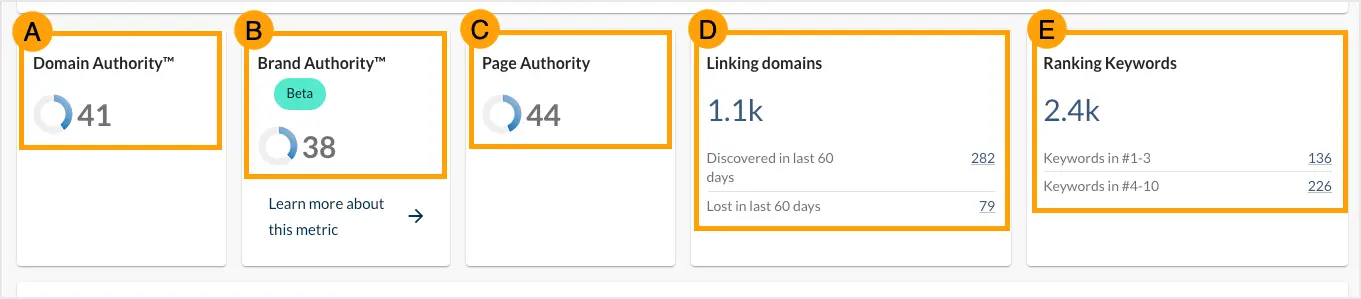
Domain Authority predicts ranking potential, not a guaranteed position.
Moz designed Domain Authority as a comparative tool. A domain with DA 60 is, on average across the test query population, more likely to outrank a domain with DA 30 than the reverse.
The metric does not predict a specific position. It estimates the probability of stronger versus weaker ranking outcomes when other factors are held equal.
The 2012 launch positioned Moz as the first widely-adopted authority metric provider.
Moz launched Domain Authority in 2012 as part of the Mozscape API. Before 2012, SEO practitioners relied on Google’s own PageRank toolbar value, which Google deprecated and eventually removed from public visibility. Domain Authority filled the gap by offering a public-facing predictive score based on Moz’s own link graph crawl.
Page Authority complements Domain Authority at the URL level.
Moz publishes Domain Authority for an entire domain and Page Authority for individual URLs. Domain Authority aggregates link-graph signals across the whole domain. Page Authority isolates the signals for a single page.
SEO buyers acquiring an aged domain check both: a domain with high Domain Authority and weak Page Authority on key URLs signals that the link equity is concentrated on a small subset of pages.
What does Domain Rating measure?
Domain Rating measures the strength of a domain’s backlink profile as a logarithmic score derived from the Ahrefs link graph. Ahrefs introduced Domain Rating in 2014 as an alternative metric to Domain Authority.
The score ranges from 0 to 100 on a logarithmic scale, weighted by the quantity and quality of referring domains and the Domain Rating of those referring domains in a recursive calculation.
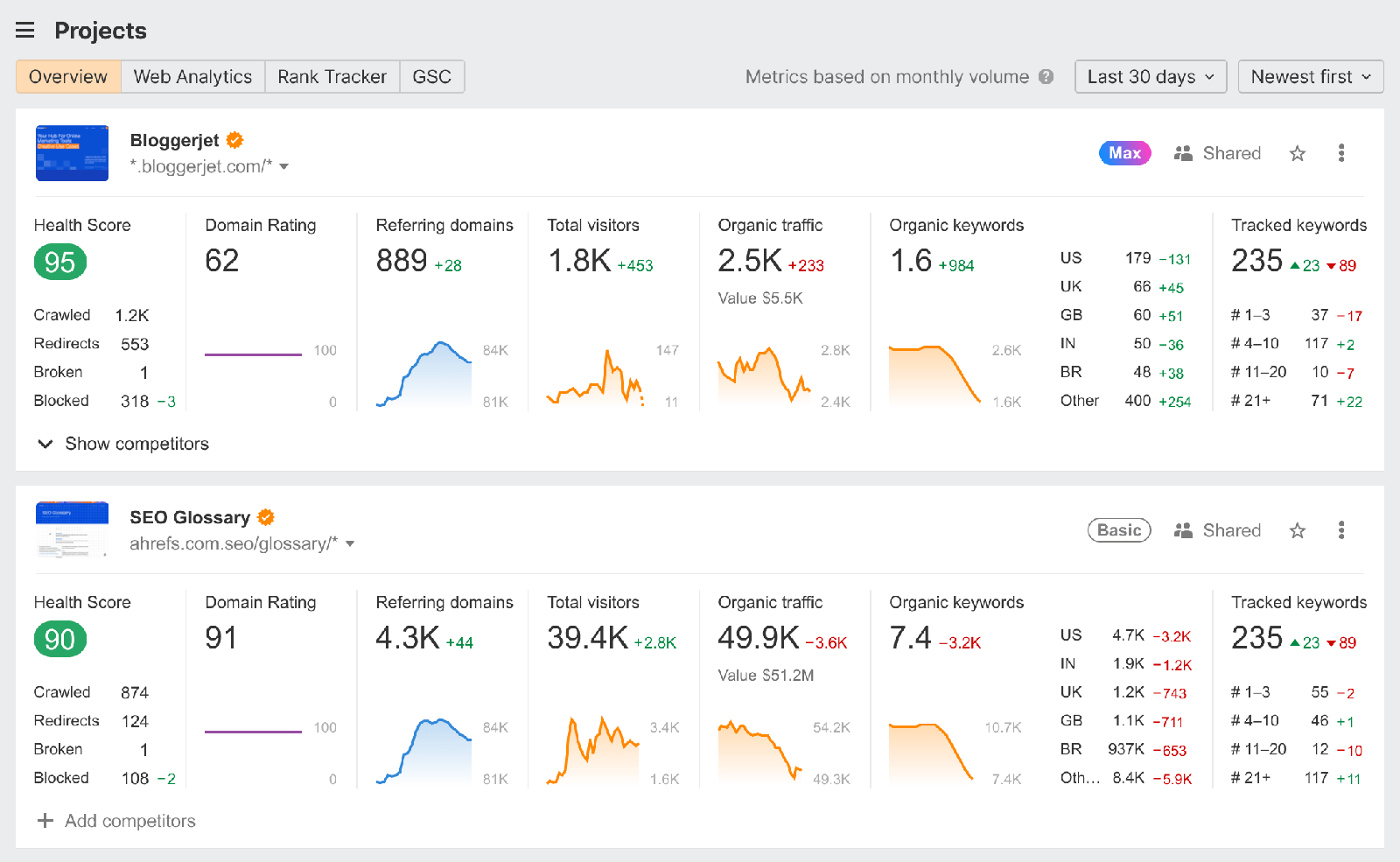
Domain Rating focuses on backlink-profile strength as the primary input.
Ahrefs designed Domain Rating to emphasize the link profile specifically. Domain Authority incorporates additional signals beyond pure link strength. Domain Rating is more narrowly a “how strong is this domain’s backlink profile” measurement. The narrow focus produces a metric that correlates highly with referring-domain count weighted by referring-domain quality.
The recursive calculation distributes Domain Rating through the link graph.
Domain Rating uses a recursive calculation: a domain’s DR is influenced by the DR values of the domains linking to it, which are in turn influenced by their own incoming DR. The recursive design produces a score that captures multi-hop link-graph relationships beyond direct first-hop links.
The recursion echoes Google’s original PageRank algorithm in concept, though Ahrefs uses its own crawl data and refresh schedule.
Ahrefs surfaces Domain Rating across multiple product surfaces.
Ahrefs surfaces Domain Rating in its Site Explorer, Batch Analysis, Rank Tracker, Content Explorer, and SEO Toolbar products. The single metric is consumed across the entire Ahrefs product line, which contributes to the metric’s wide industry adoption among SEO practitioners using Ahrefs as their primary tool.
How Moz calculates Domain Authority: the link-graph machine-learning model
Moz calculates Domain Authority using a machine-learning model trained on dozens of link-graph signals plus a Spam Score adjustment. The training target is correlation with Google search rankings across a large sample of query-result pairs.
The model outputs a 0-to-100 score normalized to the logarithmic scale. Moz refreshes the model periodically, with major model updates announced as Domain Authority 2.0 and subsequent revisions.
| Factor category | Inputs included | Effect on score |
|---|---|---|
| Linking root domains | Number of unique domains linking to the target | Direct positive contribution; weighted by quality |
| Total links | Total inbound link count across all referring URLs | Positive but with diminishing returns |
| MozRank (link equity flow) | Page-level link-equity propagation through the graph | Positive; recursive across the graph |
| MozTrust (trust signal) | Distance from seed trusted domains in the graph | Closer to trust seeds = higher score |
| Spam Score adjustment | Moz’s spam-pattern detection across 27 flags | High Spam Score reduces Domain Authority |
| Anchor text distribution | Diversity and naturalness of incoming anchors | Healthy distribution positive; manipulation negative |
The Spam Score adjustment penalizes link-pattern manipulation.
Moz introduced Spam Score as a complementary metric. Domain Authority incorporates Spam Score so that a domain with a high Spam Score (indicating manipulative link patterns) receives a lower Domain Authority than the raw link count would suggest. The adjustment limits the gap between honest authority and link-spam authority.
Moz updates the Domain Authority model on a multi-year cadence.
Moz launched Domain Authority 2.0 in 2019 as a model retraining that improved correlation with Google rankings. Subsequent model revisions are deployed without version-number announcements. SEO practitioners observe Domain Authority shifts of 5-15 points when Moz refreshes the model, even when the underlying link profile has not changed.
How Ahrefs calculates Domain Rating: the referring-domain weighted graph
Ahrefs calculates Domain Rating using a recursive algorithm that weights referring domains by their own Domain Rating values. The recursive design produces a multi-hop link-graph score where each domain’s DR is shaped by the DR of the domains linking into it.
The base unit is the referring domain, not individual link counts, which gives one strong referring domain more impact than ten weak referring links from the same domain.
| Factor category | Inputs included | Effect on score |
|---|---|---|
| Referring domain count | Number of unique domains with at least one dofollow link | Direct positive, with quality weighting |
| Referring domain DR | The DR value of each referring domain | Recursive; higher-DR referrals contribute more |
| Link count per referring domain | How many links each domain provides (dampened) | Positive but capped per domain |
| Dofollow vs nofollow | Standard SEO link attribution rules | Dofollow contributes; nofollow has limited effect |
Ahrefs refreshes Domain Rating on a near-real-time link-graph crawl.
Ahrefs runs a continuous crawl of the public web, with claimed crawl speeds among the highest in the SEO tools industry. Domain Rating values update as the crawl ingests new links and removes lost ones.
A new link from a high-DR domain produces an observable DR increase for the target within days, not months. The faster refresh cadence is one of the operational differences between Domain Rating and Domain Authority.
Scoring scale differences: DA 50 is not the same as DR 50
Domain Authority and Domain Rating both use a 0-to-100 logarithmic scale, but the scores are not directly comparable across the metrics. A domain with Domain Authority 50 can show Domain Rating 65, or vice versa.
The two scales reflect different calculation methodologies and different reference points in the link graph, so cross-metric comparisons require interpretation, not direct substitution.
The side-by-side matrix consolidates how each metric is calculated, what each one measures, and how backlinks affect each score across the seven methodology axes established in the prior sections.
Domain Authority is calculated by Moz from a machine-learning signal set; Domain Rating is calculated by Ahrefs from a recursive referring-domain graph. Reading the two columns together surfaces the divergence axes that single-metric reliance hides.
Logarithmic scaling means upper-tier increases require disproportionate effort.
Both metrics use logarithmic scaling. Moving from DA 30 to DA 40 requires significantly less effort than moving from DA 70 to DA 80. The same applies to Domain Rating.
The logarithmic design reflects the underlying reality that link-graph strength compounds non-linearly: gaining the next high-quality referring domain becomes harder as a domain accumulates more.
Niche context adjusts the tier interpretation.
A DA 40 domain in a low-competition niche outperforms a DA 60 domain in a high-competition niche on niche-specific queries. The tier interpretation provided above describes general benchmarks. Niche-specific benchmarks differ.
SEO buyers acquiring aged domains for a particular niche compare against the niche’s top performers, not against the raw tier benchmark.
Index size and refresh frequency: Mozscape versus Ahrefs link graph
Mozscape and the Ahrefs link graph differ in index size, crawl frequency, and refresh cadence. The two crawlers visit the public web on different schedules, with different priorities for re-crawling.
The result is that a domain’s Domain Authority can lag behind its Domain Rating after a major link-profile change, or vice versa, depending on which crawler reaches the new links first.
| Dimension | Moz Mozscape | Ahrefs link graph |
|---|---|---|
| Crawl approach | Periodic web crawl with index rebuilds | Continuous near-real-time crawl |
| Refresh frequency for scores | Updates roughly monthly with model recalibration events | Updates within days of link discovery |
| Index size focus | Comprehensive but slower refresh | Larger active index with faster turnover |
| Spam filtering | Spam Score model integrated | Manual spam patterns + dofollow filter |
| Public crawl transparency | Documented in Moz Learn Center | Documented in Ahrefs blog and Help Center |
The refresh cadence affects newly-acquired aged domains.
A buyer acquiring an aged domain through a marketplace expects to see the existing Domain Authority and Domain Rating values carry over with the domain.
The carry-over is mechanical: the crawlers continue to attribute the existing link profile to the domain, regardless of new ownership. The first metric refresh after the transfer reflects any link changes the new owner makes.
Refresh latency means the visible scores will not update for days to weeks after acquisition.
When Domain Authority and Domain Rating disagree: 4 explanation scenarios
Domain Authority and Domain Rating commonly produce divergent scores for the same domain. The divergence is not a tool error; it reflects the methodology differences documented in the prior sections. SEO buyers who understand the divergence sources interpret the disagreement productively, not by dismissing one metric.
| Scenario | DA-DR pattern | Interpretation |
|---|---|---|
| 1. Link-spam manipulation | DR high, DA lower | Spam Score adjustment in DA penalizes the manipulation pattern; raw link count carries DR higher |
| 2. Recent link gains | DR higher, DA lower | Ahrefs crawled the new links faster than Moz; DA will catch up at next refresh |
| 3. Recent link losses | DA higher, DR lower | Ahrefs detected the lost links sooner; DA reflects the older snapshot |
| 4. Niche-specific link patterns | Either direction | Different crawlers weight niche-specific link types differently in their respective models |
Spam-pattern detection separates the two scores most visibly.
Domain Authority incorporates the Moz Spam Score adjustment. Domain Rating does not apply an equivalent spam penalty.
A domain with a manipulative link profile (paid link networks, anchor text over-optimization, low-trust referring domains) shows a lower Domain Authority relative to its Domain Rating.
The DA-DR gap is one of the strongest single signals of link-profile manipulation that a buyer can audit pre-acquisition.
Refresh timing causes temporary divergence after link-profile changes.
The Ahrefs crawler reaches new links faster than the Mozscape crawler in the typical case.
A domain that gains 10 strong referring domains in a single month shows the Domain Rating increase first, with the Domain Authority increase following at the next Mozscape update.
The opposite happens with link losses: Ahrefs records the loss first, Domain Authority lags. The lag is operational, not analytical.
Domain Authority and Domain Rating for aged-domain evaluation
Aged-domain buyers cross-check Domain Authority and Domain Rating to identify link-profile health before acquisition. Both metrics function as third-party predictive proxies for link-graph strength: independent Moz and Ahrefs calculations applied to the same domain produce two angles on link-profile health.
Used together, the two metrics reveal patterns that single-metric reliance misses, particularly link-spam manipulation and recent link-profile shifts.
Cross-checking surfaces manipulation that one-metric reliance would miss.
A buyer relying only on Domain Rating risks purchasing a domain with a high DR that hides Spam Score patterns Domain Authority would have flagged.
A buyer relying only on Domain Authority risks dismissing a domain with strong recent link gains that Domain Rating has already reflected.
Cross-checking both surfaces the full picture, and a wide DA-DR gap is itself a signal requiring deeper investigation.
Trust Flow and Citation Flow add a third independent perspective.
Majestic publishes Trust Flow and Citation Flow as parallel link-graph metrics. Trust Flow weights link quality by distance from a curated seed set of trusted domains. Citation Flow counts raw link strength without the trust weighting.
The Trust Flow to Citation Flow ratio identifies link-spam patterns from a third angle, complementing the DA-DR cross-check. Three independent metrics agreeing or disagreeing provides stronger signal than any single metric or two-metric pair.
Predictive-proxy interpretation outperforms ranking-factor interpretation across multi-tool SEO workflows.
SEO practitioners treat Domain Authority and Domain Rating as predictive proxies for link-graph strength, not as direct ranking inputs.
The proxy framing is the practitioner standard across Koray Tugberk Gubur’s entity-based topical authority writing, Charles Floate’s PBN A/B test documentation, the Detailed link-metric correlation analyses, and the Backlinko link-building studies.
The proxy interpretation produces correct acquisition decisions; the ranking-factor misinterpretation produces wasted acquisition budget on metrics that do not predict ranking outcomes.
Domain Authority vs Domain Rating: frequently asked questions
The five questions SEO buyers raise repeatedly when reconciling Domain Authority against Domain Rating, answered against the methodology record documented above. The answers reflect the SEO Domains analytical position: both scores are independent third-party link-graph proxies, cross-validated together and never substituted for one another.
Q1How do SEO practitioners interpret Domain Authority and Domain Rating?
As predictive third-party proxies for link-graph strength, not as direct ranking inputs. Domain Authority (Moz, 2012) and Domain Rating (Ahrefs, 2014) are calculated independently of search engine algorithms.
The SEO industry standard is multi-metric cross-checking across Domain Authority, Domain Rating, Trust Flow, and Citation Flow to surface link-spam patterns and recent profile shifts that single-metric reliance misses.
Q2What is the difference between Domain Authority and Domain Rating?
Domain Authority is calculated by Moz using a machine-learning model trained on dozens of link-graph signals plus a Spam Score adjustment.
Domain Rating is calculated by Ahrefs using a recursive algorithm that weights referring domains by their own Domain Rating values. Both score 0 to 100 on a logarithmic scale, but the calculation methodologies, index sources, and refresh frequencies differ.
Q3Can a domain have a high Domain Rating and low Domain Authority?
Yes. A wide DA-DR gap commonly accompanies a manipulative link profile: Domain Authority applies the Moz Spam Score adjustment that lowers the score for spam-pattern domains, while Domain Rating applies no equivalent spam penalty.
A high Domain Rating with significantly lower Domain Authority is one of the strongest signals of link-profile manipulation that aged-domain buyers audit before acquisition.
Q4Which metric is correct for evaluating an aged domain?
Both Domain Authority and Domain Rating together, plus Trust Flow and Citation Flow from Majestic where available. Single-metric reliance misses link-spam patterns and recent link-profile shifts. Multi-metric cross-checking surfaces the full picture.
Curated marketplaces such as SEO Domains apply multi-metric screening at inventory ingestion, so a listing reaches the buyer already cross-validated.
Q5When was Domain Authority introduced and when was Domain Rating introduced?
Moz introduced Domain Authority in 2012, the first widely-adopted predictive ranking metric in the SEO industry. Ahrefs introduced Domain Rating in 2014 with a different methodology focused on backlink-profile strength through recursive referring-domain weighting.
How aged-domain marketplaces use both metrics in screening
Curated aged-domain marketplaces use Domain Authority, Domain Rating, Trust Flow, and Citation Flow together in inventory screening. Multi-metric screening filters out the link-spam patterns that single-metric reliance would miss. The SEO Domains catalogue applies the multi-metric screen at inventory ingestion, before listings reach buyers.
| Screening dimension | Metrics referenced | Filter logic |
|---|---|---|
| Link-spam pattern detection | DA-DR gap + Spam Score + TF:CF ratio | Wide DA-DR gap with high Spam Score or low TF:CF ratio excludes the listing |
| Recent link-profile stability | DR refresh history + DA refresh history | Volatile recent history (sudden DR spikes or drops) flags the listing for manual review |
| Trust signal strength | Trust Flow value + DA MozTrust component | Low trust signals exclude listings even with high raw link counts |
| Niche topical match | Topical Trust Flow (Majestic) + niche-relevant DR | Listings without niche-aligned authority are categorized for niche-specific use cases |
The catalogue construction process applies the multi-metric screen at inventory ingestion.
SEO Domains catalogue listings surface Domain Authority, Domain Rating, Trust Flow, Citation Flow, and Majestic Topical Trust Flow data points at the listing level. The catalogue construction process applies the multi-metric screen during inventory ingestion.
The buyer reviews pre-screened listings instead of running the multi-metric audit manually across raw inventory. Each listing shows the consensus quality signal across the four metrics.
ICANN-accredited transfer ensures the link-graph carries cleanly.
SEO Domains operates with ICANN-accredited transfer protocols.
The link-graph attribution carries with the hostname: Mozscape and the Ahrefs link graph record link profiles by URL and propagate the inherited Domain Authority and Domain Rating values to the new owner without re-validation.
Buyers acquire the inherited scores along with the link profile that produced them, validated by the catalogue’s multi-metric screen at inventory ingestion.
