 BUY WEBSITES
 BUY DOMAINS
 LOGIN
LOGIN
 SIGNUP



Domain Rating: Ahrefs link-graph metric explained, calculation methodology, and how aged-domain buyers use it
Domain Rating is the Ahrefs link-graph metric that estimates the strength of a domain’s backlink profile on a logarithmic scale from 0 to 100.
Ahrefs introduced Domain Rating in 2014, three years after launching the link-graph index that feeds it.
The score is calculated through a recursive algorithm that weights each referring domain by its own Domain Rating, producing a multi-hop signal that captures link-graph topology beyond direct first-hop links.
The SEO Domains analytical position: Domain Rating is the practitioner-standard backlink-profile proxy across the SEO industry, valued for its near-real-time refresh cadence and its narrow focus on link-graph strength as a single dimension.
Aged-domain buyers read Domain Rating alongside Domain Authority, Trust Flow, and Citation Flow to cross-validate the inherited link profile before acquisition.
SEO Domains operates the curated marketplace with a 220,000+ pre-screened catalogue from $100 entry-level through $1.5 million premium acquisitions. ICANN-accredited transfer and Managed Account expert support cover every acquisition.
Every listing surfaces the Domain Rating value alongside Domain Authority, Trust Flow, Citation Flow, and the catalogue’s 7-vector inheritance screen.
What does Domain Rating measure?
Domain Rating measures the strength of a domain’s backlink profile on a logarithmic scale from 0 to 100. Ahrefs designed the metric as a single-dimension proxy for link-graph strength.
The metric focuses on the quantity and quality of referring domains. It does not incorporate non-link signals.
The score predicts the relative authority of a domain’s link profile compared to every other domain in the Ahrefs link-graph index.
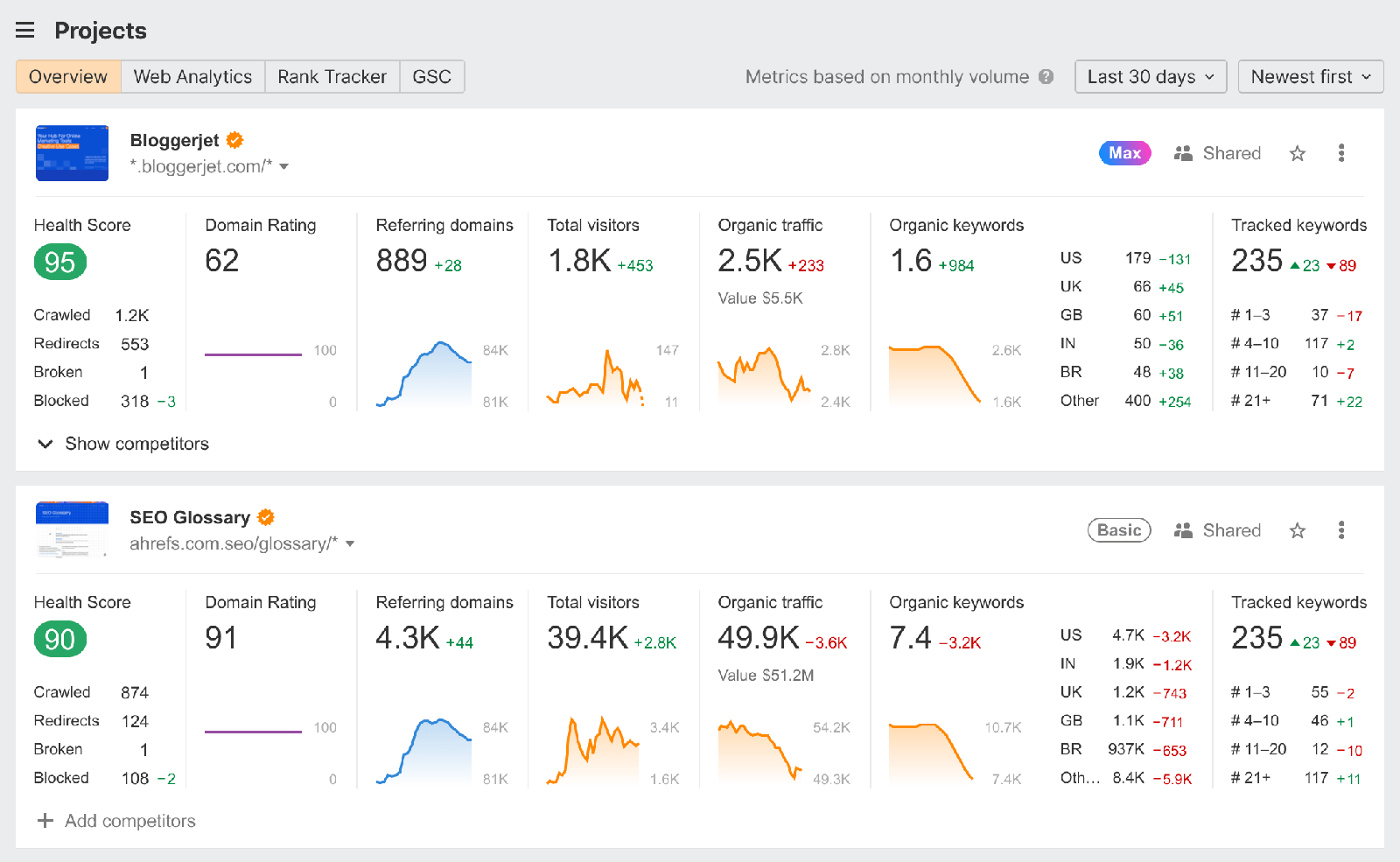
Domain Rating focuses on backlink-profile strength as its only input dimension.
Ahrefs designed Domain Rating to answer one question: how strong is this domain’s backlink profile relative to other domains. The metric does not incorporate content quality, traffic estimates, or on-page signals.
The narrow focus produces a score that correlates tightly with referring-domain count weighted by referring-domain quality, which is what SEO practitioners want from a link-graph proxy.
Domain Rating evaluates the entire domain, not individual pages.
Ahrefs publishes Domain Rating for an entire domain and URL Rating for individual URLs. Domain Rating aggregates link-graph signals across the whole domain. URL Rating isolates the signals for a single page.
Aged-domain buyers reading Ahrefs Site Explorer compare both values. A domain with high Domain Rating and weak URL Rating on key pages signals that link equity concentrates on a small URL subset. The rest of the site carries thin support.
Domain Rating is a relative metric, not an absolute strength score.
Domain Rating depends on the full state of the Ahrefs link graph. When new domains gain authority, the relative position of existing domains shifts.
Practitioners observing a 2-point DR drop on a static link profile sometimes find the cause is competitor link-graph growth, not any change on the audited domain itself. The relativity is a methodology trait, not a defect.
Ahrefs launched Domain Rating in 2014 as a link-graph proxy
Ahrefs introduced Domain Rating in 2014, three years after launching the Ahrefs link-graph index in 2011. The 2014 introduction positioned Ahrefs as the first major SEO toolset to publish a recursive link-graph metric calculated entirely on a proprietary independent crawler.
Domain Authority (Moz, 2012) preceded Domain Rating by two years; the two metrics now anchor the SEO industry-standard link-graph proxy pair.
The 2011 link-graph index gave Ahrefs three years of crawl data before launching Domain Rating.
Ahrefs launched its link-graph crawler in 2011, building a proprietary index of the public web’s backlink structure. By 2014, the crawler had accumulated enough data and recrawl history to calculate a stable recursive metric.
The three-year data accumulation is part of why Domain Rating launched with credibility: the metric reflected the link-graph state from day one, not a cold-start guess.
Ahrefs surfaces Domain Rating across Site Explorer, Batch Analysis, Content Explorer, Rank Tracker, and the SEO Toolbar.
Domain Rating appears in 5 Ahrefs product surfaces, each serving a different workflow:
- Site Explorer for single-domain deep audits.
- Batch Analysis for bulk domain comparison.
- Content Explorer for content-prospecting filters.
- Rank Tracker for competitor SERP analysis.
- SEO Toolbar for in-browser quick reads.
The single metric is consumed across the entire Ahrefs product line. That breadth contributes to industry adoption among SEO teams using Ahrefs as their primary tool.
How Ahrefs calculates Domain Rating: 4 inputs to the recursive algorithm
Ahrefs calculates Domain Rating through a recursive algorithm that weights each referring domain by its own Domain Rating. The recursive design produces a multi-hop link-graph score.
A domain’s DR is shaped by the DR of the domains linking into it. Those domains carry DR shaped by their own incoming DR, and so on down the chain.
The base unit is the referring domain, not individual link counts. One strong referring domain carries more impact than ten weak referring links from the same domain.
| Input factor | What Ahrefs measures | Effect on Domain Rating |
|---|---|---|
| Referring domain count | Number of unique domains with at least one dofollow link to the target | Direct positive contribution; weighted by referring-domain quality |
| Referring domain DR | The Domain Rating value of each referring domain | Recursive; a DR 70 referrer contributes far more than a DR 20 referrer |
| Outbound link dilution | How many other domains each referring domain links to | A referring domain that links to 10,000 sites dilutes per-link contribution; one that links to 50 sites concentrates it |
| Dofollow attribution | Standard SEO link-attribution rules (dofollow vs nofollow) | Dofollow contributes the documented weight; nofollow has limited effect on Domain Rating |
Multiple links from the same referring domain count as one referring domain.
Ahrefs collapses multiple links from a single referring domain into one referring-domain unit for the Domain Rating calculation. A domain that links to the target 10 times still contributes as one referring domain.
This deduplication prevents site-wide footer links and template-injected links from inflating Domain Rating beyond the strength their single source provides.
Practitioners running outreach campaigns target referring-domain expansion, not link count, because the underlying metric only counts new referring domains.
The outbound dilution dampener prevents link-farm referrers from carrying full weight.
A referring domain that links to 10,000 other domains dilutes the per-link contribution toward each one. Ahrefs applies a dampener proportional to the referring domain’s outbound link count.
The dampener is one of the structural reasons that link-farm referrers carry less Domain Rating weight than the raw DR-70 number would suggest.
Charles Floate documented this dampener empirically in PBN A/B testing where high-DR but high-outbound-link sites failed to produce the expected DR transfer.
Dofollow attribution remains the standard for Domain Rating contribution.
Ahrefs applies the documented dofollow versus nofollow distinction in the Domain Rating calculation. Dofollow links contribute the documented weight; nofollow links have limited effect on Domain Rating.
The dofollow rule aligns Domain Rating with the broader SEO industry treatment of link attribution, which Brian Dean at Backlinko has covered extensively in link-building studies across 2018-2024.
Domain Rating uses a 0-to-100 logarithmic scale
Domain Rating scales from 0 to 100 on a logarithmic curve where upper-tier movement requires exponentially more high-quality referring domains than lower-tier movement. The logarithmic design reflects how link-graph strength compounds non-linearly.
Gaining the next high-quality referring domain becomes harder as a domain accumulates more. Movement from DR 20 to DR 30 happens through normal outreach effort. Movement from DR 80 to DR 90 requires a different scale of editorial relationships entirely.
| DR tier | Profile interpretation | Effort to reach |
|---|---|---|
| 0-10 | Minimal backlink profile (new site, no outreach) | Default state for an unlinked domain |
| 10-30 | Early-stage outreach success (50-300 referring domains) | 3-6 months of consistent outreach |
| 30-50 | Established link-building presence (300-1,500 referring domains) | 12-24 months of structured outreach campaigns |
| 50-70 | Well-established authority site (1,500-10,000 referring domains) | 24-48 months of editorial outreach plus digital PR |
| 70-100 | Top-tier media, enterprise, institutional domains (10,000+ referring domains) | Years of brand-building plus newsworthy content drive |
Logarithmic scaling means upper-tier movement requires disproportionate effort.
Moving from DR 30 to DR 40 requires roughly the same number of new referring domains as moving from DR 80 to DR 81.
The logarithmic curve is steeper at the top, which is why high-DR domains rarely shift more than 1-2 points per quarter even with active link acquisition.
The Detailed link-metric analyses by Glen Allsopp have documented this asymmetry across thousands of audited sites.
Niche context adjusts the tier interpretation for aged-domain evaluation.
A DR 40 aged domain in a low-competition niche outperforms a DR 60 aged domain in a high-competition niche on niche-specific queries. The tier interpretation in Figure 4 reflects general benchmarks.
Niche-specific benchmarks differ, which is why aged-domain buyers acquiring for a particular niche compare candidates against the niche’s top performers, not against the absolute DR tier.
Domain Rating refreshes on a continuous near-real-time crawl
Ahrefs runs a continuous crawl of the public web and updates Domain Rating values as the crawler discovers new links and removes lost ones. The near-real-time refresh cadence is one of Domain Rating’s structural advantages over slower-refreshing competitor metrics.
A new link from a high-DR referring domain produces an observable Domain Rating increase for the target within days, not months.
The continuous crawl captures link gains and losses within days.
Ahrefs claims one of the highest crawl speeds in the SEO tools industry. The crawler revisits high-priority domains daily and lower-priority domains on weekly to monthly cycles depending on observed update frequency.
The dynamic prioritisation means newly-built link campaigns surface in Domain Rating reports within a refresh window measured in days, which feeds practitioner workflows that depend on near-real-time link tracking.
Domain Rating values can shift downward when referring domains lose their own DR.
Because Domain Rating is recursive, a target domain’s score can drop without losing any of its own links. If the referring domains lose their own DR (through link decay or downgrading), the recursive calculation propagates the reduction downstream.
Aged-domain buyers occasionally observe a DR drop on a static link profile that traces to a referring-domain DR change, not to any change on the audited domain itself.
Domain Rating compared to Domain Authority: scope and methodology differences
Domain Rating and Domain Authority both score domains 0 to 100 on a logarithmic scale. The methodologies, index sources, and refresh cadences differ in ways that matter for SEO practitioners.
Domain Authority (Moz, 2012) incorporates a Spam Score adjustment that Domain Rating does not apply. Domain Rating uses recursive referring-domain weighting; Domain Authority weights its inputs differently through a machine-learning model.
The two metrics agree on link-profile-strong domains. They diverge on the manipulation edge cases.
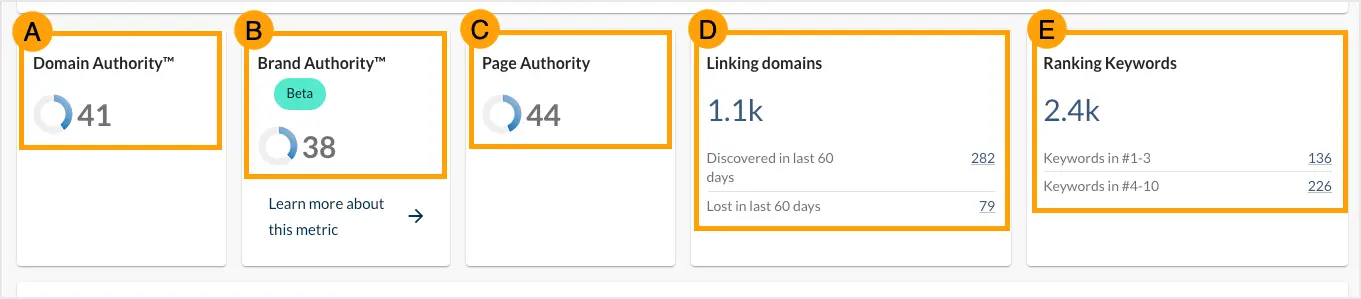
| Dimension | Domain Rating (Ahrefs) | Domain Authority (Moz) |
|---|---|---|
| Launch year | 2014 | 2012 |
| Calculation methodology | Recursive referring-domain weighting | Machine-learning model on 6 factor categories |
| Spam-pattern adjustment | None applied at metric level | Moz Spam Score reduces DA on manipulative profiles |
| Index source | Ahrefs proprietary link graph (2011-launched) | Mozscape link index |
| Refresh cadence | Continuous near-real-time | Roughly monthly with model recalibration events |
| URL-level companion metric | URL Rating (UR) | Page Authority (PA) |
Domain Rating refreshes faster than Domain Authority on link gains.
A domain that gains 10 strong referring domains in a single month shows the Domain Rating increase first, with the Domain Authority increase following at the next Mozscape model refresh.
The opposite happens with link losses: Ahrefs records the loss first, Domain Authority lags. Cross-checking both metrics is how aged-domain practitioners surface refresh-lag artifacts and avoid misreading a transient gap as a methodology divergence.
Wide Domain Rating vs Domain Authority gaps signal link-profile manipulation.
Domain Authority applies the Moz Spam Score adjustment that lowers DA on manipulative link profiles. Domain Rating does not apply an equivalent spam penalty.
A domain with significantly higher DR than DA shows one of the strongest single signals of link-profile manipulation that aged-domain buyers can audit pre-acquisition.
Cross-checking the two metrics together surfaces patterns that single-metric reliance misses entirely.
Domain Rating for aged-domain evaluation: pre-acquisition link-profile screening
Aged-domain buyers read Domain Rating as one input in a multi-metric screening framework alongside Domain Authority, Trust Flow, and Citation Flow. Single-metric reliance on Domain Rating produces blind spots that the multi-metric cross-check surfaces.
The Koray Tugberk Gubur framework for entity-based topical authority adds another layer. A high Domain Rating without topical relevance to the buyer’s intended niche signals that the link equity will not transfer cleanly to a new content focus.
Domain Rating alone misses Spam Score patterns that Domain Authority catches.
A high Domain Rating with a low Domain Authority signals manipulative link patterns that the Domain Rating calculation does not penalize.
Aged-domain buyers cross-checking both metrics flag wide-gap domains for three follow-up checks:
- Deeper Spam Score investigation on the manipulation signal.
- Link-by-link review through Ahrefs Site Explorer or Moz Link Explorer.
- Wayback Machine validation of historical content alignment.
The SEO Domains catalogue applies this cross-check at inventory ingestion, before listings reach buyers.
Trust Flow and Citation Flow from Majestic add a third independent angle on Domain Rating.
Trust Flow weights link quality by distance from a curated seed set of trusted domains. Citation Flow counts raw link strength without the trust weighting.
The Trust Flow to Citation Flow ratio identifies link-spam patterns from a third angle that neither Domain Rating nor Domain Authority surfaces alone.
Three independent metrics agreeing or disagreeing provides stronger signal than any single metric or two-metric pair, a pattern Charles Floate has documented in PBN A/B testing through 2018-2024.
Domain Rating predicts ranking probability, not specific positions.
Domain Rating estimates the relative probability that a domain will rank stronger than another domain on a given query, all other factors held equal. The metric does not predict a specific SERP position.
Practitioners treating Domain Rating as a ranking-position predictor misread the methodology; practitioners treating it as a comparative link-graph proxy use the metric correctly. The Backlinko link-correlation studies have documented this distinction since 2016.
5 frequently asked questions about Domain Rating
The 5 top Domain Rating questions from SEO practitioners and aged-domain buyers. Answers reflect the SEO Domains analytical position alongside the documented Ahrefs methodology and industry-leader commentary.
Q1What is a good Domain Rating score?
A good Domain Rating depends on the niche, the practitioner stage, and the comparison benchmark. As a general guide:
- DR 30-50 indicates established link-building presence.
- DR 50-70 indicates well-established authority sites.
- DR 70-100 indicates top-tier media and enterprise domains.
Niche-relative comparison against top-3 SERP competitors is more useful than the absolute number for acquisition decisions.
Q2How long does it take to improve Domain Rating?
Improvement timelines depend on the starting DR and the niche. Movement from DR 10 to DR 30 takes 3-6 months of consistent outreach. Movement from DR 30 to DR 50 takes 12-24 months of structured campaigns.
Movement above DR 70 takes years of editorial relationships plus newsworthy content drive. Aged-domain acquisition skips this ramp by inheriting an existing link profile.
Q3Does Domain Rating affect Google rankings directly?
Domain Rating is a third-party predictive proxy for link-graph strength calculated by Ahrefs on the Ahrefs link graph.
The SEO industry standard treats DR as a cross-validated signal alongside DA, TF, CF, not as a direct ranking input.
The predictive-proxy interpretation produces correct acquisition decisions; the ranking-factor misinterpretation produces wasted acquisition budget on metrics that do not predict ranking outcomes.
Q4Can Domain Rating be manipulated?
Domain Rating can be manipulated short-term through link-farm referrers, PBN networks, and pattern-injected referring domains. Charles Floate documented the manipulation patterns in PBN A/B testing through 2018-2024.
The outbound link dilution dampener in the Domain Rating calculation reduces the effectiveness of high-outbound-link referrers, and cross-checking with Domain Authority Spam Score plus Trust Flow surfaces the manipulation patterns.
Aged-domain marketplaces that pre-screen catalogue inventory filter out the manipulation patterns at acquisition.
Q5What is the difference between Domain Rating and URL Rating?
Domain Rating scores the entire domain’s backlink profile. URL Rating scores an individual URL’s backlink profile. Both use the same recursive methodology and 0-100 logarithmic scale.
Aged-domain buyers reading Ahrefs Site Explorer check both: a high DR with weak URL Rating on key pages signals that link equity concentrates on a small URL subset.
How aged-domain marketplaces use Domain Rating in inventory screening
Curated aged-domain marketplaces use Domain Rating, Domain Authority, Trust Flow, and Citation Flow together in inventory screening. Multi-metric screening filters out the link-spam patterns that single-metric reliance would miss.
The SEO Domains catalogue applies the multi-metric screen at inventory ingestion, before listings reach buyers.
| Screening dimension | Metrics referenced | Filter logic |
|---|---|---|
| Link-profile strength baseline | DR + DA | Listings below catalogue-tier DR and DA thresholds excluded from premium-tier inventory |
| Link-spam pattern detection | DR-DA gap + Spam Score + TF:CF ratio | Wide DR-DA gap with high Spam Score or low TF:CF ratio excludes the listing |
| Refresh-history stability | DR historical refresh pattern | Volatile DR history (sudden DR spikes or drops) flags the listing for manual review |
| Niche topical relevance | Topical Trust Flow + niche-aligned DR sample | High DR without niche-aligned authority categorized for niche-specific use cases |
The catalogue construction process applies the multi-metric DR screen at inventory ingestion.
SEO Domains catalogue listings surface Domain Rating, Domain Authority, Trust Flow, Citation Flow, and Majestic Topical Trust Flow data points at the listing level. The catalogue construction process applies the multi-metric screen during inventory ingestion.
The buyer reviews pre-screened listings instead of running the multi-metric audit manually across raw inventory. Each listing shows the consensus quality signal across the four metrics.
ICANN-accredited transfer preserves the Domain Rating value through ownership change.
SEO Domains operates with ICANN-accredited transfer protocols. The link-graph attribution carries with the hostname: the Ahrefs crawler records link profiles by URL and propagates the inherited Domain Rating value to the new owner without re-validation.
Buyers acquire the inherited Domain Rating along with the link profile that produced it, validated by the catalogue’s multi-metric screen at inventory ingestion.
