 BUY WEBSITES
 BUY DOMAINS
 LOGIN
LOGIN
 SIGNUP



What is a good Domain Rating: Scoring tiers, niche benchmarks, and aged-domain targets for SEO buyers
A good Domain Rating is the score that beats the niche-relative top-3 SERP competitors on the queries the buyer targets.
Absolute tier benchmarks (DR 50 is solid, DR 70 is strong) describe general link-graph strength, but acquisition decisions depend on the competitive baseline of the buyer’s intended niche.
The SEO Domains analytical position: target DR matches the niche’s median top-10 SERP competitor for organic acquisition campaigns, and exceeds the niche median by 10-20 points for aged-domain acquisition where the buyer is paying for inherited authority.
SEO Domains operates the curated marketplace with a 220,000+ pre-screened catalogue from $100 entry-level domains through $1.5 million premium acquisitions. Every listing surfaces the Domain Rating value alongside Domain Authority, Trust Flow, Citation Flow, and the catalogue’s 7-vector inheritance screen. Buyers compare candidates against niche-relative DR benchmarks before acquisition.
What is a good Domain Rating: tier-by-tier interpretation
A good Domain Rating is the score that beats or matches the niche-relative top-3 SERP competitors on the queries the buyer targets. Absolute tier benchmarks describe general link-graph strength. The competitive baseline of the intended niche determines what counts as good for an acquisition decision.
The 5 scoring tiers below describe what each Domain Rating range reflects in link-profile depth and outreach investment. Each tier also marks the referring-domain volume that moves a profile up to the next band.
| DR tier | Profile interpretation | Effort to reach | Referring domains |
|---|---|---|---|
| 0-10 | Minimal backlink profile (new site, no outreach) | Default state for an unlinked domain | 0-30 referring domains |
| 10-30 | Early-stage outreach success | 3-6 months of consistent outreach | 30-300 referring domains |
| 30-50 | Established link-building presence | 12-24 months of structured campaigns | 300-1,500 referring domains |
| 50-70 | Well-established authority site | 24-48 months of editorial outreach plus digital PR | 1,500-10,000 referring domains |
| 70-100 | Top-tier media, enterprise, institutional | Years of brand-building plus newsworthy content drive | 10,000+ referring domains |
Absolute DR tiers describe link-profile depth without competitive context.
The DR 50-70 bracket describes a site with 1,500-10,000 referring domains and 24-48 months of editorial outreach investment. That description is accurate as a profile snapshot.
The description does not answer the buyer’s actual question: will this DR rank against the competitors I face. The competitive benchmark is the layer the absolute tier cannot reach.
Domain Rating 0 to 30: early-stage outreach baseline
Domain Rating 0-30 describes a new or early-stage site that has built an initial referring-domain base through entry-level outreach. The bracket spans three sub-stages of the first 6 months of link-building:
- DR 0-10 covers brand-new sites with no outreach history.
- DR 10-20 covers sites with roughly 3 months of consistent outreach.
- DR 20-30 covers sites approaching the 6-month outreach milestone.
A DR in this range is competitive only in genuinely low-competition niches. The top-10 SERP competitors there also sit in the 10-30 bracket.
DR 0-10 reflects the default state for an unlinked or barely-linked domain.
Brand-new sites and sites with fewer than 30 referring domains sit in the 0-10 bracket. Aged-domain buyers reading DR 0-10 investigate one distinction. The domain either carries a historical link profile that has decayed, or it has never built links at all.
The Wayback Machine plus historical link-graph tools surface this distinction.
DR 10-30 reflects early outreach success and a 50-300 referring-domain base.
The 10-30 bracket is the outreach milestone every new site targets in its first 3-6 months. The Backlinko link-building studies through 2018-2024 have documented this trajectory across SaaS, affiliate, and content-site case studies.
Domain Rating in this range is competitive for long-tail content queries in low-competition niches and inadequate for any commercial-intent query in competitive verticals.
Domain Rating 30 to 50: established link-building presence
Domain Rating 30-50 describes a site with established link-building presence and a 300-1,500 referring-domain base accumulated through 12-24 months of structured campaigns. The bracket is the entry point for serious commercial-intent ranking in mid-competition niches. It remains insufficient for highly competitive verticals like finance, insurance, and law.
The transition from DR 30 to DR 50 requires roughly 4x more referring-domain volume than the prior tier transition. Logarithmic scaling drives the steepening cost at each step.
DR 30-50 corresponds to 300-1,500 unique referring domains across 12-24 months.
The referring-domain count range reflects practitioners running 4-8 outreach campaigns per quarter over 1-2 years. Editorial conversion rates at this stage hold at 5-10 percent.
Authority Hacker has documented this campaign structure as the standard playbook for affiliate and SaaS sites moving from new-site DR 10 to established-presence DR 50.
The DR 30-50 bracket is competitive for mid-competition commercial-intent queries.
Mid-competition niches include B2B SaaS sub-verticals, niche e-commerce categories, and specialised affiliate verticals where the top-10 SERP DR ranges from DR 40 to DR 60.
A DR 45 site can rank competitively in these niches with strong on-page optimisation and topical authority. Highly competitive verticals where top-10 SERP DR averages 65+ require higher tier acquisition.
Domain Rating 50 to 70: well-established authority sites
Domain Rating 50-70 describes well-established authority sites with 1,500-10,000 referring domains accumulated through 24-48 months of editorial outreach plus digital PR. The bracket covers the practitioner sweet spot for competitive commercial-intent ranking across 70 percent of SEO verticals.
Aged-domain acquisition in the DR 50-70 range is the highest-leverage path for SEO teams. It skips the 24-48 month organic build timeline.
DR 50-70 sites accumulate referring domains through 4-tactic outreach mix.
The tactic mix at this tier combines four parallel workstreams:
- HARO and journalist outreach.
- Resource-page inclusion.
- Broken-link replacement.
- Podcast appearances.
The Authority Builders playbook by Matt Diggity documents the campaign structure that produces DR 50-70 outcomes across affiliate and niche-site portfolios. Sites at this tier run 6-12 active outreach workstreams in parallel.
The DR 50-70 bracket is competitive for highly competitive commercial-intent queries.
Highly competitive verticals include finance, insurance, legal, health, technology, and B2B enterprise SaaS. The top-10 SERP DR in these verticals averages 65-85. DR 50-70 sites compete at the lower end of the SERP.
Aged-domain acquisition in this tier is how SEO teams enter these verticals without the 24-48 month organic build cost.
Domain Rating 70 to 100: top-tier media and enterprise domains
Domain Rating 70-100 describes top-tier media publications, enterprise brands, and institutional domains with 10,000+ referring domains accumulated through years of brand-building plus newsworthy content drive. At this tier, editorial relationships and brand recognition compound link acquisition beyond what outreach alone produces.
Aged-domain acquisition at this tier is the premium-tier path for SEO buyers entering top-competitive verticals.
DR 70-100 sites accumulate referring domains through digital PR and brand drive.
The tactic mix at this tier emphasises four brand-led channels:
- Newsworthy data drops.
- Expert-commentary syndication.
- Brand-mention reclamation.
- Editorial relationships with top-tier publications.
Glen Allsopp at Detailed has documented this tier in enterprise SEO programme audits across finance, technology, and media verticals. Pure-outreach campaigns rarely reach DR 80+ without parallel brand investment.
The DR 70-100 bracket dominates SERP positions on the top-competitive commercial-intent queries.
Top-competitive queries carry high CPC and top-10 SERP DR averaging 80-95. The bracket dominates these results:
- "best credit card"
- "personal injury lawyer"
- "life insurance quotes"
A DR 75 site competes mid-SERP in these niches. A DR 90 site competes at the top. Premium-tier aged-domain acquisition is the operational path SEO teams use to enter these verticals at scale.
Niche-relative Domain Rating benchmarks across 6 industry verticals
Niche-relative Domain Rating benchmarks reflect the median Domain Rating of the top-10 SERP competitors on the buyer’s target queries. The 6 industry verticals below show typical top-10 SERP DR ranges based on documented competitive audits.
The benchmarks are starting points for acquisition decisions. Specific queries within each vertical produce their own competitive baseline. Buyers verify that baseline before committing acquisition budget.
| Industry vertical | Top-10 SERP DR range | Median competitor DR | Aged-domain target |
|---|---|---|---|
| Finance and insurance | 75-95 | ~85 | DR 80+ for competitive entry |
| Health and YMYL niches | 70-90 | ~80 | DR 75+ for competitive entry |
| Legal and law firms | 65-85 | ~75 | DR 70+ for competitive entry |
| Technology and SaaS | 55-80 | ~65 | DR 60+ for competitive entry |
| Affiliate and review sites | 40-65 | ~50 | DR 50+ for competitive entry |
| Niche content sites | 30-55 | ~40 | DR 40+ for competitive entry |
Finance and insurance verticals require the highest Domain Rating thresholds.
The finance and insurance verticals concentrate top-tier publications, established review sites, and enterprise brands at DR 75-95. Charles Floate has documented the competitive landscape in these verticals across PBN A/B testing through 2018-2024.
Aged-domain acquisition at DR 80+ is the operational path for SEO teams entering finance affiliate or insurance comparison without the 48-month organic build cost.
Niche content sites accept Domain Rating 30-55 as the competitive range.
Niche content verticals include hobby sites, regional content, and specialised information sites where the top-10 SERP DR averages DR 40. A DR 45 site competes mid-SERP; a DR 55 site competes at the top.
Aged-domain acquisition at DR 40+ is the entry threshold; sites below that range struggle to compete even on long-tail queries.
SERP competitor comparison: the only Domain Rating benchmark that predicts ranking
SERP competitor comparison is the only Domain Rating benchmark that predicts ranking outcome on the buyer’s target queries. Three benchmark layers each answer a different question:
- Absolute tier benchmarks describe link-profile depth.
- Niche-vertical benchmarks describe industry averages.
- SERP competitor comparison describes the actual competitive baseline.
A good score rests on the competitors a domain faces, not on the absolute number in isolation. Comparing the candidate DR against the top-10 competitor scores, then setting the acquisition target above the competitor median, is the read that translates into ranking outcomes.
The 3-step SERP competitor read produces a query-specific Domain Rating target.
The read converts a buyer’s target queries into a single acquisition number. It runs in three steps, mapped in the framework below.
The process takes 30-60 minutes per acquisition decision. It replaces guesswork with a measurable competitive baseline.
Aleyda Solis has documented the SERP-relative read across enterprise SEO consulting engagements.
The SERP-relative read is the methodology Aleyda Solis applies across enterprise SEO consulting engagements through 2020-2024. The same methodology underpins the multi-metric screening framework the SEO Domains catalogue applies at inventory ingestion. Every listing is read against niche-relative SERP baselines before reaching buyers.
5 frequently asked questions about a good Domain Rating
The 5 top questions practitioners and aged-domain buyers ask about a good Domain Rating. Answers reflect the SEO Domains analytical position alongside documented industry-leader interpretation.
Q1Is DR 50 a good Domain Rating?
DR 50 describes a well-established link profile with 1,500-3,000 referring domains.
The score is good for mid-competition niches (top-10 SERP DR averaging 50-65) and inadequate for high-competition verticals like finance or insurance (top-10 SERP DR averaging 75-90).
The niche-relative SERP comparison produces the actual competitive read.
Q2Is DR 70 a good Domain Rating?
DR 70 describes a strong established authority site with 5,000-10,000 referring domains. The score is competitive across 70 percent of SEO verticals including legal, technology, and health affiliate.
The score is mid-SERP in the top-competitive verticals like personal injury legal or credit card affiliate where top-10 SERP DR averages 80-90.
Q3What is a good Domain Rating for an affiliate site?
A good Domain Rating for an affiliate site depends on the affiliate vertical. The competitive range shifts with the money behind the niche.
- General affiliate review sites compete at DR 40-65.
- Finance affiliate competes at DR 75-95.
- Health affiliate competes at DR 70-90.
The query-specific SERP-relative read produces the actual target.
Q4What is a good Domain Rating for a new site?
A new site targets DR 30 in the first 6-12 months through structured outreach campaigns. The DR 30 milestone reflects 300-500 referring domains and is the entry threshold for serious commercial-intent ranking.
Sites targeting competitive verticals from a new-site start face 24-48 months of organic build; aged-domain acquisition compresses that timeline to a 14-day registrar transfer.
Q5What Domain Rating is the right target when buying an aged domain?
The aged-domain DR target exceeds the niche-median top-10 SERP competitor DR by 10-20 points.
The premium covers the inherited authority the buyer pays for and provides the competitive headroom for the buyer’s content production after acquisition.
The SEO Domains catalogue surfaces niche-relative DR comparisons at the listing level so buyers compare candidates against the competitive baseline they will face after acquisition.
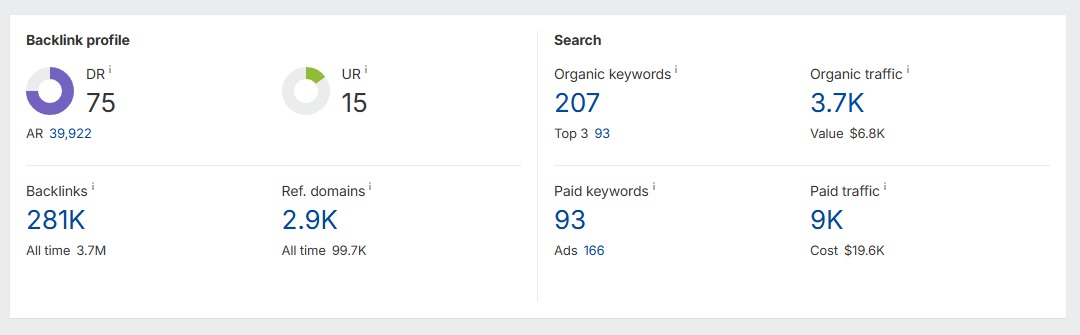
Aged-domain Domain Rating targets: how to read DR at the SEO Domains marketplace
Aged-domain Domain Rating targets exceed niche-median top-10 SERP competitor Domain Rating by 10-20 points. The premium covers the inherited authority value the buyer pays for and provides competitive headroom for post-acquisition content production.
The SEO Domains catalogue applies niche-relative DR comparison at inventory ingestion and surfaces the comparison at the listing level for buyer review.
| Buyer intent | Target DR rule | Catalogue screening |
|---|---|---|
| Niche affiliate entry | DR 50+, exceeds niche median by 10 points | Multi-metric screen plus topical relevance check |
| SaaS or B2B authority | DR 60+, exceeds niche median by 15 points | Spam Score audit plus Trust Flow validation |
| High-competition affiliate (finance, insurance) | DR 75+, exceeds niche median by 10-15 points | Premium-tier screening plus Managed Account support |
| Top-tier media or institutional | DR 80+, exceeds niche median by 5-10 points | Premium-tier inventory plus editorial history verification |
The catalogue surfaces niche-relative DR comparison at the listing level.
SEO Domains catalogue listings show the Domain Rating value alongside the niche-relative competitive baseline. Buyers compare the listing DR against the niche median top-10 SERP competitor DR before acquisition.
The comparison is the operational shortcut to the SERP-relative read. Practitioners would otherwise run that read manually for each candidate.
ICANN-accredited transfer preserves Domain Rating attribution through ownership change.
SEO Domains operates with ICANN-accredited registrar transfer protocols. The Ahrefs link-graph crawler records link profiles by URL and propagates the inherited Domain Rating to the new owner without re-validation.
Buyers acquire the established Domain Rating along with the link profile that produced it, validated by the catalogue’s 7-vector inheritance screen at inventory ingestion.
