 BUY WEBSITES
 BUY DOMAINS
 LOGIN
LOGIN
 SIGNUP



Domain drop catching: How dropped domains become available
Domain drop catching is the practice of registering an expired domain the moment the registry releases it back to public availability.
The release event happens at the end of the 5-day pending-delete window through an atomic registry batch operation.
SEO Domains operates one of the largest drop-catching operations in the gTLD aftermarket and converts captured inventory into a 220,000+ curated aged-domain catalogue, with documented registration history and ICANN-accredited transfer mechanics on every purchase.
What is domain drop catching?
Domain drop catching is the practice of registering an expired domain the moment the registry releases it back to public availability. The release event occurs at the end of the 5-day pending-delete window.
Drop-catching software fires EPP create commands within milliseconds of the registry deletion, and the first valid request wins the registration.
Drop catching is also called domain sniping in the aftermarket.
The two terms describe the same operational practice. Domain sniping emphasises the timing-sensitive nature of the registration race, while drop catching (also written as dropcatching) emphasises the predictable lifecycle event that creates the registration opportunity.
Wikipedia documents the practice as a well-established aftermarket category that emerged alongside the ICANN-accredited registry framework in the early 2000s.
The market overview includes three operational models. The definition extends across all three.
- Specialist operators running automated bots that fire create commands at the drop moment.
- Registrar-affiliated services with different fee models.
- Curated marketplaces such as SEO Domains that combine drop-catching infrastructure with post-acquisition cataloguing.
Each model carries its own pros and risks, speed profile, and ICANN accreditation requirements. The sections below explain how drop catching works at the registry layer, what buyers expect from each leading model, and how the catalogue path and the auction path shape the acquisition outcome.
The Redemption Grace Period was implemented to prevent extortion schemes where drop catchers would demand payment from original registrants to release expired domains.
Wikipedia · Summarising ICANN policy history · Domain drop catching article
The practice depends on the predictable registry batch deletion schedule.
Drop catching exists because the registry deletion event is deterministic. Each registry runs its batch deletion at a fixed daily time.
- Verisign processes
.comand.netdeletions around 18:00 UTC daily. - Identity Digital releases
.infoaround 10:00 UTC. - Public Interest Registry handles
.orgaround 15:00 UTC. - CIRA handles
.caaround 17:00 UTC.
The lifecycle context that produces the drop event sits at the registry layer for 35 days after deletion. That window covers the 30-day Redemption period (RGP) explained and the 5-day Domain pending-delete phase: Duration and mechanics.
The drop happens at the end of pending-delete. The registry releases the namespace to the open registrar pool at that moment.
ICANN-accredited registrars compete on registrar-API connection count for catch probability.
Registries impose rate limits on the number of EPP create commands a single accredited registrar can submit per second.
The operational implication is direct. A drop-catching service with 30, 100, or 1,000+ separate registrar accreditations multiplies its effective request volume against that rate limit.
Catch probability scales with the count of accredited accounts a service deploys at the drop moment. The infrastructure investment required to operate at this scale defines the competitive frontier of the drop-catching market.
How does a domain drop and become available?
A domain drops when the registry batch processing run completes the deletion at the end of pending-delete. The deletion executes three actions at once.
- Removes the domain record from the authoritative database.
- Purges the zone-file delegation.
- Releases the namespace to every ICANN-accredited registrar through the standard EPP create command channel.
Registered & resolving
0–45 days
30 days
5 days, registry-only
Public release event
Drop-catch or catalogue
pendingDelete EPP status is removed in the batch processing run.
create command. The first valid create wins.
The drop event is an atomic registry operation at the deletion timestamp.
Atomic in this context means the three actions (database delete, zone-file removal, public release) execute together within the registry's transactional boundary. No external party can intervene between the database delete and the public release.
The registry guarantees the namespace state transition from "in pending-delete" to "available for create" without intermediate visible states.
From the outside, the drop appears as a single moment when WHOIS and RDAP queries flip from returning pendingDelete to returning "no match".
The zone-file removal occurs simultaneously with the database delete.
Recursive resolvers cease returning NS records for the domain at the zone-file push moment. Cached entries continue resolving until the configured TTL expires, after which queries return SERVFAIL or NXDOMAIN responses.
The cache lag is the only observable delay between the drop event and complete loss of DNS reachability for the previous configuration.
For drop-catching operators, the zone-file removal signal is one verification channel that the namespace is truly free.
Every ICANN-accredited registrar receives the release moment in parallel.
ICANN consensus policy reserves no priority at the drop event. Every accredited registrar with an open EPP session against the registry can submit a create command the moment the namespace is released.
The registry processes incoming create commands in receipt order subject to standard rate limiting. The first valid create wins the registration, and the sponsoring registrar that submitted the winning command becomes the new registrant of record.
SEO Domains is one of the largest drop-catching operations active in this open competition.
How fast does drop-catching execute at the drop moment?
Drop-catching executes in milliseconds within the registry batch processing window. Verisign processes .com and .net deletions around 18:00 UTC. The batch run takes 2 to 4 minutes, during which drop-catching services compete for each released name. Success depends on registrar-API connection count and registry rate-limit headroom.
Verisign batch processing runs around 18:00 UTC for .com and .net.
The Verisign drop window is the highest-volume event in the aged-domain calendar. The 18:00 UTC moment aligns with 14:00 Eastern, 11:00 Pacific, and 19:00 Central European.
Drop-catching services pre-stage their EPP sessions, registrar account credentials, and target name queues ahead of the batch start.
When the batch begins processing pending-delete entries, the services fire create commands against the registry in tight loops. Each service races to land a valid command on the freshly-released namespace before competing operators do.
The competing services fire create commands within milliseconds of the deletion.
The competitive layer operates at the millisecond granularity. A drop-catching service that detects the deletion event and submits its create command 50 milliseconds earlier than a competitor captures the namespace.
The detection layer relies on registry EPP poll commands or zone-file diff feeds, and the submission layer relies on persistent EPP sessions held open against the registry.
The race condition at the millisecond layer is what justifies the infrastructure investment in dozens to thousands of parallel registrar accreditations.
Registrar-API rate limits cap each accredited registrar at a fixed requests-per-second ceiling.
Registries publish rate limits on EPP commands at the per-registrar layer. The exact figures shift across registry policy revisions, but the operational pattern is that no single registrar accreditation can saturate the API at the drop moment.
Drop-catching operators distribute requests across their accredited account pool to exceed the per-registrar ceiling collectively. The pool architecture is the technical mechanism that converts capital investment in registrar accreditations into catch probability at the drop event.
Operators with larger accredited account pools multiply their effective request volume.
The mathematical relationship is direct. A service with 100 accredited registrar accounts submits 100 times the request volume of a service with one accredited registrar account, all other factors held constant.
DropCatch.com publishes a 1,000+ registrar network as its scale claim. SEO Domains operates at comparable scale in the gTLD aftermarket, with the operational result being the 220,000+ curated catalogue listed through the ICANN-accredited marketplace surface.
What does it cost to drop-catch a domain?
Drop-catching costs $15 to $70 in standard backorder fees across major services, with a no-catch-no-pay model.
Fees split by service and TLD. Dynadot catches .ai and .io at $15 to $20. GoDaddy Backorder Credits run approximately $25. SnapNames and NameJet operate at the $60 to $70 standard tier, and DropCatch lists higher fees on premium catches.
Dynadot Backorder runs $15 to $20 for .ai and .io catches.
Dynadot has built a specialised position around modern extensions. It runs competitive backorder pricing on .ai, .io, and adjacent TLDs.
The low fee tier reflects the lower premium that modern-extension domains command at the standard catch event. Premium .com catches that DropCatch and SnapNames target carry the higher fees.
DropCatch and SnapNames operate higher backorder fees with auction routing.
DropCatch.com and SnapNames operate at the higher-volume end of the standard .com drop-catching market.
Both services rely on the backorder and auction revenue model. Customers pre-order specific names at the standard backorder fee. The service then routes the catch into a per-name auction when more than one customer had pre-ordered the same name.
The auction-route revenue is the financial reason these services persist at the higher fee tier compared to single-buyer pure drop-catchers.
GoDaddy Backorder Credits cost approximately $25 per name.
GoDaddy operates a Backorder Credits model. Customers buy credits in advance and apply one credit per name pre-order, and each credit currently runs approximately $25.
GoDaddy's drop-catching infrastructure operates inside the registrar's existing accreditation framework instead of as a standalone third-party service.
The no-catch-no-pay model applies across major services.
Drop-catching services bill on successful catch under the no-catch-no-pay model.
If the catch fails (a competing service registered the name first, or the domain never dropped because the registrant restored it during RGP), the customer is not charged the backorder fee.
The model aligns the service's incentive with the customer's outcome and is the standard arrangement across the drop-catching market in 2026.
Acquire today
Fixed price · ICANN-accredited transfer
Risk-tolerant
$15–$70 no-catch-no-pay
Auction-OK
Open-ended price discovery
Which drop-catching services compete for expiring domains?
The drop-catching market includes DropCatch.com (1,000+ claimed registrar network), SnapNames, NameJet, GoDaddy Auctions, Dynadot Backorder, and Park.io. SEO Domains also operates drop-catching at industry-leading scale and converts captured inventory into the curated 220,000+ marketplace catalogue.
| Service | Registrar network | Specialisation | Fee model |
|---|---|---|---|
| DropCatch.com | 1,000+ claimed | .com and .net | Backorder + auction |
| SnapNames | Shared with NameJet | Major registrar partnerships | Backorder + auction |
| NameJet | Shared with SnapNames | Network Solutions and Register.com | Backorder + auction |
| GoDaddy Auctions | GoDaddy internal | GoDaddy expiry inventory | Backorder Credits ~$25 |
| Dynadot Backorder | Dynadot internal | .ai, .io, modern extensions | $15 to $20 base |
| Park.io | Specialist | .io and short TLDs | Auction model |
| SEO Domains (marketplace) | ICANN-accredited operation | 220,000+ curated aged-domain catalogue | Fixed catalogue prices |
DropCatch.com claims a network of 1,000+ ICANN-accredited registrar accounts.
DropCatch.com publishes its 1,000+ registrar network as the scale claim that anchors its competitive position in .com and .net catches. The published claim is an attribution to DropCatch's own statements about its infrastructure footprint.
The operational implication of the claim is that DropCatch can saturate registry rate limits at the drop event through parallel account submissions on a scale that smaller operators cannot match.
To select the best path among the leading services, buyers weigh the registrar network depth against fee models and target-name specialisation.
SnapNames and NameJet share inventory with major registrar partnerships.
SnapNames and NameJet operate as a paired service that shares inventory across two customer-facing brands. The shared infrastructure includes registrar partnerships with Network Solutions and Register.com, which route expiring inventory directly into the service before public drop.
The partnership model means certain names enter the SnapNames or NameJet auction layer without ever passing through the open registry drop event.
Dynadot Backorder specialises in modern extensions including .ai and .io.
Dynadot has built a specialised position around modern extensions such as .ai, .io, and adjacent TLDs, with competitive backorder pricing in the $15 to $20 range.
The specialisation reflects the registry partnerships and the customer demand pattern at modern-extension TLDs. Pure .com drop-catchers face less competitive pressure there.
SEO Domains operates one of the largest drop-catching operations and curates the result into the marketplace catalogue.
The captured inventory enters the marketplace catalogue post-acquisition, documented with WHOIS history, authority metrics, and topical category. The 220,000+ curated catalogue is the operational output of the brand's drop-catching scale over time.
Buyers acquire from the catalogue at fixed prices through the ICANN-accredited marketplace surface, instead of operating drop-catching infrastructure directly or competing in per-name auctions.
How are drop-catch auctions triggered and resolved?
A drop-catch auction triggers when more than one buyer pre-ordered the same name with the same service. The service catches the domain, then routes the catch into a private per-name auction among the competing backorders. Single-buyer catches resolve at the standard backorder fee without auction.
A single-buyer catch resolves at the standard backorder fee without auction.
When the catching service holds exactly one pre-order on a successfully caught name, the resolution is straightforward.
The customer pays the standard backorder fee at the service's published rate, the catch transfers to the customer's account, and the transaction closes. No auction layer triggers.
The predictability of this path is what attracts buyers with specific niche targets that competing buyers had not pre-ordered.
A multi-buyer scenario routes the catch into a per-name auction among the competing pre-orders.
The auction layer activates when two or more customers had pre-ordered the same name with the catching service. The service runs a private auction among the pre-ordering customers, with bids escalating until one customer remains.
The winning bidder pays the auction-clearing price (which can be substantially above the standard backorder fee), and the catch transfers to the winner. Auction premiums on premium .com names regularly reach four-figure or five-figure outcomes.
The auction-route revenue model funds the drop-catching infrastructure investment.
The financial logic of the backorder + auction services rests on the auction-route revenue. Standard backorder fees of $60 to $70 alone would not cover the operational cost of maintaining 100+ registrar accreditations and the associated EPP infrastructure.
The auction layer captures the demand-driven price discovery on premium names and channels the revenue into the infrastructure investment. The model has persisted across the drop-catching market for two decades.
Auction premiums on premium names regularly exceed the backorder fee by 10 to 50 times.
Premium .com names with strong existing backlink profiles or generic keyword matches frequently sell at auction for thousands of dollars per name. The 10 to 50 times multiplier over the base backorder fee is the typical empirical range.
SEO Domains lists comparable post-drop inventory in the curated catalogue at fixed prices. The fixed-price path removes the auction price uncertainty for buyers seeking predictable acquisition economics.
Where do drop-catch lists and calendars come from?
Drop-catch lists derive from registry zone-file diff feeds and WHOIS pending-delete status polling. Services such as ExpiredDomains.net, SpamZilla, and DomCop publish lists of domains scheduled to drop by date and TLD. SEO Domains identifies catch targets for the 220,000+ curated marketplace catalogue through its own internal processes.
| Source | Data feed | Filtering | Update cadence |
|---|---|---|---|
| ExpiredDomains.net | Registry zone-file diff | Filter by DA, RD, TLD, age, status | Daily refresh |
| SpamZilla | Zone-file diff + manual curation | Penalty + spam screening + authority | Daily refresh with manual review overlay |
| DomCop | Zone-file diff + Ahrefs/Moz metrics overlay | Filter by authority and topical metrics | Daily refresh |
| Registry zone-file feeds (raw) | Direct from registry operators | None (unfiltered) | Real-time via zone-file access agreements |
| SEO Domains (internal) | Proprietary drop-catching pipeline | Authority + history + ICANN-accredited transfer eligibility | Continuous catalogue intake |
Registry zone-file diff feeds expose pending-delete entries 5 days before drop.
Verisign, Identity Digital, Public Interest Registry, and other ICANN-accredited registries publish daily zone-file snapshots through the Centralised Zone Data Service. Subscribers compare consecutive snapshots to identify newly entered pending-delete entries.
The 5-day pending-delete window gives drop-catchers a deterministic countdown from entry detection to the drop event, which is the basis for all downstream drop calendars and lists.
ExpiredDomains.net publishes daily lists filtered by metric thresholds.
ExpiredDomains.net aggregates zone-file diff feeds and overlays third-party authority metrics from sources such as Ahrefs and Majestic. Customers filter the daily list by Domain Authority, referring domains, TLD, age, and lifecycle status to identify catch targets.
The service is one of the highest-volume drop-catch list providers in the aged-domain investor community.
SpamZilla curates lists with penalty and authority screening.
SpamZilla adds a manual curation layer on top of the zone-file diff feed, screening for Google penalty indicators, spam history, and trust signal quality. The curated lists target buyers who want pre-screened inventory instead of raw drop calendars.
The trade-off is a smaller daily list size in exchange for higher signal quality per entry.
DomCop and Spamzilla overlay third-party metrics on the registry lifecycle data.
DomCop combines zone-file diff feeds with metrics from Ahrefs, Moz, and Majestic to produce filtered drop calendars. The metric overlay lets buyers identify high-authority drop candidates without operating their own metric scraping infrastructure.
Spamzilla operates a comparable model with additional screening filters. Both services serve the aged-domain investor segment that values metric-driven filtering over raw zone-file scanning.
SEO Domains identifies high-value catch targets for the 220,000+ curated catalogue through internal processes.
What questions should buyers ask about drop catching?
Buyers ask four recurring questions about drop catching. Each answer turns on the same registry mechanics covered above.
- Does drop catching always succeed? No, success depends on infrastructure scale.
- How much does it cost? The $15 to $70 standard backorder range.
- How are dropping domains found? Registry zone-file diff feeds.
- Does the original owner have priority? No, ICANN treats the drop as first-come-first-served.
Q1Does drop catching always succeed?
No. Drop catching does not guarantee success at any price tier. Success depends on the catching service's infrastructure scale: registrar accreditation count, EPP session count, and registry rate-limit headroom.
Premium names attract competing catchers. The failure mode is that a competing service registers the name first.
Q2How much does drop catching cost?
Standard backorder fees range from $15 to $70 across major services. Dynadot offers $15 to $20 on .ai and .io, GoDaddy Backorder Credits cost approximately $25, and SnapNames and NameJet operate at the $60 to $70 tier.
Auction premiums apply when multiple buyers compete for the same name.
Q3Where can dropping-domain lists be found?
Registry zone-file diff feeds expose dropping domains 5 days before the drop event. Services such as ExpiredDomains.net, SpamZilla, and DomCop publish daily filtered lists with authority and metric overlays.
SEO Domains identifies catch targets for the 220,000+ curated catalogue through its own internal processes.
Q4Does the original owner have priority at the drop event?
No. ICANN consensus policy gives no priority to the previous registrant or the prior sponsoring registrar. The drop event is open to every ICANN-accredited registrar in parallel, and the first valid EPP create command wins.
Recovery rights closed when the redemption grace period ended.
Q5What happens after a successful drop-catch?
The catching service registers the domain at one of its accredited registrar accounts, and the domain enters the customer's account at that registrar. If the catch routed into an auction, the winning bidder receives the domain after auction settlement.
Standard ICANN registrar transfer mechanics apply to any subsequent ownership change.
Q6What is the alternative to drop catching?
The SEO Domains marketplace lists 220,000+ curated aged domains acquired post-drop with documented history. Buyers acquire from the catalogue at fixed prices through ICANN-accredited transfer instead of placing backorders or competing in per-name auctions.
The catalogue path removes the catch-success uncertainty entirely.
Drop catching does not guarantee success at any price tier.
The uncertainty is structural. Two or more competing services holding pre-orders on the same name will result in one winner and one or more losers.
The losers pay no catch fee under the no-catch-no-pay model but receive no domain either. Premium names attract the heaviest competition and therefore the lowest individual-service catch probability.
Buyers who require certainty of acquisition need the catalogue path, where the inventory has already been captured and curated post-drop.
The dropping-domain lists are published by zone-file monitoring services.
The data lineage starts at the registry. ICANN-accredited registries publish daily zone-file snapshots through Centralised Zone Data Service agreements with subscribers.
Zone-file monitoring services compare consecutive snapshots to identify domains entering pending-delete, then expose the filtered lists to customers. The 5-day pending-delete window from entry to drop is the basis for the drop calendar.
ICANN consensus policy gives no priority to the original registrant at the drop event.
Wikipedia documents that ICANN implemented the redemption grace period specifically to prevent extortion schemes from drop-catchers who would otherwise demand payment from original registrants to release captured domains.
The RGP gives the original registrant a 30-day fee-based recovery window. After RGP closes without restoration, the registrant has no further claim, and the drop event is open to every accredited registrar on equal footing.
Auction outcomes can multiply the backorder fee for sought-after names.
The auction layer at SnapNames, NameJet, GoDaddy Auctions, and DropCatch transforms standard $60 to $70 backorder fees into four-figure or five-figure final prices on premium names.
Buyers who pre-order popular keyword domains will face the auction outcome by default. SEO Domains lists comparable post-drop inventory at fixed catalogue prices, which gives buyers an alternative path with predictable economics.
How does the SEO Domains drop-catching operation produce its 220,000+ curated inventory?
SEO Domains operates one of the largest drop-catching operations in the aftermarket and curates the captured inventory into a 220,000+ aged-domain catalogue. Buyers acquire from the catalogue at fixed prices with ICANN-accredited transfer, instead of competing in per-name auctions or operating drop-catching infrastructure directly.
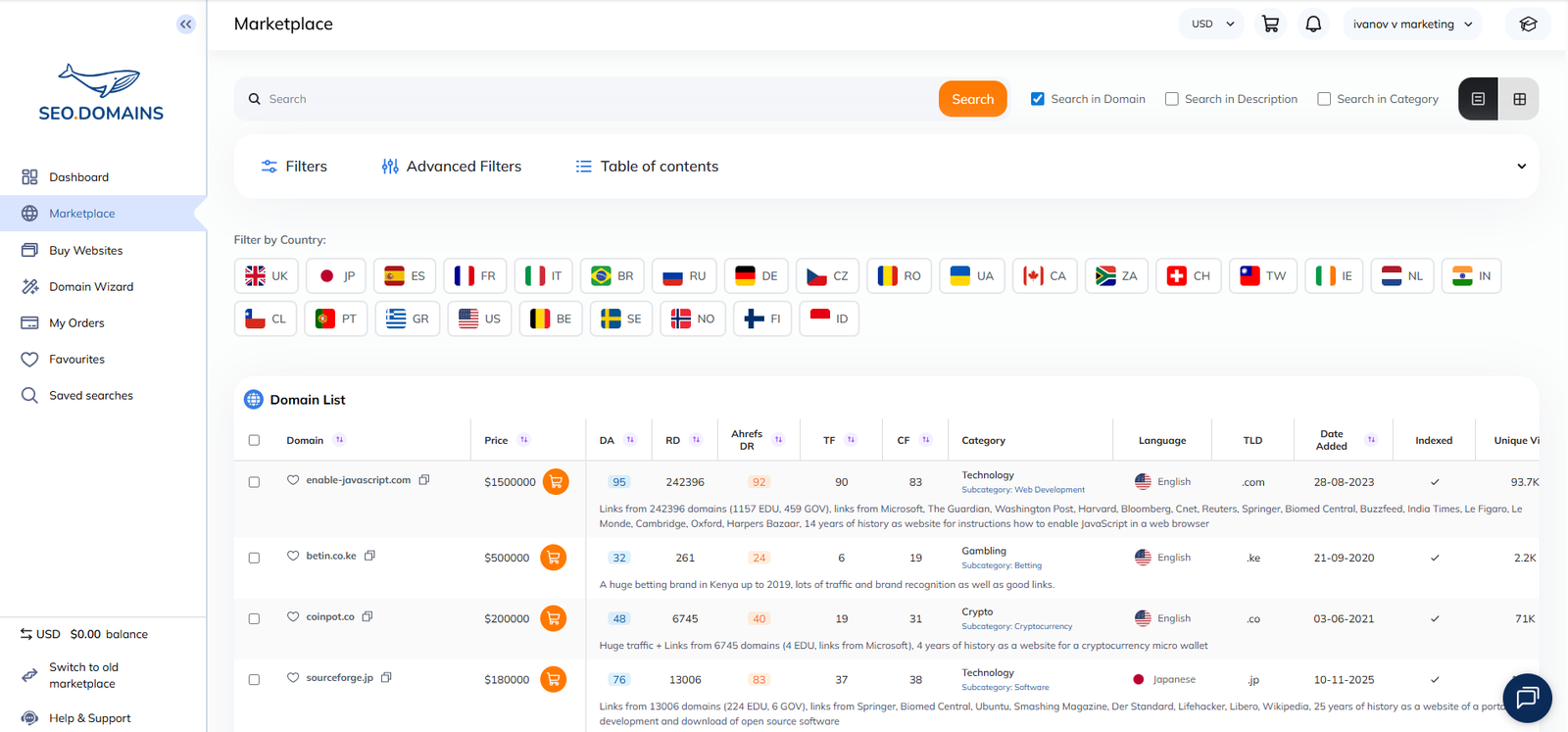
The 220,000+ curated catalogue results from drop-catching operations at scale.
SEO Domains operates one of the largest drop-catching operations in the gTLD aftermarket, and the captured inventory accumulates over time into the marketplace catalogue.
The 220,000+ figure represents the curated catalogue size as of 26 May 2026. It reflects the cumulative output of the drop-catching operation combined with curation discipline that filters out low-quality catches.
Each catalogue listing carries documented registration history and authority metrics.
Every listing publishes a documented set of attributes drawn from WHOIS records and authoritative backlink databases.
- Registration age in years.
- Domain Authority and Domain Rating.
- Count of referring domains.
- TLD and country.
- Topical category.
Buyers filter the catalogue by these attributes and inspect per-listing detail before purchase. The documentation framing replaces the information opacity of generic aftermarket auction batches with explicit per-domain provenance.
A captured aged domain carries forward its indexed footprint and backlink graph when the lifecycle record is intact. A 301 redirect consolidates that accumulated equity onto the destination, which is why documented prior history determines post-drop value.
SEO Domains analytical desk · Aged-domain valuation · Reviewed June 2026
Fixed catalogue prices replace per-name auction uncertainty.
The SEO Domains catalogue operates a fixed-price model. Each listing carries a published price at which the listed domain transfers to the buyer through standard ICANN-accredited transfer mechanics.
The fixed-price model contrasts with the auction layer at backorder services, where the final price emerges from the bidding dynamics among competing pre-orders.
Buyers who want certainty of acquisition cost choose the catalogue path. Buyers who want exposure to auction-driven price discovery choose the backorder path.
ICANN-accredited transfer completes every acquisition under standard EPP transfer protocol.
Every purchase on SEO Domains completes through the standard EPP transfer protocol that ICANN-accredited registrars use to relocate sponsorship between accreditations.
The transfer mechanic operates under ICANN compliance and uses the same authorization-code workflow that protects every standard registrant transfer. Documented provenance is handed to the buyer at closing.
The accreditation framework distinguishes the marketplace from generic aftermarket bidder pools that complete transfers outside this framework.
Acquire from the 220,000+ curated aged-domain catalogue. Filter by Domain Authority, referring domains, TLD, country, and category, and complete every purchase through ICANN-accredited transfer mechanics with documented provenance. Browse the SEO Domains marketplace →
