 BUY WEBSITES
 BUY DOMAINS
 LOGIN
LOGIN
 SIGNUP



Domain drop schedules for major ccTLDs: .uk, .de, .au, .eu and country-code mechanics
Country-code top-level domains operate independent lifecycle frameworks set by each registry. No universal ccTLD drop schedule exists across the 14 country registries documented below. The four headline registries diverge on every axis.
- Nominet publishes a daily
.ukdrop list with UTC timestamps. - DENIC runs a 30-day Redemption Grace Period for
.dewith last-holder-only restoration. - auDA processes
.authrough twice-daily purge cycles at 1:00pm and 1:30pm AEST. - EURid applies a 40-day quarantine for
.eu.
SEO Domains lists curated international ccTLD inventory alongside the 220,000+ aged-domain catalogue. ICANN-accredited transfer mechanics apply where the TLD policy permits standard EPP transfer.
What are the major ccTLDs and how do their drop schedules differ?
Major ccTLDs operate under independent policy frameworks set by country registries. Nine headline registries each set lifecycle policies independently. No universal ccTLD standard exists across countries.
Those nine registries diverge across three axes: grace duration, redemption availability, and drop scheduling.
- Nominet, DENIC, and auDA anchor the .uk, .de, and .au namespaces.
- CIRA, EURid, and AFNIC govern .ca, .eu, and .fr.
- SIDN, JPRS, and Registro.br run .nl, .jp, and .br.
| Registry | TLD | Grace | Redemption / Quarantine | Drop pattern | Residency |
|---|---|---|---|---|---|
| Nominet | .uk | 30 days | 60-day suspension + 5-day pending-delete | Daily drop list (UTC timestamp) | Privacy default; no restriction |
| DENIC | .de | 0 days | 30-day RGP (last-holder only) | Post-RGP release | German presence required |
| auDA | .au | 30 days | 0-day redemption | Twice-daily purge (1:00pm + 1:30pm AEST) | Australian entity required |
| CIRA | .ca | 45 days | 30-day RGP (restore for one year) | Weekly TBR list (Wednesdays 19:00 UTC) | Canadian presence required |
| EURid | .eu | 0 days | 40-day quarantine | First-come-first-served post-quarantine | EU presence for businesses |
| AFNIC | .fr | 0 days | 30-day redemption + 30-day quarantine | 60-day post-expiry release | Birth date required |
| SIDN | .nl | 0 days | 40-day quarantine | First-come-first-served post-quarantine | No restriction |
| JPRS | .jp | 0 days | 0 days | Monthly drop lists | Local Japan contact |
| Registro.br | .br | 73 days | 0 days | Variable post-grace | Brazilian CPF or CNPJ |
| NZRS | .nz | 45 days | 90 days | Variable | UDAI auth code |
| .in registry | .in | 40 days | 30 days | Random within pending-delete | Mandatory KYC/e-KYC from July 2025 |
| IT-Nic | .it | 15 days | 30 days | Variable | Italian or EU presence |
| Red.es | .es | 10 days | 0 days | Variable (auth code from 20 November 2024) | Spanish NIE or NIF |
| NASK | .pl | 0 days | 30 days | Variable (email verification from 5 August 2025) | No restriction |
ICANN grants ccTLD registries autonomy on lifecycle policy decisions.
ICANN administers the gTLD namespace through standard registry agreements that fix the 5-day pending-delete duration and the 30-day Redemption Grace Period across Redemption period (RGP) explained. ccTLD registries operate outside this framework.
Each country's registry sets policy independently, which produces the wide diversity documented across the 14 ccTLDs above. The autonomy reflects national sovereignty over country-code namespace administration.
No universal ccTLD drop schedule exists across countries.
The diversity in ccTLD policies is not an oversight. Each registry tunes its lifecycle to local commercial practice, registrant protection priorities, and registry infrastructure capacity. Nominet publishes daily drop lists with UTC timestamps; JPRS publishes monthly.
DENIC, auDA, and Registro.br require local presence; Nominet and SIDN permit international registration. The article on Domain drop schedules by TLD: .com, .net, .org and Verisign mechanics covers the gTLD schedule that this article complements.
Post-expiry hold ranges from 0 days to 73 days across major ccTLDs.
The zero-grace registries (DENIC, EURid, AFNIC, SIDN, JPRS, NASK) delete or queue the domain immediately at expiry. Registro.br operates a 73-day frozen and redemption window, the longest documented post-expiry hold.
The hold duration determines how long a registrant has to renew before the redemption, quarantine, or release phase begins. International aged-domain operators plan acquisition timing against these per-ccTLD durations.
Redemption and quarantine periods range from 0 days to 90 days.
The .au and .es registries operate zero-day redemption phases, releasing post-grace inventory immediately to the public. The .nz registry runs a 90-day redemption, the longest among the 14 documented.
EURid and SIDN use the term "quarantine" instead of "redemption" for the post-cancellation hold; the functional behaviour is comparable.
The .fr policy combines a 30-day redemption with a separate 30-day quarantine for a 60-day total post-expiry window.
How does .uk drop work under Nominet's 90-day suspension model?
Nominet operates a 30-day grace plus 60-day suspension and 5-day pending-delete model that totals 95 days post-expiry. Nominet publishes a daily drop list with UTC timestamps.
The original registrant restores the domain at no separate fee during the suspension window. No redemption surcharge applies.
A drop list is intended to be generated and published at the same time each day. Drop lists and EPP domain:check responses will provide the UTC timestamp a drop will happen. The drop list file is a gzipped CSV with the list of all domains that are now pending delete.
Nominet · .uk namespace registrar resources · New domain expiry process
.uk drop list daily as a gzipped CSV file with UTC timestamps for each pending-delete entry. The publication practice gives drop-catchers and aged-domain operators authoritative timing data per name.Nominet operates the 30-day grace + 60-day suspension + 5-day pending-delete model.
The .uk lifecycle has three post-expiry phases. The 30-day grace period gives the registrant standard-rate renewal. The 60-day suspension period follows; the domain is removed from DNS but the original registrant restores at no separate fee.
The 5-day pending-delete window completes the lifecycle before drop. Total post-expiry duration is 95 days, significantly longer than the 80-day gTLD baseline at Verisign.
The total post-expiry timeline is 95 days from expiry to drop.
An aged-domain investor tracking a .uk name from expiry sets the drop-target date 95 days forward. The duration provides extended planning visibility compared to gTLD timing.
Nominet publishes the per-name pending-delete timestamp through both the daily drop list and EPP domain:check responses, which gives drop-catching operators precise per-name drop dates within the published file.
The original registrant restores during the suspension at no separate fee.
Unlike the ICANN gTLD framework where the registrar charges a registry-set redemption fee during RGP, Nominet allows restoration during the .uk suspension at the standard renewal price only.
The policy reflects Nominet's registrant-protection priorities set by the Nominet Policy Advisory Body. The absence of a redemption fee makes .uk restoration economics distinct from gTLD recovery economics documented in Redemption period (RGP) explained.
Nominet publishes the daily drop list as a gzipped CSV with UTC timestamps.
The published drop list file format is a gzipped CSV with one row per pending-delete domain, including the UTC timestamp at which the registry will process the deletion.
The file publishes at a consistent daily time, with delayed publication on technical exception days. Drop-catching operators ingest the file daily and align their EPP create commands against the per-domain timestamps.
The publication practice is more transparent than the Verisign approach documented in Domain drop schedules by TLD: .com, .net, .org and Verisign mechanics.
How does .de drop differ without a grace period?
DENIC operates no grace period for .de domains. The 30-day Redemption Grace Period applies after deletion. German presence is required for .de registration.
Restoration during the RGP is restricted. Only the last domain holder, or a third party the last holder designates, re-registers the domain during the window.
.de lifecycle bypasses the registrar grace period and applies the 30-day RGP immediately at deletion. The Quarantine status protects the last holder's re-registration priority during the 30-day window. Public availability begins on day 31. Data per DENIC official policy.DENIC operates zero grace period for .de domains.
The standard ICANN gTLD framework provides a 0 to 45-day auto-renew grace at the registrar. DENIC bypasses this approach entirely.
A .de domain that fails to renew enters deletion at expiry and the 30-day RGP at the registry layer begins immediately.
The contrast with Nominet's 30-day grace, and with the 0 to 45-day registrar grace documented in Grace period and auto-renew grace, is stark.
The 30-day RGP follows deletion and limits restoration to the last holder.
During the DENIC RGP, only the last domain holder or a third party named by the last holder is authorised to re-register the domain.
The restriction protects the prior registrant from drop-catcher extortion patterns that ICANN identified during the early-2000s policy reviews.
The DENIC RGP differs from the standard ICANN RGP because no fee structure applies; the last holder re-registers at standard pricing.
German presence is required for registration.
DENIC enforces German presence requirements through registration agreements. A registrant outside Germany acquires .de domains through a German-resident agent or a local presence service.
The residency requirement shapes aged-domain acquisition planning. International buyers track .de inventory and arrange local presence before completing transfer at drop or at marketplace acquisition.
The DENIC Quarantine status applies during the RGP window.
WHOIS queries on a .de domain in the RGP return the Quarantine status code. The status signals that the domain is under DENIC's post-deletion hold and is not available for third-party registration.
Drop-catching operators monitor the Quarantine-to-released transition through DENIC's published status feeds instead of zone-file diff feeds (the standard mechanism for ICANN gTLDs).
How does .au drop work with auDA's twice-daily purge cycle?
auDA processes two daily purge cycles: deleted domains at 1:00pm AEST (2:00pm AEDT) and expired domains at 1:30pm AEST (2:30pm AEDT). Australian entity registration is required.
The 30-day grace period precedes drop list publication. Client deletes publish for 3 days; policy breaches publish for 14 days.
auDA runs a 30-day grace period before expired hold.
An expiring .au domain enters Expired Hold at the registry immediately at expiry and remains in that state for 30 days. The Expired Hold removes the domain from DNS but preserves restoration eligibility for the original registrant.
The 30-day duration mirrors the auto-renew grace pattern at ICANN gTLD registrars but applies at the registry layer instead of the registrar layer.
The expired hold lasts 30 days before drop list publication.
On day 30, the domain transitions from Expired Hold to Expired Pending Purge and lands on the Official Domain Drop List. The publication signals the imminent drop.
auDA's drop list practice matches Nominet's. Both registries provide transparent timing data to drop-catching operators.
The drop list publishes for 3 days for client deletes (14 days for policy breaches).
Client-initiated deletions (registrant chooses to release the domain) appear on the drop list for 3 days before purge. Policy breach deletions (auDA enforcement) appear for 14 days.
The longer policy-breach window gives affected parties time to challenge the deletion before the namespace releases. Drop-catching operators distinguish the two paths because the 14-day policy-breach inventory carries different acquisition risk than client-initiated releases.
Two daily purge cycles process deleted (1:00pm AEST) and expired (1:30pm AEST) domains.
auDA runs the two purge cycles 30 minutes apart. The Cycle 1 deletion run at 1:00pm AEST processes client-initiated deletions. The Cycle 2 expiry run at 1:30pm AEST processes expired-without-renewal domains.
Both cycles run daily including weekends and public holidays. Drop-catching operations targeting .au align their EPP sessions to both windows to maximise catch coverage across the two daily release events.
How does .eu drop with EURid's 40-day quarantine?
EURid operates a zero-day grace and 40-day quarantine model. Cancelled .eu domains enter quarantine immediately and become available first-come-first-served after the 40-day window. EU presence is required for business registrants; individuals can reside outside the EU.
EURid applies zero grace period after .eu cancellation.
EURid does not provide a registrar-layer grace period for .eu domains. A cancellation request or non-renewal triggers immediate movement into the 40-day quarantine.
EURid also deletes unrenewed .eu domains 5 days before the published expiry date, which compresses the renewal decision window further.
The model differs from Nominet (.uk 30-day grace) and auDA (.au 30-day grace) by skipping the grace phase entirely.
The 40-day quarantine precedes public availability.
During the 40-day quarantine, the .eu namespace is reserved and not available for new registration. The quarantine functions comparably to a redemption period: the registrant has the option to recover the domain, and third parties cannot register.
At the end of the 40 days the namespace releases to the public on a first-come-first-served basis.
EU presence is required for business registrants.
EURid enforces an EU presence requirement for business registrants. Companies registering .eu must operate within an EU member state. The policy aligns with EU regulatory frameworks on commercial registration.
Aged-domain operators acquiring .eu inventory for commercial use build EU presence arrangements into the acquisition workflow.
Individual registrants can reside outside the EU.
EURid permits individual registrants to reside outside the EU, subject to the EU citizenship requirements introduced in recent policy revisions. The individual-versus-business presence distinction is unique among major ccTLDs.
That distinction gives international individual investors a clearer registration path for .eu domains than the business-restricted alternatives.
How do .fr and .nl drops differ from gTLD timing?
AFNIC .fr operates 30-day redemption plus 30-day quarantine for a 60-day post-expiry timeline. SIDN .nl operates a 40-day quarantine without a separate redemption phase. A new SIDN policy from 26 March 2026 deletes .nl domains one day before expiry.
.fr runs a 60-day post-expiry window with both redemption and quarantine phases. SIDN .nl runs a 40-day quarantine without separate redemption. Both registries operate zero grace at the registrar layer.AFNIC runs a 30-day redemption period for .fr domains.
The AFNIC .fr redemption window runs 30 days post-deletion. During the redemption phase, the original registrant restores the domain through the registrar.
The 30-day duration aligns with the standard ICANN gTLD RGP, even though AFNIC operates outside the ICANN gTLD framework.
An additional 30-day quarantine follows the redemption window.
After the 30-day redemption, AFNIC applies a 30-day quarantine. The quarantine extends the post-expiry window to 60 days total.
During the quarantine, restoration eligibility transitions away from the original registrant, but the namespace is not yet available for new registration.
The combined 60-day window is significantly longer than the 35-day pending-delete + redemption window for ICANN gTLDs documented in Domain pending-delete phase: Duration and mechanics.
SIDN operates a 40-day quarantine for .nl without a separate redemption phase.
SIDN takes a simpler approach than AFNIC. The 40-day quarantine combines the redemption and post-redemption holding period into a single phase.
No separate registrar-layer restoration applies. The cancelled .nl domain enters quarantine immediately, and the 40-day clock runs uninterrupted until public release.
A new SIDN platform migration takes effect 26 March 2026.
SIDN migrates to the Hello Registry platform effective 26 March 2026. The migration introduces a 12-month minimum registration term, replacing the prior shorter-cadence renewal options. The change affects renewal planning for .nl registrants and registrar workflows.
Aged-domain operators tracking .nl inventory align their renewal and re-registration arithmetic with the new platform terms.
How do .jp and .br drops differ from typical ccTLD patterns?
JPRS publishes .jp drop lists monthly instead of daily and operates registrar transfers through a REG-ID mechanism, not standard EPP auth codes.
Registro.br operates a 73-day frozen and redemption window for .br domains with Brazilian CPF or CNPJ residency required and no transfer support. Both registries diverge sharply from gTLD and other ccTLD patterns.
JPRS publishes .jp drop lists monthly instead of daily.
The JPRS monthly drop list cadence is unique among major TLD registries. Drop-catching operators targeting .jp inventory plan against the monthly schedule instead of the daily cycles that dominate gTLD operations.
The lower-frequency publication concentrates competing demand into infrequent events, with larger inventory volumes per drop.
.jp registration requires a local contact in Japan.
JPRS registration agreements require a local Japan contact for each .jp registration. International aged-domain investors use Japan-based agents or local-presence services to register.
Three factors set .jp aged-domain operations apart from gTLD workflows:
- Monthly drop list cadence instead of daily cycles.
- A REG-ID transfer mechanism instead of standard EPP auth codes.
- A mandatory local Japan contact for registration.
Registro.br operates a 73-day frozen and redemption window for .br domains.
The Registro.br 73-day frozen window is the longest documented post-expiry hold among major ccTLDs. A .br domain enters Expired status one day after expiry and Frozen status after 14 days. The Frozen window runs until release.
Brazilian registrants restore the domain during the post-expiry hold; once the window closes without renewal the namespace releases.
.br registration requires Brazilian CPF or CNPJ.
Registration of .br domains requires a Brazilian taxpayer identification number: CPF for individuals or CNPJ for businesses. The requirement combined with the no-transfer policy means .br domains stay with the original CPF/CNPJ for the life of the registration.
International acquisition requires either obtaining a Brazilian CPF/CNPJ or operating through a Brazilian-registered legal entity.
What questions do buyers ask about ccTLD drops?
Buyers raise four recurring questions about ccTLD drops:
- Which ccTLDs operate without a grace period (
.de,.eu,.nl,.jp,.pl). - Which require local residency (
.de,.au,.ca,.eu,.br,.jp,.it,.es). - How to track daily versus monthly drop lists.
- Which registries support international purchase via aftermarket marketplaces.
Q1Which ccTLDs operate without a grace period?
The zero-grace ccTLDs include .de (DENIC), .eu (EURid), .fr (AFNIC), .nl (SIDN), .jp (JPRS), and .pl (NASK). These registries delete or queue the domain immediately at expiry without offering a registrar-layer grace window.
Q2Which ccTLDs require local residency?
Eight major ccTLDs require local residency or presence: .de (German presence), .au (Australian entity), .ca (Canadian presence), .eu (EU presence for businesses), .br (Brazilian CPF/CNPJ), .jp (local Japan contact), .it (Italian or EU), and .es (Spanish NIE/NIF).
Nominet .uk and SIDN .nl carry no residency restriction.
Q3How are daily and monthly drop lists tracked?
Daily drop list publishers include Nominet .uk (gzipped CSV with UTC timestamps) and auDA .au (3-day drop list for client deletes, 14-day for policy breaches). JPRS publishes .jp drop lists monthly. Other ccTLDs vary in publication cadence; tracking each registry's official channels is the practical approach.
Q4Which ccTLDs allow international transfer?
Transfer support varies widely. Standard ICANN-style EPP transfer applies for .uk, .de, .eu, .nl, .it, .es, and .pl.
.au and .ca permit transfer with a 1-year extension. .jp transfers operate through a REG-ID mechanism instead of standard EPP auth codes. .br does not permit transfers, so the domain stays with the original CPF/CNPJ.
Q5How does ccTLD inventory enter the aged-domain marketplace?
The SEO Domains catalogue lists curated international ccTLD inventory alongside the 220,000+ aged-domain catalogue. Acquisition completes through ICANN-accredited transfer mechanics where the TLD policy permits standard EPP transfer. Buyers access ccTLD inventory without operating against country-specific drop schedules.
Q6What ccTLD policy changes are scheduled for 2025 and 2026?
NASK introduces email verification for .pl registrations from 5 August 2025.
The .in registry introduces mandatory KYC and e-KYC verification within 7 days of registration from July 2025; the requirement is procedural and does not restrict registration to Indian citizens.
Red.es requires auth codes for .es transfers from 20 November 2024. SIDN migrates to the Hello Registry platform on 26 March 2026 with 12-month minimum registration terms.
Zero-grace ccTLDs include .de, .eu, .nl, .jp, and .pl.
The six zero-grace ccTLDs share an operational pattern: expiry triggers immediate movement into post-expiry holding states without a registrar-layer grace window.
The shared pattern simplifies aged-domain operations across these TLDs because the renewal-cliff timing is identical. The DENIC, EURid, AFNIC, SIDN, JPRS, and NASK registries all set the policy independently but converge on this approach.
Major ccTLDs requiring local residency cover most national registries.
The residency requirement is the dominant pattern across major ccTLDs. Nominet .uk stands out as the largest ccTLD without a residency requirement. SIDN .nl also operates without a residency restriction.
These two registries treat the ccTLD as an open commercial namespace, in contrast to the country-restricted approach of DENIC, auDA, CIRA, Registro.br, JPRS, and the European national registries.
Daily drop list publishers include Nominet .uk and auDA .au.
Nominet and auDA publish daily drop lists with structured machine-readable formats. Nominet publishes a gzipped CSV with UTC timestamps.
auDA publishes the Official Domain Drop List with 3-day visibility for client deletes and 14-day visibility for policy-breach deletes. The transparent publication practice gives drop-catching operations precise per-name timing data.
JPRS publishes .jp drop lists monthly.
The JPRS monthly cadence concentrates .jp drop events into infrequent batches. Drop-catching operators target .jp through the published monthly list and align their EPP infrastructure to the lower-frequency cycle.
The model reduces continuous monitoring overhead and raises per-event competition, because all .jp drops in the month run together.
How does ccTLD inventory fit on SEO Domains' marketplace?
The SEO Domains catalogue lists curated ccTLD inventory alongside the 220,000+ aged-domain catalogue. ICANN-accredited transfer mechanics apply where TLD policies permit standard EPP transfer.
Buyers access international ccTLD inventory without operating against country-specific registry schedules, residency requirements, or monthly drop list cycles.
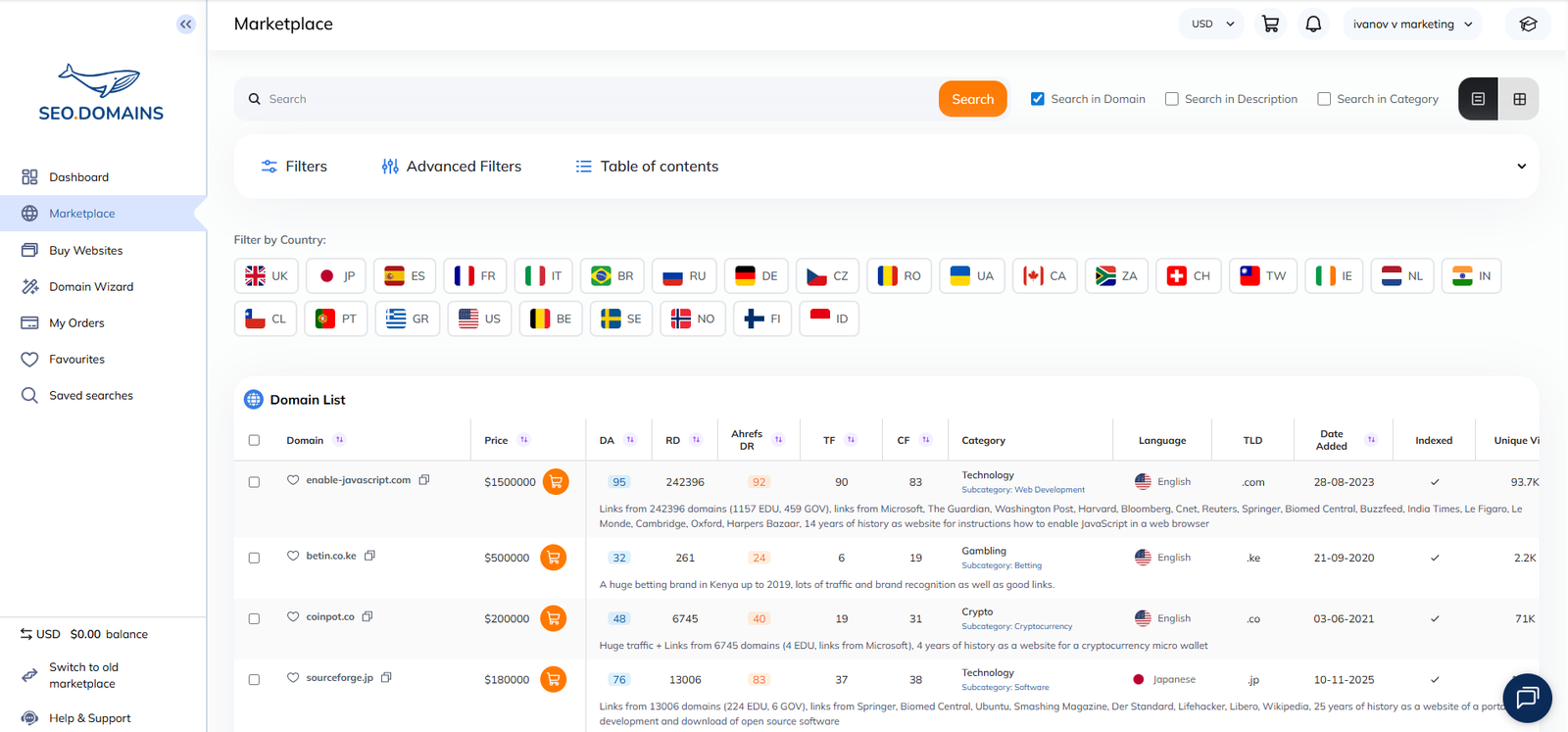
The SEO Domains catalogue surfaces international ccTLD inventory.
The curated catalogue lists ccTLD inventory captured through aged-domain operations across the international registry landscape. Each listing carries the same documented metadata as the gTLD inventory:
- Registration age.
- Domain Authority and Domain Rating.
- Referring domains.
- Country.
- Topical category.
ccTLD-specific compliance signals appear where the registry's residency or transfer policy creates additional acquisition considerations.
Curated listings include grace-period status and registry compliance signals.
Each ccTLD listing includes the policy framework metadata documented above: registry operator, applicable grace period, redemption availability, and transfer policy. Buyers evaluating .de, .au, .ca, or other restricted-residency ccTLDs see the residency requirement alongside the listing.
The transparency simplifies acquisition planning compared to aftermarket platforms that omit ccTLD policy context.
ICANN-accredited transfer mechanics apply where TLD policies permit standard EPP transfer.
Standard EPP transfer applies for .uk, .de, .eu, .nl, .it, .es, .pl and other ccTLDs that operate ICANN-style transfer protocols. .au and .ca transfers complete with an automatic 1-year extension. .jp transfers operate through a REG-ID mechanism.
.br does not permit transfers; SEO Domains lists those TLDs through acquisition workflows compatible with the registry's transfer mechanics.
Buyers acquire ccTLD inventory without operating against country-specific drop schedules.
The diversity of ccTLD drop schedules documented across this article creates operational complexity for buyers who want exposure to multiple ccTLDs.
A drop-catcher targeting .uk, .de, .au, and .jp operates against four different policy frameworks with four different scheduling cadences.
The SEO Domains catalogue removes this complexity by surfacing inventory post-acquisition. The timing-agnostic acquisition pattern runs through Domain drop catching: How dropped domains become available.
The SEO Domains analytical desk treats a captured aged domain with an intact lifecycle record as a carrier of its accumulated backlink graph. A 301 redirect consolidates that documented equity onto the destination.
That redirect mechanic is what makes both gTLD and ccTLD aged inventory commercially valuable.
Acquire international ccTLD inventory without operating against country-specific schedules. Browse the 220,000+ curated aged-domain catalogue on SEO Domains, including ccTLD inventory, and complete purchases through ICANN-accredited transfer mechanics where the TLD policy permits. Browse the SEO Domains marketplace →
