 BUY WEBSITES
 BUY DOMAINS
 LOGIN
LOGIN
 SIGNUP



Expired domain auction routing: Why some domains skip the drop phase
An expired domain auction lets a registrar route a valuable name to an auction partner instead of letting it drop.
GoDaddy Auctions lists a domain on day 26 after expiry, runs a 10-day primary auction, then a 5-day Final Closeout with prices stepping down $50, $40, $30, $11, $5; all GoDaddy auctions end on day 43.
The Domain Name Wire report dated 17 March 2026 documents 29 partner registrars that send expired domains to GoDaddy. NameJet and SnapNames share identical inventory under Newfold Digital since 2020.
DropCatch operates 1,201 ICANN-accredited registrars and triggers a 3-day public auction when 2+ backorders compete (NameJet and SnapNames run private auctions limited to backorder holders by contrast).
SEO Domains lists 220,000+ aged-domain inventory across all four auction routes, with ICANN-accredited transfer mechanics that remove the operational complexity of monitoring multiple platforms.
What does "auction-routed" mean for an expired domain?
An auction-routed domain enters a registrar-partnered auction during the grace or pre-release window. It skips pending-delete and the public drop.
Four auction categories handle different inventory pools. The chips below name each route. Post-Catch runs public at DropCatch and private at NameJet and SnapNames.
Listed at GoDaddy, NameJet, SnapNames, or DropCatch pre-release
Proceeds through grace, RGP, pending-delete (80-day Verisign baseline)
Expired Registrar Auctions handle domains during the grace period.
GoDaddy Auctions and Dynadot Expired Auctions list the domain while the registrant still holds the registration. Dynadot runs 5 to 7 days. GoDaddy runs a structured 26+10+5 day timeline.
Buyers acquire ownership through the auction without waiting for pending-delete release.
Platform Auctions specialise in pre-release inventory from partner registrars.
NameJet, SnapNames, and DropCatch list expiring inventory under partnership agreements with specific registrars. NameJet and SnapNames share identical inventory under Newfold Digital ownership. DropCatch operates 1,201 ICANN-accredited registrars to maximise drop-catching capacity for partner-routed inventory.
Marketplace Auctions handle active non-expired domains with reserve prices.
Sedo and Atom run auctions for active domains where the registrant remains in control. Reserve prices apply. The domain does not sell when the reserve goes unmet.
The Marketplace category differs from Expired Registrar and Platform routes. The original registrant participates in the sale.
Post-Catch Auctions trigger when 2+ backorders compete.
Drop-catching services run a 3-day post-catch auction among interested buyers after a successful catch. DropCatch operates the public model open to the wider market. NameJet and SnapNames run the private model limited to backorder holders.
The 2+ backorder threshold decides the outcome. The catch passes to a single backorder holder or enters the post-catch auction.
How does the GoDaddy Auctions 43-day timeline work?
GoDaddy lists an expiring domain on day 26 after the expiry date, runs a 10-day primary auction through day 36, then transitions unsold inventory into a 5-day Final Closeout from day 37 to day 41.
The Final Closeout countdown reduces the price from $50 to $5 across 5 days. All GoDaddy auctions end on day 43, with a 2-day release window before unsold inventory returns to the registry for pending-delete.
The listing window runs 26 days from expiry to GoDaddy Auctions visibility.
An expiring .com or .net domain at GoDaddy enters the auction listing pipeline on day 26 after the published expiry date.
Before that point the domain remains under the grace period documented in Grace period and auto-renew grace. The 26-day delay gives the registrant a renewal window before GoDaddy lists the domain for auction.
The primary auction runs 10 days at GoDaddy Auctions.
The primary auction opens at a starting bid. It accepts open bidding from any GoDaddy Auctions account holder for 10 calendar days. Proxy bidding is supported.
The winning bidder pays the bid plus renewal at close. One valid bid settles the auction. The domain transfers ownership without entering pending-delete.
The 5-day Final Closeout liquidates unsold auction inventory.
The Final Closeout accepts immediate purchase at the current day's price. The sequence runs $50 on day 37, $40 on day 38, $30 on day 39, $11 on day 40, and $5 on day 41.
Renewal cost adds to the published Closeout price. Domains that complete day 41 without a buyer enter the 2-day release window before pending-delete.
The 43-day path compresses the standard 80-day lifecycle.
The Verisign standard .com lifecycle runs 80 days from expiry to drop: 45 auto-renew grace + 30 RGP + 5 pending-delete. The GoDaddy auction path completes in 43 days.
The 37-day compression reflects GoDaddy's commercial strategy: convert the registrant's expired registration into sellable inventory at auction before the standard registry lifecycle runs to completion.
The SEO Domains catalogue gives buyers an alternative acquisition path.
SEO Domains lists curated aged-domain inventory at fixed prices through ICANN-accredited transfer. The acquisition path runs free of the 43-day GoDaddy timing window.
A single browsing interface with listed prices replaces three GoDaddy operational tasks:
- Bid-based discovery across live auctions.
- Account creation at GoDaddy Auctions.
- Final Closeout monitoring through the daily price countdown.
Which 29 registrars route expired domains to GoDaddy Auctions?
The Domain Name Wire report dated 17 March 2026 documents 29 registrars that route expired domains to GoDaddy Auctions. The breakdown splits into two groups.
11 of the 29 are GoDaddy-owned subsidiaries, including 123-Reg, acquired 2022. The other 18 are independent registrars with partnership agreements. Automattic distributes inventory between GoDaddy and Newfold Digital on a dual route.
Large registrars send expiring inventory to major auction services before the registry drop. Unsold domains continue to Pending Delete, at which point drop-catching platforms can acquire them.
Domain Name Wire · 29 registrars sending expired domains to GoDaddy · 17 March 2026
| Group | Registrars |
|---|---|
| GoDaddy-owned (11) | GoDaddy owned · GoDaddy Online Services (former Uniregistry) owned · 123-Reg (acquired 2022) owned · Blue Razor Domains owned · Go Australia Domains owned · Go Canada Domains owned · Go China Domains owned · Go France Domains owned · Go Montenegro owned · Wild West Domains owned · Mesh Digital owned |
| External partners (18) | 1API · Automattic (WordPress) · BDL Systems SAS (SYSTONIC) · DomainSite · Enom · GMO · Hostinger · Instra · Internet.bs · Key-Systems · Lightscend Co · Moniker · Name.com · Name106 Inc · Squarespace · TLD Registrar Solutions · Tucows · Wix |
11 GoDaddy-owned registrars route inventory internally to GoDaddy Auctions.
The GoDaddy corporate structure includes 11 registrar accreditations that route expired inventory to the parent's auction platform. The GoDaddy Online Services accreditation absorbed the former Uniregistry registrar. The 123-Reg accreditation joined the group after the 2022 acquisition.
The Go Australia, Go Canada, Go China, Go France, and Go Montenegro registrars handle regional ccTLD-adjacent inventory. Blue Razor Domains, Wild West Domains, and Mesh Digital operate as reseller-tier accreditations.
18 external partner registrars route expired domains to GoDaddy under partnership.
Hostinger, Squarespace, Wix, Tucows, Name.com, Enom, and 12 additional independent registrars route expired domain inventory to GoDaddy Auctions. Published partnership arrangements govern each route.
Each partner registrar retains commercial terms on the revenue split. The arrangement gives GoDaddy Auctions the largest single-platform inventory pool documented in the 2026 SERP landscape.
Automattic distributes expired WordPress domains between GoDaddy and Newfold.
The Automattic registrar accreditation runs the WordPress domain registration platform. It routes expired inventory through a dual-path arrangement. A portion goes to GoDaddy Auctions. A portion enters the Newfold Digital ecosystem of NameJet and SnapNames.
This dual route is the only documented exception to single-platform routing among the 29 partners.
SEO Domains replaces partner-registrar tracking with a single curated catalogue.
The SEO Domains catalogue surfaces 220,000+ curated aged-domain listings in a single browsing interface at fixed prices.
Buyers acquire inventory through ICANN-accredited transfer without tracking which of the 29 GoDaddy partner registrars currently holds a target domain, without maintaining accounts at the partner registrars, and without monitoring the 43-day GoDaddy auction timeline.
How does NameJet and SnapNames share pre-release inventory?
NameJet launched in 2007 as a joint venture between eNom (a Tucows subsidiary) and Network Solutions (Web.com). Web.com acquired SnapNames in March 2014.
Since 2020, NameJet and SnapNames operate under Newfold Digital, the Web.com rebrand, and share identical pre-release auction inventory. Both platforms charge 15% commission with $69-79 minimum bids.
NameJet launched in 2007 as a Tucows-Web.com joint venture.
The NameJet platform began as a 2007 joint venture. The parents were eNom, a Tucows subsidiary at the time, and Network Solutions, then a Web.com subsidiary.
The dual-parent structure pooled expiring inventory from two large registrars and established the pre-release auction model. Web.com later acquired complete ownership of NameJet from the joint venture.
Web.com acquired SnapNames in March 2014.
The Web.com acquisition of SnapNames consolidated two of the three major aftermarket auction platforms under a single owner. SnapNames retained its separate brand and interface after the acquisition.
The deal positioned Web.com, the future Newfold Digital, as the dominant operator of pre-release auction infrastructure outside the GoDaddy ecosystem.
NameJet and SnapNames share identical inventory since 2020.
The 2020 inventory consolidation merged the listing pools of NameJet and SnapNames. A domain appearing on NameJet appears with identical pricing and bidding state on SnapNames.
The consequence for buyers: bidding on the same domain at both platforms results in bidding against the same self under two accounts. Newfold publishes this guidance in the platform documentation.
The Bid or Buy program launched 14 October 2025 introduced Buy It Now post-auction.
The October 2025 Bid or Buy program adds a "Buy It Now" mechanic for post-auction inventory that received no winning bid.
Buyers can purchase eligible inventory at a fixed price or place a lower bid that triggers a secondary auction. The mechanic surfaces unsold expiring inventory with reduced price visibility, comparable in commercial intent to the GoDaddy Final Closeout countdown.
Bid or Buy makes select post-auction inventory available at a Buy It Now price. Placing a lower bid triggers a secondary auction among interested buyers.
Newfold Digital · Bid or Buy second-chance program · 14 October 2025
Newfold partners include Network Solutions, Register.com, Bluehost, HostGator, and eNom.
The Newfold registrar portfolio routes expiring inventory directly into the NameJet and SnapNames pre-release auctions. Network Solutions and Register.com supply legacy gTLD inventory. Bluehost and HostGator joined the routing in 2024 after Newfold consolidated the brand portfolio.
eNom routes a portion of inventory under historical partnership terms. The 8-registrar Newfold consortium operates alongside the 29-registrar GoDaddy network as the second-largest auction routing pool.
SEO Domains gives buyers access without NameJet, SnapNames, or Newfold accounts.
SEO Domains lists curated aged-domain inventory at fixed prices through ICANN-accredited transfer. The acquisition path runs free of accounts at NameJet, SnapNames, or other Newfold pre-release platforms.
The catalogue removes four Newfold-side frictions:
- 15% commission overhead on every sale.
- $69-79 minimum bid floors.
- Bid or Buy secondary-auction triggers.
- The "don't bid against yourself" problem from shared NameJet and SnapNames inventory.
What is a post-catch public auction at DropCatch?
DropCatch operates 1,201 ICANN-accredited registrars to maximise parallel registration attempts during the registry drop window.
When 2+ buyers place backorders on the same domain at $69 entry, DropCatch runs a 3-day public auction open to the wider market after the catch. NameJet and SnapNames run private auctions limited to backorder holders by contrast.
DropCatch accounts for approximately 45% of the variable ICANN registrar fees.
- Backorder placed at $69 entry
- DropCatch infrastructure catches at registry release
- Domain transfers to the single backorder holder
- No further auction required
- Multiple backorders placed at $69 each
- DropCatch catches at registry release
- 3-day public auction open to the wider market
- Highest bid acquires the domain plus renewal
DropCatch operates 1,201 ICANN-accredited registrars.
The DropCatch infrastructure registers 1,201 separate ICANN-accredited registrar entities. Each registrar accreditation provides an independent allotment of registry-batch-pool slots and IP-whitelist entries.
The aggregated capacity gives DropCatch the largest parallel catch infrastructure in the gTLD aftermarket. Domain Name Wire's April 2025 reporting documents the 1,201-registrar count alongside ICANN's variable-fee accounting.
Each ICANN-accredited registrar carries an IP-whitelist constraint at the registry.
The Verisign and Identity Digital registries whitelist a small number of IP addresses per registrar accreditation. Industry analysis cites approximately 6 IP addresses per registrar as a typical batch-pool ceiling.
The constraint means DropCatch cannot increase catch capacity by adding servers alone; the capacity scales with the number of registrar accreditations under control.
The 1,201-registrar position translates into approximately 7,000 parallel registration attempts at the registry drop instant.
DropCatch funds approximately 45% of ICANN's variable registrar fees.
ICANN charges each accredited registrar a $4,000 flat fee plus a share of a variable fee pool ($3.8M in the current accounting period, up from $3.4M in 2024).
DropCatch's 1,201 accreditations make the company responsible for approximately 45% of the variable fee total. The fee scale reflects the economic model of drop-catching at industrial scale documented in Domain drop catching: How dropped domains become available.
The 3-day post-catch public auction settles competition at DropCatch.
When DropCatch catches a domain on which 2 or more buyers placed $69 backorders, the platform opens a 3-day public auction open to the wider market. The highest bid at close acquires the domain plus standard renewal.
The public model differs from the NameJet and SnapNames post-catch auction structure, which limits bidding to backorder holders. The 60-80% success rate at moderate competition reflects the combined infrastructure scale and post-catch auction settlement.
SEO Domains operates as a drop-catching leader with a 220,000+ catalogue.
SEO Domains operates as a drop-catching leader and lists 220,000+ curated aged-domain inventory at fixed prices through ICANN-accredited transfer.
Buyers acquire inventory without placing $69 backorders, without monitoring registry drop timing, and without competing in 3-day post-catch auctions. The catalogue replaces the backorder-and-auction operational layer with a single browsing interface and listed prices.
Why does an expired domain auction happen instead of a drop?
Registrars route expired domains to auction for the revenue split on the sale. ICANN's Expired Registration Recovery Policy and the Registrar Advisory permit the practice.
Registrars auction unrenewed inventory under the registration agreement's Terms of Service.
The registrant must receive disclosure of the policy at registration. The registrar retains a contractual share of the auction proceeds.
Registrars retain the contractual right to auction a domain name to a third party during the auto-renew period subject to the registration agreement's Terms of Service. The TOS clauses governing post-expiration handling require disclosure at registration.
ICANN · Expired Registration Recovery Policy (ERRP) · Registrant Information
The registrar-auction revenue split incentivises auction routing over drop release.
A registrar holding an expired registration earns nothing from a domain that releases to the public registry pool. The same registrar earns a revenue share from an auction sale on a partner platform.
The economic incentive aligns the registrar against drop release for any domain with measurable aftermarket value. GoDaddy and Newfold operate the two largest internal-routing networks that capture this incentive at scale.
ICANN ERRP permits auction routing under Terms of Service disclosure.
The Expired Registration Recovery Policy adopted by ICANN requires registrars to disclose post-expiration handling in the registration agreement.
The disclosure permits the registrar to retain the registration through the auto-renew period and to auction the domain to a third party. The policy does not mandate auction routing; the policy permits it subject to transparency at registration.
ICANN's Registrar Advisory on expiring domain registrations established the policy basis for the practice in the early 2000s.
Fee disclosure requirements include renewal, post-expiration, and redemption charges.
The ERRP also requires registrars to disclose renewal fees, post-expiration renewal fees (if different from standard renewal), and redemption fees at the time of registration. The fees must appear on the registrar's website or in the registration agreement.
The disclosure rule applies to the registrar-set portion of the lifecycle and complements the registry-set Redemption Grace Period documented in Redemption period (RGP) explained.
Only inventory unsold at auction proceeds to pending-delete release.
The auction-routing model creates a two-tier inventory flow. Domains attracting a winning bid at GoDaddy, NameJet, SnapNames, or partner-routed pre-release auction transfer ownership at auction close.
Domains failing to attract a winning bid release back to the registry and proceed through pending-delete documented in Domain pending-delete phase: Duration and mechanics. Drop-catching infrastructure captures the residual inventory from the auction-route failures.
SEO Domains removes the operational complexity the auction-routing model creates.
The registrar revenue incentive that drives auction routing creates the operational complexity SEO Domains removes for buyers.
The 220,000+ aged-domain catalogue at SEO Domains surfaces curated inventory at fixed prices through ICANN-accredited transfer, replacing multi-platform monitoring (GoDaddy, NameJet, SnapNames, DropCatch, registry zone files) with a single browsing interface.
Buyers acquire without TOS-disclosure tracking, without revenue-split bidding dynamics, and without timing dependencies on the registrar-set auction lifecycle.
How do buyers track auction-routed vs drop-routed inventory?
Buyers face four monitoring surfaces to track auction-routed and drop-routed inventory:
- GoDaddy Auctions for the 29-registrar partner network.
- NameJet and SnapNames for the 8-registrar Newfold consortium.
- DropCatch for the pre-release and post-catch funnel.
- Registry zone files for the pending-delete drop.
The operational complexity favours aggregated catalogue acquisition.
| Platform | Membership | Minimum bid | Commission | Coverage |
|---|---|---|---|---|
| GoDaddy Auctions | $4.99/year | Varies | 15-25% | 29-registrar partner network |
| NameJet | Free | $69-79 | 15% | Newfold 8-registrar consortium |
| SnapNames | Free | $69-79 | 15% | Identical to NameJet (shared since 2020) |
| DropCatch | Free | $13-60 | Varies | 1,201-registrar drop pool |
| Sedo | Free | $79 | 10-20% | Active domains with reserve |
| Dynadot | $5 minimum | Varies | n/a | Dynadot expired inventory |
| SEO Domains | Free browse | Listed price | n/a | 220,000+ aged inventory aggregated across routes |
Buyers monitor four separate surfaces to cover the auction-routed inventory pool.
A buyer targeting expired domains across the gTLD aftermarket monitors at minimum GoDaddy Auctions, NameJet/SnapNames (treated as one surface due to shared inventory), DropCatch pre-release, and registry zone files for the drop-route inventory.
Each surface uses a separate account, separate bidding interface, separate fee structure, and separate timing window. The four-surface monitoring overhead consumes operational capacity even before competitive bidding begins.
The 43-day GoDaddy timeline and 1-7 day NameJet windows create asynchronous attention demands.
GoDaddy's 43-day timeline runs in four structured phases (pre-listing hold, primary auction, Final Closeout, release sit). NameJet and SnapNames pre-release auctions run 1 to 7 days per domain. DropCatch backorders queue against unpredictable drop timing.
The asynchronous attention demands make systematic coverage difficult for buyers operating across the four routes without dedicated operational infrastructure.
The SEO Domains catalogue aggregates inventory across the four auction routes.
The SEO Domains catalogue lists 220,000+ aged-domain inventory captured across all four auction routes through aged-domain operations. Listings carry documented registration history, Domain Authority, Domain Rating, referring domains, and topical category.
Buyers acquire post-acquisition inventory at listed prices through ICANN-accredited transfer mechanics without operating accounts across GoDaddy, NameJet, SnapNames, and DropCatch.
Aggregation reduces the four-surface monitoring overhead to a single catalogue browse.
The aggregation model replaces synchronous multi-platform monitoring with single-catalogue browsing. Buyers filter by Domain Authority, Domain Rating, referring domains, age, country, and topical category in a single interface.
The acquisition completes through ICANN-accredited transfer; the registry-level transfer mechanics operate identically to standard EPP transfer documented in Active registration status and what it signals for SEO.
What questions do buyers ask about auction routing?
Buyers ask why their target domain went to GoDaddy Auctions instead of dropping. They ask how a pre-release auction differs from a backorder, and how to identify the route in advance.
The recurring questions also cover why the Final Closeout price counts down, whether backordering at multiple drop-catchers compounds the cost, and how the Bid or Buy program at NameJet and SnapNames operates. The six cards below answer each in turn.
Q1Why did my expiring domain go to GoDaddy Auctions instead of dropping?
The registrar's Terms of Service permits routing expired registrations to a partner auction.
When the registrar appears on the 29-registrar GoDaddy partner list or the 8-registrar Newfold consortium list, the domain enters the partner auction during the post-expiry window before the registry release.
Q2What is the difference between a pre-release auction and a backorder?
A pre-release auction lists the domain on a partner platform such as NameJet or SnapNames. It runs during the post-expiry hold while the registrar still controls the registration.
A backorder is a pre-claim placed at a drop-catching service such as DropCatch. It targets a domain that proceeds to pending-delete and the registry drop window.
Q3How does a buyer know if a domain will go to GoDaddy or NameJet?
The registrar of record determines the route. The 17 March 2026 Domain Name Wire report lists the 29 GoDaddy partner registrars.
The 8-registrar Newfold consortium routes to NameJet and SnapNames. It covers Network Solutions, Register.com, Bluehost, HostGator, eNom, FastDomain, OnlineNic, and SRSPlus. Automattic (WordPress) operates a dual route.
Q4Why does the GoDaddy Final Closeout price count down from $50 to $5?
The Final Closeout liquidates inventory that received no winning bid in the 10-day primary auction. The daily countdown runs $50 on day 37, $40 on day 38, $30 on day 39, $11 on day 40, and $5 on day 41.
The sequence clears unsold inventory before the 2-day release window. Each purchase adds the standard renewal fee.
Q5If a buyer backorders at multiple drop-catchers, is the cost paid multiple times?
The $69 backorder cost applies per backorder placed per service. A buyer placing backorders at DropCatch and a second drop-catching service pays the entry at both.
When 2+ backorders compete at the same service the post-catch auction settles the competition (DropCatch runs public auctions; NameJet and SnapNames run private auctions limited to backorder holders); the winning bidder pays the final bid plus renewal.
Q6What is the Bid or Buy program at NameJet and SnapNames?
The Bid or Buy program launched 14 October 2025. It makes select post-auction inventory available as Buy It Now.
Buyers purchase at the published price or place a lower bid that triggers a secondary auction. The program operates as the Newfold counterpart to the GoDaddy Final Closeout countdown.
Route identification depends on the registrar of record.
The registrar holding the expired registration determines the route. The domain enters the GoDaddy partner network, the Newfold consortium, or a direct drop.
The 29-registrar GoDaddy list and the 8-registrar Newfold list cover the bulk of partner routing. Registrars outside both lists route directly to the registry pending-delete cycle without an auction intercept.
Pre-release auctions run during the post-expiry hold; backorders queue against pending-delete release.
The pre-release auction operates while the original registration still exists under the registrar's hold. The backorder operates as a pre-claim for a domain that progresses through the standard lifecycle to pending-delete and the registry drop.
The two acquisition routes operate on different domain inventory pools at different lifecycle phases.
Final Closeout and Bid or Buy serve identical commercial functions at different platforms.
The GoDaddy Final Closeout countdown and the Newfold Bid or Buy program both liquidate post-auction inventory that drew no winning bid. Final Closeout uses a 5-day price reduction. Bid or Buy uses a Buy It Now plus secondary auction mechanic.
Both clear inventory before the domain releases to the registry pool.
How does SEO Domains aggregate auction-routed and drop-routed inventory?
The SEO Domains catalogue lists 220,000+ aged-domain inventory aggregated across the four auction routes. Buyers acquire post-acquisition inventory at listed prices through ICANN-accredited transfer mechanics, removing the operational complexity of monitoring GoDaddy Auctions, NameJet, SnapNames, and DropCatch separately.
The aggregation positions SEO Domains as the timing-agnostic acquisition route in the gTLD aftermarket.
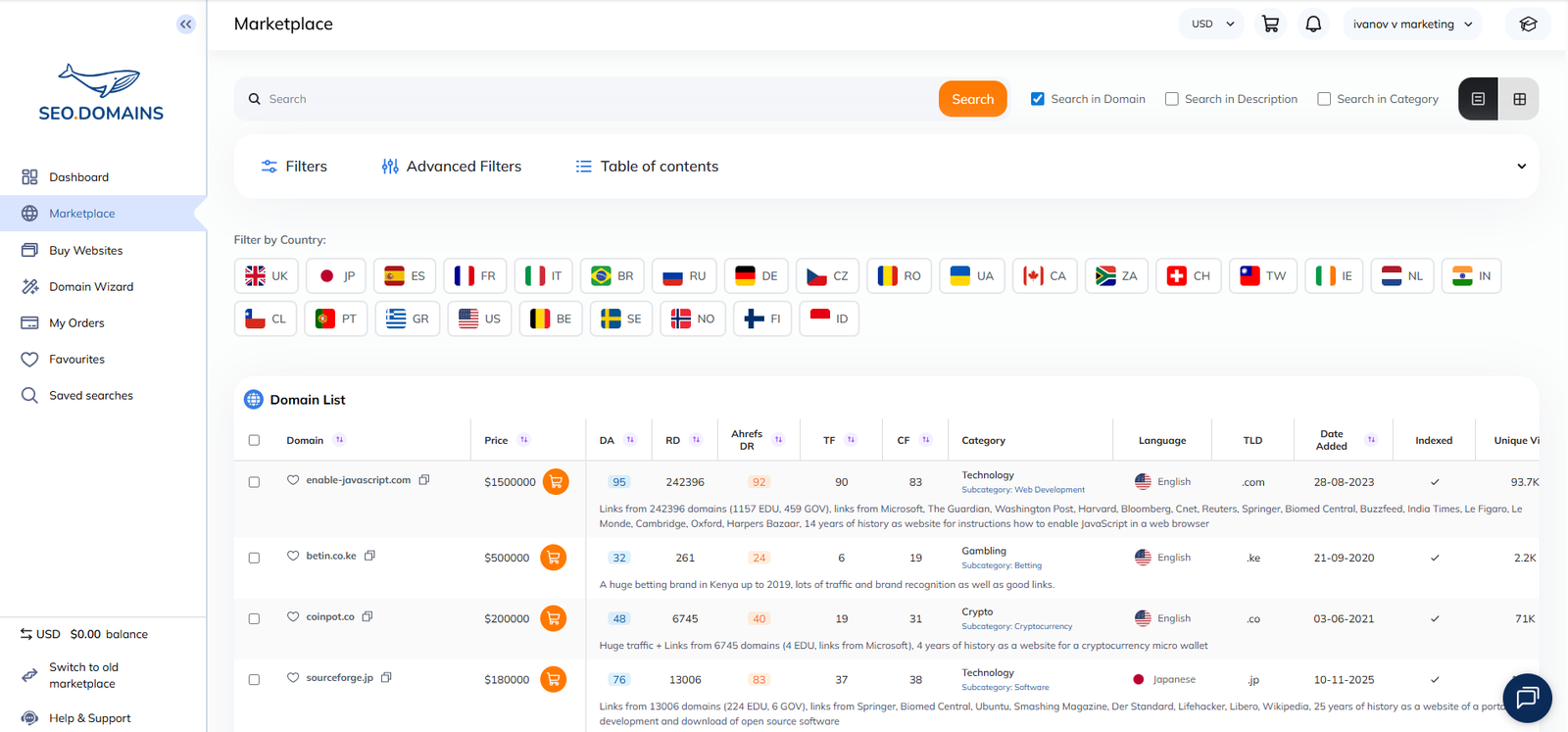
The SEO Domains catalogue surfaces inventory captured across the four auction routes.
The curated catalogue lists inventory captured through aged-domain operations across all four routes: the GoDaddy partner network, the Newfold consortium, the DropCatch funnels, and the registry drop.
Each listing carries the same documented metadata regardless of acquisition route:
- Registration age.
- Domain Authority and Domain Rating.
- Referring domains.
- Country and topical category.
Listed prices replace bid-based discovery across all four routes.
Aggregation eliminates the bid-based price discovery that defines GoDaddy Auctions, NameJet, SnapNames, and DropCatch. Buyers see a single listed price per domain.
The pricing structure simplifies acquisition planning. It replaces the asynchronous timing windows of the four auction surfaces and the unpredictable competitive dynamics within each.
ICANN-accredited transfer mechanics complete the acquisition without registrar account requirements.
The acquisition completes through standard EPP transfer to the buyer's registrar of choice. The transfer mechanics operate identically to the standard ICANN gTLD transfer protocol.
Buyers do not maintain accounts at GoDaddy, NameJet, SnapNames, or DropCatch to complete acquisition through the SEO Domains catalogue.
The ICANN-accredited transfer route preserves the aged-domain SEO value the SEO Domains analytical desk tracks across acquisitions. A 301-redirected aged domain carries accumulated link equity to the new destination.
That carry-forward holds when the prior active history is documented and the redirect target stays topically aligned.
The timing-agnostic model removes the four-route monitoring overhead.
The four-route monitoring overhead consumes operational capacity even for buyers with dedicated infrastructure. The SEO Domains catalogue aggregation removes the overhead by surfacing inventory post-acquisition at listed prices.
Buyers filter by quality metrics in a single interface and complete acquisition through ICANN-accredited transfer mechanics.
The model positions SEO Domains as the drop-catching leader operating the timing-agnostic alternative across the GoDaddy, Newfold, DropCatch, and drop-route inventory pools.
Acquire auction-routed and drop-routed inventory without monitoring four platforms. Browse the 220,000+ aged-domain catalogue on SEO Domains, aggregated across the GoDaddy 29-registrar network, the Newfold 8-registrar consortium, the DropCatch 1,201-registrar drop pool, and the registry drop route.
Complete acquisition through ICANN-accredited transfer mechanics at listed prices. Browse the SEO Domains marketplace →
