 BUY WEBSITES
 BUY DOMAINS
 LOGIN
LOGIN
 SIGNUP



How to recover an expired domain: 4-phase timeline and registrar restoration costs
Expired domain recovery runs through a 4-phase timeline: grace period (0-45 days at standard renewal cost), redemption (30 days at $99-$208 retail restoration), pending-delete (5 days, recovery effectively impossible), and released to the registry pool.
The Verisign wholesale redemption fee is $40 at the registry; registrar markup pushes retail to $99 at Bluehost, $176 at Namecheap, $200 at GoDaddy, and $208 at Name.com.
SEO Domains operates as a drop-catching leader with a 220,000+ aged-domain catalogue at fixed prices through ICANN-accredited transfer.
Domain owners whose recovery window has closed can search the SEO Domains catalogue for their previously-owned domain or for similar aged-authority alternatives.
What happens immediately when a domain expires?
A domain that crosses its expiry date stops resolving in DNS within 24 hours, taking the website offline, breaking inbound and outbound email, invalidating the SSL/TLS certificate, and triggering search engine ranking degradation. The registrar transitions the EPP status to autoRenewPeriod or clientHold, removing the domain from the published zone file at the registry.
DNS resolution stops
The domain no longer resolves to the configured nameservers; visitors see DNS errors.
Website goes offline
HTTP requests to the domain return connection refused or DNS lookup failed.
Email services break
Inbound mail bounces; outbound mail fails authentication on the missing MX record.
SSL certificate invalid
HTTPS connections fail certificate validation because the domain serves no certificate.
Search rankings degrade
Search engines record consecutive crawl failures and reduce the indexed footprint.
Third-party integrations break
OAuth, webhook, and API integrations that depend on the domain return connection errors.
DNS resolution stops within 24 hours of expiry.
The registrar updates the registry record on expiry and the registry removes the domain from the published zone file.
DNS resolvers cache results based on the TTL set in the prior zone record; lookups continue resolving during the TTL window and fail after the cache expires. Resolvers see the failure within 24 hours in the standard case.
Website and email services break in parallel.
HTTP requests fail because DNS does not return the configured A/AAAA records. SMTP servers reject the recipient address because the MX record no longer resolves. Service breakage is simultaneous across web and mail because both depend on the same DNS resolution layer documented in Active registration status and what it signals for SEO.
SSL certificates become invalid on revocation or HTTPS failure.
The SSL/TLS certificate references the domain in the subject and SAN extensions. When the domain stops resolving, HTTPS clients fail certificate validation through one of two paths: certificate authority revocation (if reported), or inability to reach a server presenting the certificate.
Search engines record crawl failures within days.
Search crawlers detect consecutive HTTP failures within their normal crawl cadence. The crawl-rate decreases and indexed URLs eventually drop from the search index.
Recovery after the domain returns requires re-indexing the URL inventory, and a re-registered expired domain carries no ranking bonus from the prior site, a recovery dynamic the SEO Domains analytical desk documents later in this article.
The 4-phase recovery timeline
The standard gTLD recovery timeline runs 4 phases over approximately 80 days: grace period (0-45 days at the registrar's discretion), redemption (30 days at the registry per ICANN RGP policy), pending-delete (5 days at the registry), then released to the public pool. Recovery cost increases at each phase boundary; recovery probability decreases.
Grace period recovery succeeds at standard renewal cost.
The grace period spans 0-45 days at the registrar's discretion documented in Grace period and auto-renew grace. Recovery during grace requires standard renewal payment without restoration fees. Domain owners discover missed renewal during this window through registrar notifications in the typical case.
Redemption recovery requires the registrar-set restoration fee.
The 30-day Redemption Grace Period at the registry follows the registrar's deletion of the expired registration. Recovery during RGP requires payment of the registrar's restoration fee plus the standard renewal cost. The mechanics are documented in Redemption period (RGP) explained.
Pending-delete recovery operates outside normal restoration paths.
The 5-day pending-delete window at the registry locks the domain into the deletion queue. Recovery is not available through standard restoration. The mechanics and operator constraints are documented in Domain pending-delete phase: Duration and mechanics.
Released domains require aftermarket acquisition.
Released domains enter either the public registration pool (drop-catching, documented in Domain drop catching: How dropped domains become available) or a registrar-partnered auction (documented in Domain auction routing: Why expired domains skip the drop phase). Original owners face the same acquisition path as any other buyer.
How does grace-period recovery work?
Grace-period recovery is the simplest and cheapest path: log into the registrar, locate the expired domain in the portfolio, click renew, and pay the standard annual price ($10-20 for typical gTLDs). The domain reactivates within 24 hours of payment, and DNS propagation completes within 24-48 hours.
Standard renewal payment reactivates the domain.
The registrar accepts standard renewal payment during the grace period and updates the registry with the new expiry date. No restoration fee applies. The transaction completes through the registrar's normal renewal interface without contacting customer support.
DNS reactivates within 24 hours of payment.
The registry updates the zone file after receiving the renewal transaction from the registrar. Resolvers begin returning the configured A/AAAA records on the next zone refresh. Reactivations complete within 24 hours in the standard case, with DNS propagation finishing within 24-48 hours depending on TTL.
Email and HTTP services restore as DNS propagates.
Inbound SMTP receivers find the MX record and deliver queued mail. HTTP/HTTPS connections reach the web server on the next cached DNS expiry. The SSL/TLS certificate validates against the resolving domain. Search crawlers retry recently-failed URLs and resume indexing on subsequent crawl cycles.
Auto-renewal failure modes account for the bulk of missed grace windows.
Auto-renewal failures fall into four categories: expired credit card on file, bounced renewal notification emails, change of registrar without updating payment, and registrar payment processing errors.
Each failure mode produces a domain that proceeds to redemption despite the registrant's intent to renew.
The OnlyDomains case documented in Domain auction routing: Why expired domains skip the drop phase shows how silent auto-renewal failure leads to high-value domain loss.
What does redemption recovery cost across major registrars?
Redemption recovery costs range from ~$50 at Cloudflare to $207.99 at Name.com. Cloudflare's at-cost model passes the $40 Verisign wholesale fee directly to the customer.
Hostinger charges $80, Bluehost $99, Porkbun $120, Dynadot $125-140, Squarespace $170 total, NameSilo $161-176, Namecheap $175.98, GoDaddy $199.98, and Name.com $207.99. The variation reflects each registrar's markup on the $40 wholesale floor.
| Registrar | Restoration fee | Renewal | Total recovery | Processing time |
|---|---|---|---|---|
| Cloudflare | ~$40 (at-cost) | ~$10 | ~$50 | Up to 72 hours |
| Hostinger | $80 | + renewal + VAT | $95-110 | Up to 72 hours |
| Bluehost | $99 | + renewal | $114+ | Up to 72 hours |
| Porkbun | $120 | $11 | $131 | Up to 72 hours |
| Dynadot | $125-140 | $10 | $135-150 | Up to 72 hours |
| Squarespace | $150 | $20 | $170 | Up to 72 hours |
| NameSilo | $150-165 | $11 | $161-176 | Up to 72 hours |
| Namecheap | $160 | $15.98 | $175.98 | Up to 72 hours |
| GoDaddy | $179.99 | $19.99 | $199.98 | Up to 72 hours |
| Name.com | $195 | $12.99 | $207.99 | Up to 72 hours |
| SEO Domains catalogue | n/a (no recovery) | Listed price | Search the catalogue | ICANN-accredited transfer |
Bluehost charges the lowest restoration fee at $99.
Bluehost's official redemption fee is $99, paid to the registry plus the standard renewal cost. The total recovery completes within 72 hours after payment per Bluehost's documented processing time. The fee cannot be waived because the registry sets the underlying wholesale charge.
Squarespace, Namecheap, and GoDaddy occupy the mid-tier at $170-$200.
The mid-tier registrars apply moderate markup on the wholesale redemption fee. Squarespace's $170 total includes $150 restoration plus $20 renewal. Namecheap's $175.98 total includes $160 restoration plus $15.98 renewal.
GoDaddy's $199.98 total includes $179.99 restoration plus $19.99 renewal. The differences reflect each registrar's pricing strategy on aged-domain commercial value.
Name.com charges the highest at $207.99 total.
Name.com's $207.99 total breaks down to $195 restoration plus $12.99 renewal. The restoration fee carries the largest markup over the $40 wholesale baseline among the surveyed registrars. The trade-off is that Name.com's customer service handles restoration through structured ticket flows that operators sometimes prefer over self-service portals.
Processing time is consistent at up to 72 hours across registrars.
The 72-hour processing window reflects the registrar's manual registry-restore workflow. The registry processes the restore request, updates the zone file, and the registrar confirms recovery to the customer.
DNS propagation adds 24-48 hours after the registry update. Operators who must minimise downtime act on day 1 of redemption instead of at day 29.
Why is the redemption fee so high?
The redemption fee structure runs $40 wholesale at the Verisign registry plus registrar markup of $59-$155 to reach the $99-$195 retail restoration price. ICANN adds a $0.20 per-transaction fee (July 2025).
The wholesale fee compensates the registry for the manual restore-request workflow that reverses the deletion process at the registry layer.
The redemption fee is high. It is set by our upstream Registrar and Domain Registry, that is why we cannot waive it.
Namecheap Support · Article on why redemption fee is so high
Verisign collects $40 wholesale for each .com redemption.
The Verisign registry charges $40 per redemption request to compensate for the manual restore-request workflow at the registry. The fee reverses the deletion process initiated when the registrar issued the original delete command after the grace period. The non-waivable nature of the fee reflects the registry's operational cost structure.
ICANN per-transaction fee applies to renewal and restoration.
The ICANN $0.20 per-transaction fee (effective July 2025) applies to domain create, renew, and transfer operations across the gTLD landscape. The fee is small relative to the wholesale redemption charge but adds to each registrar invoice.
Registrar markup covers customer support and operational overhead.
The registrar markup ranges from $59 at Bluehost to $155 at Name.com on the $40 wholesale baseline. The markup compensates for customer support (handling restoration requests), payment processing fees, fraud risk on high-value transactions, and account-management overhead. The wide variation reflects pricing strategy instead of direct cost difference.
ccTLD redemption fees diverge sharply from the gTLD model.
Country-code TLDs operate independent fee structures. DENIC's .de RGP does not charge a restoration fee because the policy permits only the last holder to re-register at standard pricing. Nominet's .uk suspension period also avoids restoration fees.
The full ccTLD breakdown is documented in Domain drop schedules for major ccTLDs: .uk, .de, .au, .eu and country-code mechanics.
What happens if recovery fails and the domain goes to auction?
Domains that fail recovery enter registrar-partnered auctions or proceed to the public drop. Recent cases show auction acquisitions face clawback risk: GoDaddy reversed the butane.com sale to Prime Loyalty ($19,755) and the calor.com sale to Crisby Studio AB approximately 2 months after closing.
The blockchain.ai domain hit $405,000 at auction in October 2025 with a lawsuit pending from the original registrant.
The blockchain.ai domain was set to auto-renew with OnlyDomains, but the auto-renewal failed, resulting in expiration on July 19, 2025. After becoming aware of the failure on September 21, the registrant claims he paid OnlyDomains for the renewal and received a confirmation.
Domain Name Wire · 12 October 2025
The butane.com and calor.com cases show clawback exposure.
Prime Loyalty LLC acquired butane.com through a GoDaddy expired auction for $19,755. Crisby Studio AB acquired calor.com through the same registrar. Both domains were clawed back approximately 2 months after the auctions closed. A GoDaddy representative cited technical error preventing the original registrant from renewing. Both buyers filed lawsuits over the clawback.
The blockchain.ai case demonstrates the silent auto-renew failure pattern.
The blockchain.ai registrant set up auto-renewal at OnlyDomains. The renewal failed silently on 19 July 2025. The registrant discovered the failure on 21 September 2025 (approximately 2 months later) and claims he paid for renewal and received confirmation.
The domain went to auction and closed at $405,000 on 12 October 2025. The registrant filed a lawsuit to halt transfer to the auction winner.
The 2-month clawback window pattern repeats across cases.
The 2-month gap between auction close and clawback in the butane.com and calor.com cases aligns with the standard ICANN ERRP framework window for original-registrant restoration claims.
Registrars that reverse auction sales typically cite technical error in the original expiration process. The pattern leaves auction buyers exposed to retroactive ownership disputes on high-value domains.
SEO Domains operates ICANN-accredited drop-catching beyond the clawback window.
SEO Domains acquires aged-domain inventory through ICANN-accredited drop-catching at registry release (day 81+) after the pending-delete window completes.
The acquisition point sits beyond the registrar's clawback window, providing buyer protection against retroactive ownership disputes documented in the auction clawback cases. The 220,000+ curated catalogue surfaces inventory at fixed prices through ICANN-accredited transfer.
Do SEO rankings recover after an expired domain comes back?
A re-registered expired domain rebuilt with fresh content carries no automatic ranking bonus from the prior site: the old ranking state shakes off over time and search engines treat the domain as new and independent.
The 301-redirect strategy is the distinct path that preserves accumulated authority, where a redirect from a documented aged domain consolidates link equity onto the destination. The two outcomes split on acquisition pattern, not on the recovery transaction itself.
A re-registered expired domain rebuilt with new content starts from a baseline: the old ranking state shakes off and the site is treated as new and independent. Accumulated authority survives only on the 301-redirect path, where a documented aged domain consolidates its link equity onto a topically aligned destination.
SEO Domains analytical desk · Aged-domain recovery · Reviewed June 2026
Re-registered expired domains do not inherit a ranking bonus.
A re-registered expired domain receives no automatic ranking boost from the prior owner's site history.
Search-index authority resets for an expired domain rebuilt with new content, and the new registrant builds visibility through standard SEO work after re-registration.
The reset behaviour traces to link-algorithm changes that addressed PBN abuse patterns of the early 2000s and has held since.
The authority-reset behaviour explains the rebuild penalty.
Re-registered expired domains start at the baseline authority for the new content and do not inherit the prior site's accumulated signals.
The behaviour means a recovery aimed at relaunching the prior site delivers a clean slate, not a head start. Operators planning a content relaunch budget for the same ranking timeline a freshly registered domain would face.
The 301-redirect strategy operates under different conditions.
The 301-redirect approach preserves equity when an aged domain redirects to an existing site with documented prior history. The accumulated authority associated with the aged domain transfers to the redirect target through the 301 signal.
This is a distinct acquisition pattern from re-registering the expired domain to build a new site on it, and it is the pattern the curated catalogue's documented-history listings are built to support.
SEO Domains catalogue listings document the prior history.
The SEO Domains curated catalogue surfaces aged-domain inventory with documented registration history, Domain Authority, Domain Rating, referring domains, country, and topical category. The documented history supports the 301-redirect strategy described above by giving buyers visibility into the aged domain's prior signals before acquisition through ICANN-accredited transfer.
What causes 70% of missed renewals?
Missed renewals trace primarily to payment-method failures (40%), email notification failures (30%), and organizational oversight (15%) across the registrar industry. Assumed auto-renewal accounts for 10% and financial distress for 5%. The OnlyDomains case in the blockchain.ai lawsuit illustrates how silent auto-renew failure produces unintended expirations even with confirmed renewal intent.
Payment method failures account for 40% of missed renewals.
Expired credit cards, declined transactions, and changed billing addresses produce auto-renewal failures even when the registrant intends to renew. The registrar attempts the renewal charge and fails silently in the typical implementation. The domain proceeds through grace and into redemption while the registrant assumes the renewal succeeded.
Email notification failures account for 30% of missed renewals.
Renewal notifications bounce from outdated email addresses, route to spam folders, or fail SPF/DKIM checks at the recipient's mail server. The registrant misses the renewal reminder window and discovers the expired status weeks or months later.
ICANN's ERRP requires registrars to send notifications at multiple points but does not guarantee delivery to inattentive inboxes.
Organizational oversight and assumed auto-renewal account for 25% combined.
Domain registration responsibility shifts between team members at organizations. The original registrant departs, the renewal email routes to an unmonitored shared inbox, and the domain expires before a successor takes ownership. Separately, registrants who set up auto-renewal years prior assume it continues working without periodic verification.
Tracking workflows prevent the most common failure modes.
The lifecycle tracking workflows documented in Domain lifecycle tracking: WHOIS, RDAP, and the workflow tools that monitor every status code route alerts at 30, 14, 7, and 1 days before expiry through multiple channels (email, Slack, webhook, SMS, PagerDuty).
The multi-channel approach catches notification failures that single-email reminders miss. Multi-year renewals at registration reduce assumed-auto-renewal exposure.
Check the SEO Domains catalogue: your expired domain may already be in inventory
SEO Domains operates as a drop-catching leader with a 220,000+ aged-domain catalogue acquired through ICANN-accredited drop-catching at registry release.
Domain owners whose recovery window has closed can search the catalogue for their previously-owned domain or for similar aged-authority alternatives. Acquisition completes at fixed prices through ICANN-accredited transfer beyond the registrar clawback window.
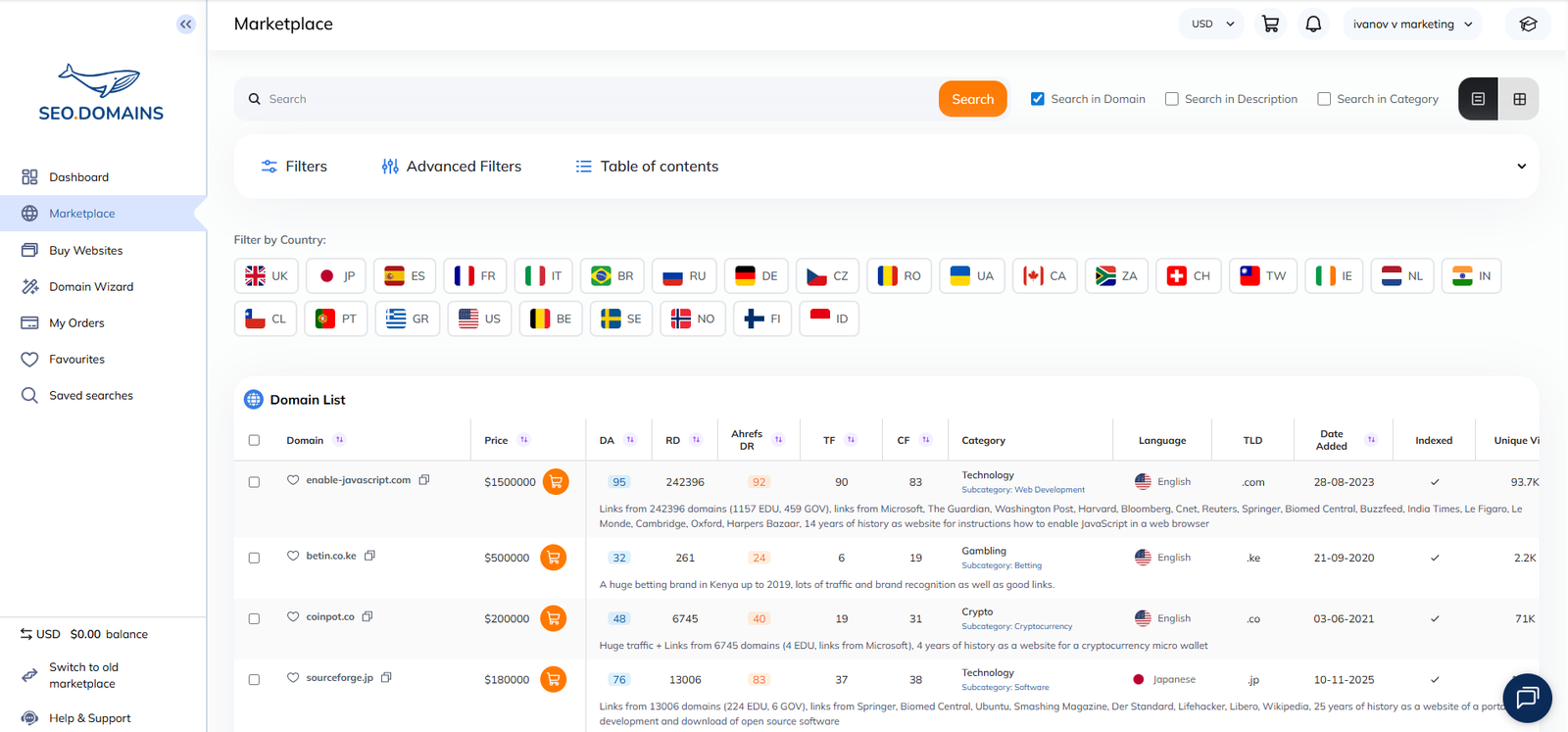
The catalogue surfaces domains released through pending-delete drop.
SEO Domains operates drop-catching infrastructure that captures inventory at registry release (day 81+) after the pending-delete window completes.
The captured inventory enters the curated catalogue with documented prior history, Domain Authority, Domain Rating, referring domains, country, and topical category. Owners whose recovery window has closed search the catalogue for the specific domain or for similar aged-authority alternatives.
Acquisition through the catalogue operates beyond the clawback window.
The drop-catching acquisition point sits beyond the registrar's clawback window documented in the butane.com and calor.com cases. The original registrant's restoration rights have closed by the time the domain enters the SEO Domains catalogue. Buyer protection against retroactive ownership disputes is structural instead of contractual.
Listed prices replace bid-based discovery and clawback uncertainty.
Each domain in the catalogue carries a listed price. Buyers acquire without bidding against unknown competitors, without backorder queue uncertainty, and without the multi-month clawback exposure of registrar-partnered auctions. The pricing structure supports planned acquisition instead of reactive scrambling at auction deadlines.
ICANN-accredited transfer mechanics preserve aged-domain SEO value for 301-redirect strategies.
Acquisition through SEO Domains completes via standard ICANN-accredited EPP transfer.
For 301-redirect strategies, the SEO Domains analytical desk treats aged-domain value preservation as conditional on continuity: a 301-redirected aged domain passes accumulated authority to the new destination when the prior active history is documented and the redirect target stays topically aligned.
The catalogue's curated history records support that transfer-and-redirect workflow.
Recovery window closed? Search the SEO Domains catalogue first. The 220,000+ curated aged-domain catalogue lists domains captured through drop-catching at registry release, including previously-owned domains and similar aged-authority alternatives. Acquisition completes at fixed prices through ICANN-accredited transfer beyond the registrar clawback window. Search the SEO Domains marketplace →
