BUY WEBSITES
 BUY DOMAINS
 LOGIN
LOGIN
 SIGNUP



How to renew a domain in the grace period and auto-renew grace
The ability to renew a domain does not end the moment it expires: the grace period is the registry-mandated window after expiry during which the previous registrant keeps exclusive rights to renew a domain at the standard fee.
ICANN consensus policy and registry operators define five distinct grace types covering registration, renewal, auto-renewal, transfer, and redemption events.
For aged-domain buyers on SEO Domains, grace period awareness is foundational. Every watch-listed domain passes through these windows.
The difference between a domain renewed in grace and one lapsed into redemption sets acquisition timing, recovery cost, and the preservation of accumulated SEO signals.
This guide covers the five grace types, the durations published by major registries and registrars, the legal and operational rules, and how SEO Domains buyers act on grace transitions during acquisition workflows.
What is the grace period to renew a domain?
A domain grace period is the registry-mandated window after expiry during which the previous registrant retains exclusive renewal rights at the standard fee.
ICANN consensus policy and registry operators define five distinct grace types. Each type carries its own duration, fee structure, and operational constraints.
The five types map to five lifecycle events:
- Registration (Add Grace Period)
- Manual renewal (Renew Grace Period)
- System auto-renewal (Auto-Renew Grace Period)
- Inbound transfer (Transfer Grace Period)
- Post-expiry recovery (Redemption Grace Period)
ICANN consensus policy defines the grace period for every gTLD registry
The Internet Corporation for Assigned Names and Numbers, through its consensus policy on the Redemption Grace Period, requires every generic top-level domain registry to provide registrants a post-expiry recovery window.
The policy emerged from ICANN’s consensus process to address registrants losing domains through accidental non-renewal, billing failures, or registrar communication gaps.
Every registrar accredited under an ICANN Registrar Accreditation Agreement must implement the registry’s grace policy and disclose its mechanics to registrants.
Registry operators implement the policy as five distinct grace types
The registry behind .org, .info, .biz, .me, .pro, and other gTLDs, Identity Digital, publishes the industry’s only documented public five-type grace taxonomy.
The Identity Digital grace periods reference documents all five types in one taxonomy.
Each type triggers on a different lifecycle event. Each carries its own credit and refund rules at the registry level.
The Extensible Provisioning Protocol, codified in RFC 5731, exposes these grace states through five status codes shown below.
The grace period is distinct from the redemption period that follows it
The grace period and the redemption period are sequential, not synonymous. The standard renewal grace period or auto-renew grace period runs first, allowing recovery at the standard renewal fee.
The redemption grace period follows, requiring a substantially elevated restoration fee plus the standard renewal cost. The companion Active registration status and what it signals for SEO guide covers the lifecycle phase that precedes both grace and redemption.
How long does the domain grace period last?
The standard post-expiry grace period spans 30 to 45 days for major gTLDs, followed by a 30-day redemption grace period before pending delete.
ccTLD durations vary substantially. The .uk registry extends the redemption grace period to 90 days, while .de, .eu, .nl, and .cx offer no redemption grace at all.
The standard gTLD grace period runs 30 to 45 days
For .com, .net, .org, .info, .biz, .me, and other major gTLDs, the post-expiry grace period lasts 30 days at minimum and up to 45 days when the Auto-Renew Grace Period applies.
The registry behind .com and .net, Verisign, follows a 45-day Auto-Renew Grace Period under the standard registry-registrar agreement. Identity Digital applies the same 45-day Auto-Renew Grace Period across its portfolio of more than 200 gTLDs.
The actual user-visible window depends on whether the registrar triggers auto-renewal billing or treats the expiry as a manual renewal opportunity.
ccTLD durations vary from 0 days to 90 days
Country-code top-level domains operate under independent registry policies and produce a wider duration range than gTLDs. Major ccTLD examples include Nominet for .uk, which extends the redemption grace period to 90 days without a redemption fee.
The German registry DENIC operates .de with no redemption grace period at all: a domain not renewed before expiry returns to availability immediately.
The Dutch registry SIDN for .nl and the EU registry for .eu apply the same instant-release policy.
Other ccTLDs such as .nu provide 7 days of reactivation followed by a 60-day redemption grace, while .gg permits roughly 28 days of reactivation followed by 26 days of redemption.
ccTLD redemption grace duration variance
The redemption grace period adds another 30 to 42 days before final drop
After the standard grace period ends, the redemption grace period begins. Identity Digital structures it as three phases:
- 30 days pending-delete: the registrant submits a restoration request.
- 7 days restore report: the registrar files the report through the Extensible Provisioning Protocol or registry web portal.
- 5 days redemption hold: the registry holds the domain before final deletion.
The total redemption grace duration runs 42 days when fully utilised. The companion guide on redemption period mechanics is forthcoming under the Domain Lifecycle pillar.
Grace period sequence from active to drop (major gTLD example)
Why does ICANN policy require grace periods?
ICANN consensus policy requires grace periods to protect registrants from accidental domain loss through payment failure, renewal miscommunication, or auto-renew billing edge cases.
The policy standardises recovery windows across every gTLD registry. It mandates registrar disclosure of grace mechanics under the ICANN Registrar Accreditation Agreement.
Grace periods protect registrants from accidental loss
Domains expire for predictable reasons:
- Credit card declines
- Email delivery failures for renewal reminders
- Registrant address changes
- Business closures
- Administrative oversight at corporate registrants
Without a recovery window, every minor billing or notification failure would convert into permanent loss of brand assets, established websites, and accumulated SEO equity.
The consensus grace period model converts these accidents into recoverable events with documented restoration paths.
ICANN consensus policy standardises the recovery window across gTLDs
The ICANN consensus policy process produces binding requirements that every gTLD registry must implement. The Redemption Grace Period consensus policy, finalised in 2003 and enforced through registry agreements, defines the 30-day post-expiry restoration window.
The policy applies uniformly across .com, .net, .org, .info, .biz, .me, .live, .blog, and every other gTLD operating under the standard registry-registrar contract.
ccTLDs operate under their own national or regional policies and diverge from the gTLD standard, as the Nominet, DENIC, and SIDN examples in the previous section demonstrate.
Registrars must disclose grace mechanics under their accreditation agreement
The ICANN Registrar Accreditation Agreement, the contract every accredited registrar signs with ICANN, requires registrars to disclose three points to registrants:
- Grace period mechanics
- Restoration fees
- The timing of pending-delete transitions
Registrars including GoDaddy, Namecheap, Cloudflare, Dynadot, Hover, Network Solutions, and Squarespace publish grace policy pages to satisfy this requirement.
Aged-domain buyers research these disclosures during due diligence to evaluate post-expiry inventory under the SEO Domains marketplace.
Which grace period applies to which lifecycle event?
The Identity Digital registry distinguishes five grace types. Add Grace, Renew Grace, Auto-Renew Grace, Transfer Grace, and Redemption Grace each cover a different lifecycle event with distinct durations and credit rules.
The five-type taxonomy applies across every gTLD operated under the standard registry agreement. No other public registry documentation matches this depth.
The Add Grace Period covers the 5-day window after initial registration
The Add Grace Period spans five calendar days following the initial registration of a domain. During this window, the registrar can delete the domain for a full refund of the wholesale registration fee at the registry.
Renewals during the Add Grace Period incur the standard renewal charge with no credit, and transfers are prohibited for sixty days following any new registration. The Extensible Provisioning Protocol exposes this state through the addPeriod status code.
The Renew, Auto-Renew, and Transfer Grace Periods cover routine operations
The Renew Grace Period spans five days following a manual renewal or extension. Deletions during this window yield a renewal-fee credit at the registry, and renewals up to ten years cumulative produce no additional grace credit.
The Auto-Renew Grace Period spans 45 days following a registry-triggered auto-renewal, with registrar deletion or transfer permitted without losing the renewal year.
The Transfer Grace Period spans five days following an inbound transfer completion, allowing deletion with full registration credit but no transfer-grace credits on subsequent renewals.
The Redemption Grace Period covers the post-expiry recovery sequence
The Redemption Grace Period operates in three sub-phases:
- 30 days pending-delete: the registrant submits a restoration request to the registrar.
- 7 days restore report: the registrar files the report through the Extensible Provisioning Protocol restore command or the registry web portal.
- 5 days redemption hold: the registry holds the domain before final deletion.
The full Redemption Grace Period duration runs 42 days when every phase is utilised. The forthcoming Redemption period (RGP) explained guide under the Domain Lifecycle pillar covers the restoration procedure in technical depth.
The five grace period types defined by Identity Digital
Add Grace
5 days post-registration- Triggers on new registration
- Full refund on delete
- Transfers blocked 60 days
- Status code: addPeriod
Renew Grace
5 days post-manual-renewal- Triggers on manual renew
- Renewal credit on delete
- Up to 10y cumulative
- Status code: renewPeriod
Auto-Renew Grace
45 days post-auto-renewal- Triggers on system auto-renewal
- Delete for credit or transfer
- Preserves the renewal year
- Status code: autoRenewPeriod
Transfer Grace
5 days post-inbound-transfer- Triggers on transfer in
- Registration credit on delete
- No transfer-grace credits
- Status code: transferPeriod
Redemption Grace
30 + 7 + 5 = 42 days- Triggers after grace ends
- Restoration fee + renewal
- Restore report required
- Status code: redemptionPeriod
Add Grace
5 days post-registration- Triggers on new registration
- Full refund on delete
- Transfers blocked 60 days
- Status code: addPeriod
Renew Grace
5 days post-manual-renewal- Triggers on manual renew
- Renewal credit on delete
- Up to 10y cumulative
- Status code: renewPeriod
Auto-Renew Grace
45 days post-auto-renewal- Triggers on system auto-renewal
- Delete for credit or transfer
- Preserves the renewal year
- Status code: autoRenewPeriod
Transfer Grace
5 days post-inbound-transfer- Triggers on transfer in
- Registration credit on delete
- No transfer-grace credits
- Status code: transferPeriod
Redemption Grace
30 + 7 + 5 = 42 days- Triggers after grace ends
- Restoration fee + renewal
- Restore report required
- Status code: redemptionPeriod
How does auto-renew grace differ from standard grace?
The Auto-Renew Grace Period spans 45 days after a registry-triggered auto-renewal, allowing registrars to delete the domain for full credit if the registrant disputes the auto-charge.
The standard Renew Grace Period covers manual renewals and lasts only 5 days. The gap reflects the operational difference between automated billing and registrant-initiated renewal.
Auto-Renew Grace is 9× longer than Renew Grace
The Auto-Renew Grace Period spans 45 days after system auto-renewal
When a registrar enables auto-renew on a domain and the registration term ends, the registry triggers an automatic renewal at the wholesale fee. The Auto-Renew Grace Period begins at that moment and runs for 45 calendar days.
During this window, the registrar holds the option to delete the domain for a full renewal-fee credit, or to transfer the domain to another registrar without losing the renewal year.
The extended duration accommodates the time required for registrar billing to reconcile, registrant card-on-file refreshes, and dispute resolution.
The standard Renew Grace Period spans only 5 days after manual renewal
When a registrant initiates a manual renewal through the registrar account interface, the registry records the renewal and starts the Renew Grace Period at 5 days.
The shorter duration reflects the assumption that a deliberate registrant action requires less reconciliation than an automated billing event.
Deletions during the Renew Grace Period yield a renewal-fee credit, with cumulative renewals up to 10 years not extending the grace credit further.
ARGP lets registrars unwind disputed auto-charges without losing the renewal
The Auto-Renew Grace Period serves the registrar’s billing reconciliation operation. The registrar can delete the domain at the registry for full credit when any of three events occurs within the window:
- Auto-renew runs against a card that declines.
- The registrar receives a chargeback dispute.
- The registrant requests a refund.
The domain then transitions into the standard expiry sequence as if the auto-renew never occurred.
Aged-domain buyers monitoring inventory through SEO Domains observe these reversals through the autoRenewPeriod status code in the WHOIS and RDAP records.
What happens to a domain during the grace period?
The DNS resolution behaviour depends on the registrar. Pattern-one registrars suspend resolution immediately at expiry to display a parking page; pattern-two registrars continue serving the original zone throughout the grace period.
The WHOIS and RDAP records expose the autoRenewPeriod or redemptionPeriod status code, and SEO ranking signals remain preserved when the domain renews within grace.
DNS resolution behaviour depends on the registrar’s grace policy
Two operational patterns dominate. Pattern one: the registrar substitutes the registrant’s nameservers with parking nameservers immediately at expiry and serves a renewal-reminder landing page until the registrant renews or the redemption grace period begins.
Pattern two: the registrar leaves the original nameservers intact for the duration of the grace period, allowing the website and email to continue functioning.
Registrars publishing pattern-one behaviour include GoDaddy and Namecheap; registrars publishing pattern-two behaviour, including Cloudflare, preserve the operational continuity through grace.
Buyers and registrants verify the specific registrar policy through the registrar disclosure page or a test WHOIS query at expiry.
WHOIS and RDAP records expose the autoRenewPeriod status code
The Extensible Provisioning Protocol, defined in RFC 5731, exposes the grace state through specific status codes.
A domain in the Auto-Renew Grace Period carries the autoRenewPeriod code in the registry record, returned through the WHOIS protocol and the modern RDAP successor.
A domain in the Renew Grace Period carries the renewPeriod code, and a domain in the Redemption Grace Period carries the redemptionPeriod code.
Reading the status field is the fastest way for an aged-domain buyer to know which grace phase a watch-listed domain currently occupies.
Example WHOIS record during Auto-Renew Grace Period
Domain Name: EXAMPLE.COM
Registry Domain ID: 2336799_DOMAIN_COM-VRSN
Updated Date: 2026-05-10T08:22:00Z
Creation Date: 2008-01-12T15:00:00Z
Registry Expiry Date: 2026-05-08T15:00:00Z
Registrar: Example Registrar, Inc.
Domain Status: autoRenewPeriod https://icann.org/epp#autoRenewPeriod
Domain Status: clientTransferProhibited https://icann.org/epp#clientTransferProhibited
Name Server: NS1.EXAMPLE-DNS.COM
Name Server: NS2.EXAMPLE-DNS.COM
DNSSEC: unsigned
SEO ranking signals stay preserved when the domain renews within grace
When a domain renews within the Auto-Renew or Renew Grace Period, the registry never strips the active label from the historical record. The continuous active history that search engines weigh across renewal cycles remains intact. It preserves three signals the SEO Domains analytical desk tracks as core continuity indicators:
- Backlink graph stability
- Indexed page count
- Host-age signal
The desk’s link-equity analysis finds that aged active domains carry redirect equity through 301 redirects when the active history is unbroken. The pass-through degrades once continuity breaks.
A domain that lapses into the redemption grace period and re-registers afterwards loses this continuity and resets to a re-registration cohort that search engines evaluate as a fresh registration, not an aged asset.
How do major registrars compare on grace period policies?
The seven largest aged-domain-friendly registrars differ on grace duration, redemption fee, and DNS behaviour.
GoDaddy charges roughly $80, Namecheap $89 plus $0.20 ICANN fee, Hover $175, Cloudflare passes registry cost at standard renewal, and Dynadot, Network Solutions, and Squarespace fall between these reference points.
Auto-renew defaults and DNS suspension policies vary across providers.
GoDaddy, Namecheap, Cloudflare, Dynadot, and Hover publish distinct grace durations
Major registrars including GoDaddy, Namecheap, Cloudflare, and Dynadot publish standard grace policies under their ICANN accreditation. GoDaddy operates a roughly 18-day post-expiry grace window before transitioning the domain into redemption.
Namecheap operates a 27-day post-expiry grace window. Cloudflare and Dynadot publish grace windows around 30 days, aligned with the standard registry policy. Hover publishes a 34-day grace window, the longest among the seven compared here.
The Auto-Renew Grace Period at the registry level remains 45 days regardless of the registrar’s user-visible grace window.
Redemption fees range from $80 to $300 across major registrars
Redemption fees vary significantly. The figures below reflect the registrar pricing pages as of 25 May 2026 and are subject to change at any time. GoDaddy charges approximately $80 to restore a domain from redemption.
Namecheap charges $89 plus the $0.20 ICANN fee for gTLDs. Hover charges $175. Cloudflare passes registry restoration cost without registrar markup. Dynadot, Network Solutions, and Squarespace charge between $90 and $100.
Restoration fees apply on top of the standard renewal cost, not in place of it. Buyers verify the current figure on each registrar’s official pricing page before acting.
Auto-renew defaults and DNS suspension policies differ across providers
Auto-renew is enabled by default at GoDaddy, Namecheap, Cloudflare, and Dynadot. Network Solutions, Hover, and Squarespace also enable auto-renew by default at registration, with registrants opting out manually through the account interface.
DNS suspension during grace varies more sharply: GoDaddy and Namecheap substitute parking nameservers at expiry, while Cloudflare preserves the original zone for the full grace period.
Cloudflare preserves the zone throughout grace; GoDaddy and Namecheap typically substitute parking pages; Hover, Dynadot, Network Solutions, and Squarespace publish varying policies that buyers verify on each registrar’s official disclosure page.
Registrar grace period comparison (current as of 25 May 2026)
| Registrar | Grace duration | Redemption fee | Auto-renew default | DNS during grace |
|---|---|---|---|---|
| GoDaddy | ~18 days | ~$80 | On | Parking page |
| Namecheap | ~27 days | $89 + $0.20 ICANN | On | Parking page |
| Cloudflare | ~30 days | At-cost | On | Zone preserved |
| Dynadot | ~30 days | ~$100 | On | Varies by policy |
| Hover | ~34 days | $175 | On | Varies by policy |
| Network Solutions | ~30 days | ~$90 | On | Varies by policy |
| Squarespace | ~30 days | ~$100 | On | Varies by policy |
What questions do registrants ask about grace periods?
Registrants and aged-domain buyers raise four recurring questions about the grace period field. The four answers below address:
- The standard renewal cost during grace
- The DNS behaviour during grace
- The difference between grace and redemption
- The recovery timeline once expiry passes 45 days
Each answer reflects the consensus policy at the registry level and the practitioner conventions across major registrars.
Standard renewal cost applies throughout the grace period
Renewal during the standard grace period costs the registrar’s published renewal fee at the regular tier.
The registrar charges the same amount whether the domain renews one day before expiry or thirty days after expiry, as long as the renewal completes within the grace window.
The redemption fee does not apply until the grace period ends and the domain enters the redemption grace period.
DNS resolution often continues during grace but varies by registrar
The DNS behaviour during grace depends on the registrar’s policy. Cloudflare preserves the original zone throughout the grace period, so the website and email continue functioning.
GoDaddy and Namecheap substitute parking nameservers at expiry, displaying a renewal-reminder page until the registrant renews. Hover, Dynadot, Network Solutions, and Squarespace publish their own DNS suspension policies on the registrar disclosure pages.
Buyers verify the current registrar policy before assuming continuous resolution.
Grace and redemption are sequential windows with different fee structures
The grace period and the redemption grace period run sequentially. The grace period accepts standard renewal fees and runs for 18 to 45 days depending on the registrar and registry.
The redemption grace period accepts an elevated restoration fee plus the standard renewal cost and runs for 30 to 42 days depending on the registry.
After the redemption grace period ends, the domain enters pending delete for 5 days, then drops to the public registry pool. The companion guide on Pending Delete: duration and mechanics covers the final 5-day window in technical depth.
Recovery beyond 45 days post-expiry requires redemption restoration
A domain that remains unrenewed for more than 45 days post-expiry has entered the redemption grace period at every major gTLD registry.
Recovery requires the registrar to submit a restore report through the Extensible Provisioning Protocol restore command or the registry web portal, alongside payment of the restoration fee plus the standard renewal cost.
The registrar’s restoration form typically requires a written reason for the late renewal and takes three to seven business days to complete at the registry.
Domains beyond 75 to 80 days post-expiry typically transition into pending delete and become unrecoverable.
How does grace period awareness shape aged-domain acquisition on SEO Domains?
Buyers on the SEO Domains marketplace monitor watch-listed domains through every grace transition because expiry timing creates acquisition windows.
The marketplace flags every status change in real time so buyers plan bids around the redemption period and pending-delete cutoff dates.
Active aged inventory with verified continuous history remains the marketplace entry point for SEO professionals, domain investors, and brand owners.
SEO Domains tracks every watch-listed domain through grace transitions
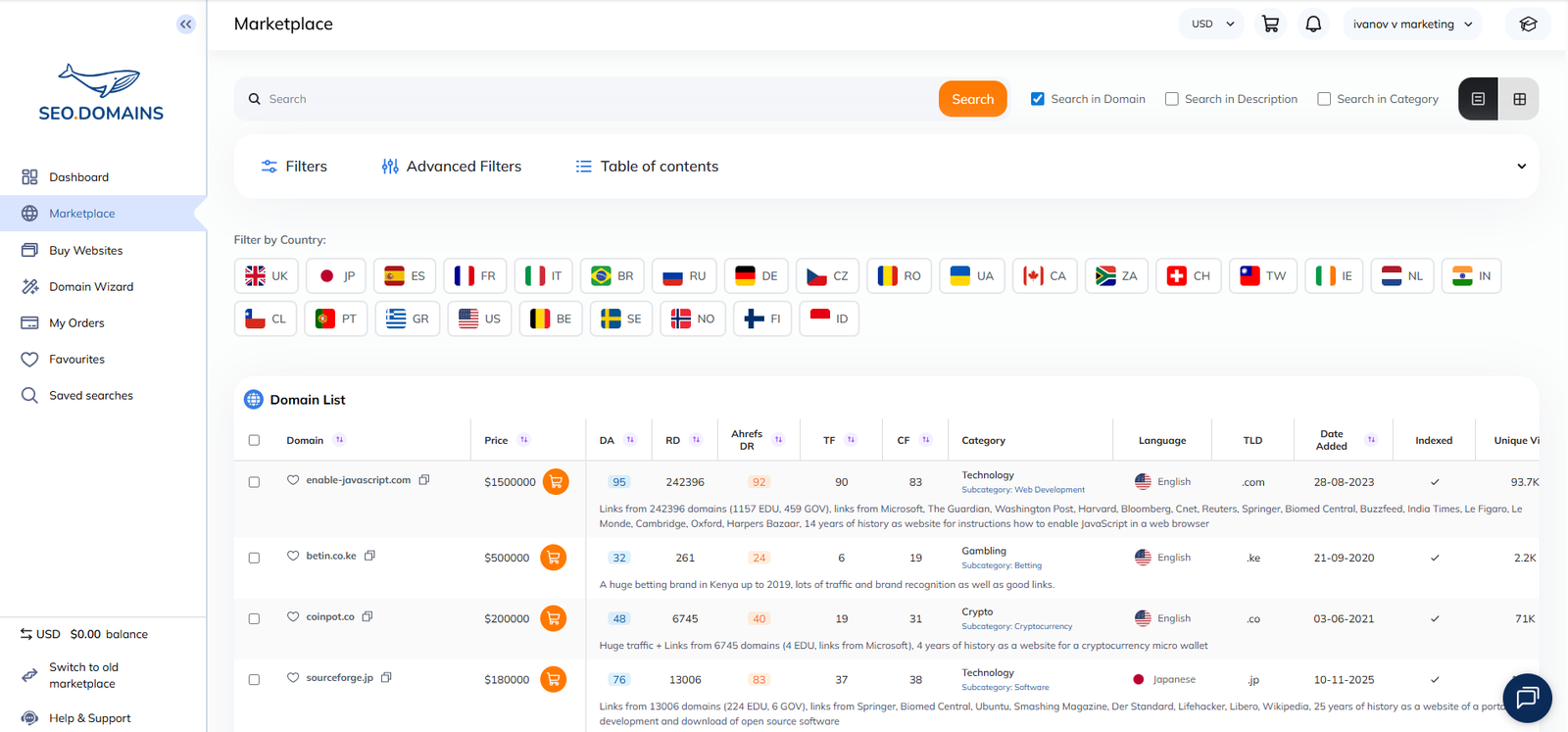
The SEO Domains marketplace, as an ICANN-accredited marketplace, runs daily WHOIS and RDAP polling against every domain in the active catalogue and against every domain placed on a buyer watch list.
When a watched domain transitions from the active state into the autoRenewPeriod or redemptionPeriod status, the marketplace records the transition and notifies the buyer.
The buyer information packet attached to each listing exposes the current status code, the days remaining in the current phase, and the projected drop date if the registrant does not renew.
The transparency layer differentiates SEO Domains from general aftermarket auction surfaces that aggregate inventory without exposing the lifecycle state.
Buyers time bids around redemption window cutoffs for optimal acquisition
Acquisition timing on aged-domain inventory follows the grace and redemption windows. The buyer’s move depends on the phase the domain occupies:
- Auto-renew grace: wait to see whether the registrant initiates a manual renewal or lets the auto-renewal stand.
- Redemption grace: evaluate whether the registrant intends to pay the restoration fee or lets the domain drop.
- Pending delete: prepare for the drop-catching window.
SEO Domains exposes each of these timings inside the listing detail view. Buyers plan bids around the specific cutoff dates instead of guessing at registry behaviour.
Active aged inventory remains the marketplace entry point for buyers
For SEO professionals, domain investors, and brand owners ready to evaluate aged expired domains with verified active history, the entry point is the active aged inventory on the SEO Domains marketplace.
The catalogue exposes three filters in sequence:
- The active status field as the primary filter
- The grace and redemption transition windows as secondary filters
- The verified registration age as the tertiary filter
Buyers acquire aged domains with documented lifecycle records on a transparent ICANN-accredited marketplace surface, with end-to-end workflow from discovery through ICANN-compliant transfer.