 BUY WEBSITES
 BUY DOMAINS
 LOGIN
LOGIN
 SIGNUP



Redemption period domain names: the RGP restore window explained
The redemption period is the 30-day registry hold that follows the auto-renew grace period in the ICANN-accredited domain lifecycle, and it is the window in which redemption period domain names can still be restored before they drop.
During the window a registrant restores an expired aged domain by paying a registry-set redemption fee and a renewal fee.
The redemption period sits between the auto-renew grace and the 5-day pending-delete phase, and registries enforce it through the EPP redemptionPeriod status defined in RFC 3915.
SEO Domains runs its own drop-catching system and holds 220,000+ expired domains in its portfolio, listed through an ICANN-accredited marketplace with documented registration history and ICANN-accredited transfer on every purchase.
What is the domain redemption period (RGP)?
The domain redemption period is a 30-day registry hold that follows the auto-renew grace for ICANN-accredited gTLDs. The original registrant restores the domain by paying a registry-set redemption fee, after which a 5-day pending-delete phase precedes permanent removal.
The redemption period sits between the auto-renew grace and the pending-delete phases.
The domain lifecycle moves through five operational states under ICANN consensus policy. After the registration expires, the registrar holds the domain in an auto-renew grace period of 0 to 45 days, configurable per registrar.
Failure to renew during the auto-renew grace pushes the domain into the redemption period at the registry layer.
The redemption window runs 30 days for gTLDs, then yields to a 5-day pending-delete phase before the registry releases the domain back to public availability.
SEO Domains covered the auto-renew grace mechanics in the prior article on Grace period and auto-renew grace, and the active-state baseline in Active registration status and what it signals for SEO.
Registered & resolving
0–45 days
30 days, registry hold
5 days, registry-only
Open to public
The 30-day window protects registrants from accidental loss.
ICANN designed the redemption window as a final safety mechanism for registrants who miss the renewal notification cycle.
Once a registrar deletes a domain at the registry, the registry restores it on receipt of a valid restore request from the sponsoring registrar within 30 days.
No third party purchases a redemption-period domain; the policy reserves the restoration right to the registered name holder at the moment of deletion.
The hold protects high-value aged domains from accidental drop and preserves backlink equity, indexation history, and brand trust through the disruption window.
The redemptionPeriod EPP status code identifies a domain in RGP.
Registry systems expose the redemption state through the Extensible Provisioning Protocol (EPP).
When the sponsoring registrar deletes the domain, the registry sets the parent EPP status to pendingDelete and the RFC 3915 RGP substatus to redemptionPeriod for the 30-day restoration window.
The 5-day pending-delete phase that follows RGP carries the same pendingDelete parent status without the redemptionPeriod substatus, signalling that restoration is no longer available.
Three server-side prohibitions apply throughout the redemption window:
serverTransferProhibitedblocks every transfer mechanism.serverUpdateProhibitedfreezes contact and nameserver edits.serverDeleteProhibitedlocks the registrar out of an early delete.
WHOIS and RDAP queries return these status codes verbatim. A registrar lookup confirms whether the domain remains restoreable.
The registrant cannot edit contact data, transfer the domain, or perform any registry-level update until the registrar completes the restoration workflow.
How long do redemption period domain names stay recoverable?
The redemption period spans 30 calendar days for generic TLDs under ICANN consensus policy. Identity Digital adds a 5-day restore lock, while ccTLD registries override the duration entirely: Nominet .uk runs 90 days, DENIC .de runs zero.
The 30-day gTLD baseline derives from ICANN consensus policy.
The 30-day redemption window is codified in the Expired Domain Deletion Policy (EDDP), which the ICANN Board adopted on 31 October 2003.
The implementation announcement followed on 21 September 2004, and the policy became binding on accredited gTLD registrars on 21 December 2004.
The policy applies to every accredited generic TLD registry contract that uses the standard registry agreement, which covers .com, .net, .org, .info, .biz, and the 1,200+ new gTLDs delegated since 2014.
Identity Digital adds a 5-day Restore Lock Period after successful restoration.
Identity Digital operates .info, .pro, .live, .online, and 250+ additional gTLDs. It layers a 5-day Restore Lock Period on top of the standard 30-day RGP.
Once a registrar completes the restoration, the registry locks the domain against further deletion or transfer for 5 days.
The lock prevents a registrant from immediately re-deleting the restored domain to claim a renewal credit. A separate 5-day Redemption Hold Period precedes the final pending-delete transition for domains that exit RGP without restoration.
The Nominet .uk registry runs a 90-day no-fee redemption window.
The .uk registry, operated by Nominet, replaces the ICANN 30-day RGP with a 90-day protected period during which the original registrant restores the domain at no separate restore fee.
The registrant pays the standard renewal cost; Nominet does not levy a redemption surcharge.
The extended window reflects Nominet's registrant-protection priorities, set by the Nominet Policy Advisory Body instead of ICANN. After 90 days the .uk domain proceeds directly to deletion. No separate pending-delete phase follows.
Five ccTLD registries operate no redemption window at all.
Five ccTLD registries skip the redemption phase under their independent policy frameworks:
- DENIC (
.de) deletes directly at the end of the registrar grace period. - auDA (
.au) routes to a 30-day pending-delete phase with no restore window. - EURid (
.eu) releases the name without a redemption corridor. - AFNIC (
.fr) follows its own deletion schedule. - JPRS (
.jp) drops the name without an ICANN-style RGP.
Registrants planning aged-domain acquisition through ccTLD inventory account for the absence of the redemption safety net before targeting these TLDs.
What does redemption restoration cost?
Redemption restoration costs $88 to $200 across ICANN-accredited registrars. The fee runs from $88.88 at Namecheap to $195.99 at Hover.
The fee is registry-set and non-refundable. It stacks on a mandatory 1-year renewal. Figure 3 charts the full retail spread.
The redemption fee originates at the registry, not the registrar.
The registry charges the sponsoring registrar a wholesale restoration fee, which the registrar passes through to the registrant with a service markup.
Three registry operators set the wholesale fee at the contract level:
- Verisign sets the restoration fee for
.comand.net. - Identity Digital sets the fee across its 250+ TLDs.
- Public Interest Registry sets the
.orgfee.
Because the wholesale charge is non-negotiable, retail prices across registrars cluster within a $100 band instead of diverging widely. A registrar absorbs none of the wholesale fee, and ICANN does not cap the retail markup.
A mandatory 1-year renewal stacks on top of the redemption fee.
The restoration workflow requires a paired renewal cycle. The registry will not lift the redemptionPeriod status without a renewal that extends the registration period by at least 12 months.
Total recovery cost equals the redemption fee plus the standard renewal price at the registrar. A .com recovery at Namecheap totals $102.86 ($88.88 + $13.98 renewal); a .com recovery at Hover totals $211.98 ($195.99 + $15.99).
The 1-year extension cannot be deferred or applied retroactively.
The restoration fee cannot be waived for any reason.
Bluehost states the position directly in its help documentation. The redemption fee "is required to pull the domain out of the holding period and is paid to the registry itself."
A registrar that absorbed the wholesale fee on a registrant's behalf would record a loss on every restoration.
ICANN-accredited registrars uniformly enforce the no-waiver rule, and customer-support escalation rarely changes the outcome. The fee structure ties to registry contracts that bind the registrar regardless of customer goodwill.
Total recovery cost runs 8 to 15 times standard renewal across major TLDs.
A standard .com renewal at Namecheap costs $13.98 per year, while the same domain in redemption costs $88.88 to restore plus the renewal: a 7.4 times multiple.
At Hover the recovery cost ($195.99 + $15.99) reaches 13.3 times the renewal rate.
Aged-domain operators who manage multi-year registration calendars factor this multiplier into the renewal-versus-loss decision. The threshold separates rational restoration from rational abandonment.
Why did ICANN create the redemption grace period?
ICANN created the redemption grace period to protect registrants from accidental loss. The ICANN Board adopted the Expired Domain Deletion Policy on 31 October 2003.
Implementation guidance issued on 21 September 2004, and enforcement began on 21 December 2004. The 2013 Expired Registration Recovery Policy extended the framework.
The Redemption Grace Period is a 30-day registry hold period for all domain names deleted by registrars. This hold period is designed to allow registrars the ability to restore names that were deleted accidentally or without the intent of the registrant.
ICANN Expired Domain Deletion Policy · Board resolution 31 October 2003 · Effective 21 December 2004
The EDDP consensus policy passed the ICANN Board on 31 October 2003.
The Expired Domain Deletion Policy emerged from the Generic Names Supporting Organization (GNSO) consensus process during 2002 and 2003.
The ICANN Board ratified the policy on 31 October 2003 alongside two related ICANN consensus policies: the Registration Data Reminder Policy and the Restored Names Accuracy Policy.
The EDDP introduced the formal 30-day redemption window across every accredited gTLD registry contract, creating a uniform recovery baseline that registrants relied on from 2004 forward.
Implementation documents issued on 21 September 2004.
ICANN published the implementation guidance package on 21 September 2004, defining the technical and contractual requirements that registries and registrars adopted.
The guidance referenced the EPP RGP extension, then under development by Scott Hollenbeck at VeriSign, which became RFC 3915 in September 2004.
The implementation timeline gave accredited parties 90 days to align registry systems and registrar interfaces with the new requirement.
Enforcement on accredited gTLD registrars began on 21 December 2004.
The EDDP became enforceable on 21 December 2004, binding every ICANN-accredited gTLD registrar and every accredited registry operating under the standard registry agreement.
The compliance regime tied directly to ICANN's contract-enforcement powers: a registrar that failed to honor a valid restore request risked accreditation review.
The enforcement date set the modern baseline for the domain redemption period framework that registrants and aged-domain operators rely on in 2026.
The 2013 ERRP extended the lineage with registrant-notification requirements.
The Expired Registration Recovery Policy took effect on 31 August 2013. It built on the EDDP foundation by adding registrant-notification rules.
Registrars now send a minimum of two renewal reminders before expiration and one post-expiration notice referencing the redemption process.
The ERRP also formalized the Registrant at Expiration (RAE) as the party eligible to redeem. The definition closed a loophole over restoration rights when contact data changed during the grace window.
How does the EPP restore command technically restore a domain?
The registrar sends an EPP <rgp:restore op="request"/> element to the registry to lift the redemptionPeriod status. RFC 3915 defines the mapping, and Identity Digital requires a follow-up <rgp:restore op="report"/> containing a complete <rgp:report> document within 5 days.
EPP RGP restore request (RFC 3915)
<epp xmlns="urn:ietf:params:xml:ns:epp-1.0">
  <command>
    <update>
      <domain:update xmlns:domain="urn:ietf:params:xml:ns:domain-1.0">
        <domain:name>example.com</domain:name>
      </domain:update>
    </update>
    <extension>
      <rgp:update xmlns:rgp="urn:ietf:params:xml:ns:rgp-1.0">
        <rgp:restore op="request"/>
      </rgp:update>
    </extension>
    <clTRID>ABC-12345</clTRID>
  </command>
</epp>
RFC 3915 defines the EPP RGP extension and five grace period status values.
RFC 3915, published by Scott Hollenbeck (VeriSign) in September 2004, specifies the Domain Registry Grace Period Mapping for EPP. The extension defines five rgpStatus values for grace periods:
addPeriodautoRenewPeriodrenewPeriodtransferPeriodredemptionPeriod
Two further EPP status values interact with RGP transitions. pendingRestore applies during an active restore operation. pendingDelete applies at deletion and persists through both the redemption and pending-delete phases.
The extension also defines the <rgp:restore> command element with two op-attribute values: request and report. The protocol grounding ensures cross-registry consistency for the restoration workflow.
The rgp:restore element initiates the restore operation via EPP.
A restore operation traverses three phases. First, the registrar sends an EPP <update> command wrapping the domain name and an <rgp:restore op="request"/> extension element to the registry.
Second, the registry validates that the domain remains within the 30-day redemption window and accepts the request, transitioning the domain into the pendingRestore status.
Third, the registrar posts payment of the wholesale restoration fee plus renewal, after which the registry returns the domain to active status. The protocol exchange completes within minutes at the EPP layer.
A subsequent rgp:restore op="report" payload submits the restore report.
Identity Digital and additional legacy registries require a second EPP transaction within 5 calendar days of the restore request. The second call uses <rgp:restore op="report"/> and carries a populated <rgp:report> child element.
The report attests to the restoration reason and provides evidence sufficient to satisfy ICANN audit requirements.
Identity Digital's policy states that failure to submit a complete report "shall result in the mandatory return of the domain name to a Pending Delete status and the forfeit of the RGP fee."
The restore report XML requires preData, postData, delTime, resTime, resReason, and two statement elements.
RFC 3915 specifies the structure of the restore report payload. The seven required elements document the deletion and restoration events:
| Element | Purpose |
|---|---|
rgp:preData | Registration data immediately before the deletion event |
rgp:postData | Registration data after the restoration |
rgp:delTime | Deletion timestamp (registry server time) |
rgp:resTime | Original restore command timestamp |
rgp:resReason | Restoration rationale text (registrar narrative) |
rgp:statement (x2) | Client attestation: registrant authorized restoration and registrar verified identity |
rgp:other (optional) | Supplementary supporting information |
Which registrars route expiring domains to auction during RGP?
GoDaddy routes expiring domains to auction at day 26, before RGP begins. Namecheap forwards expiring inventory to the same auction platform.
A domain sold at auction skips RGP entirely and transfers to the auction buyer. The route preserves registrar revenue while honoring the ICANN registrant-priority window during RGP itself.
GoDaddy Auctions lists expiring domains at day 26, before RGP begins.
GoDaddy operates an aftermarket auction platform that handles a high volume of gTLD expiry inventory.
Domains registered through GoDaddy that expire and remain unrenewed during the auto-renew grace move into GoDaddy Auctions at day 26, four days before the registry-level RGP would begin. The auction window runs for 10 days.
A successful sale results in immediate transfer to the buyer at auction close, and the original registrant cannot trigger restoration because the domain never enters the registry redemption phase.
SEO Domains takes the opposite operational stance. Every listing carries three guarantees with no pre-RGP auction diversion:
- Verified registration history.
- A transparent backlink fingerprint.
- ICANN-accredited transfer mechanics.
A successful auction sale skips the RGP path entirely.
The auction route diverts the domain off the standard ICANN restoration path. From the buyer's perspective, the auction purchase resembles a private aftermarket transaction with registrar-side transfer mechanics.
From the original registrant's perspective, the auction route eliminates the 30-day safety net the ICANN policy intended.
Registrars structure terms-of-service language to permit the auction route, and the route remains legal under current ICANN compliance interpretations because the domain is not technically deleted while at auction.
Namecheap forwards expiring inventory to the same auction platform.
Namecheap announced a partnership routing expiring Namecheap-registered domains to GoDaddy Auctions, consolidating expired-domain liquidity at the GoDaddy aftermarket layer.
Namecheap retains the original registrant restoration option through the standard renewal window. The auction-routing partnership shortens the effective recovery window for registrants who delay action past the auto-renew grace boundary.
The arrangement reflects registrar-side economics instead of ICANN policy.
The auction route preserves registrar revenue while honoring registrant priority during the RGP window.
The legal interpretation supporting the auction route relies on a strict reading of ICANN's deletion definitions.
A domain at auction is technically still registered to the original registrant during the auction window; the registrar has not submitted an EPP delete to the registry.
Only after auction sale does the registrar update the registrant data and transfer sponsorship. Because the registry never sees a deletion event for a successfully-auctioned domain, the ICANN-mandated redemption phase never triggers.
The arrangement remains in place across operators that bundle registrar and auction services. Buyers who require ICANN-accredited transfer mechanics, transparent lifecycle history, and verified provenance read the auction route as a gap.
Those buyers source aged-domain inventory from the SEO Domains marketplace instead of registrar-bundled auctions.
How do redemption period rules compare across major registrars?
ICANN-accredited registrars align on the 30-day RGP duration under ICANN policy while diverging on fee and pre-RGP behaviour. Porkbun, Cloudflare, Hover, and Dynadot honor the full RGP path.
GoDaddy and Namecheap route inventory through auction first. Identity Digital adds restoration locks at the registry layer. Figure 6 sets the fees and routes side by side.
| Registrar | Renewal (.com) | Redemption fee | Pre-RGP behaviour | Restore route |
|---|---|---|---|---|
| Porkbun | $10.11 | $170.11 | 44-day grace | EPP restore via control panel |
| Cloudflare | $9.77 | $169.77 | 30-day grace | EPP restore via dashboard |
| Dynadot | $9.99 | $144.99 | 30-day grace | EPP restore via dashboard |
| Hover | $15.99 | $195.99 | 30-day grace | EPP restore via support |
| Namecheap | $13.98 | $88.88 | 30-day grace, auction forward | EPP restore via live chat |
| Bluehost | $21.99 | $99.00 | 0 to 45-day grace | EPP restore via support |
| GoDaddy | $19.99 | $169.98 | 26-day grace then auction | EPP restore via support |
| SEO Domains (marketplace) | Post-drop listing | N/A (post-RGP acquisition) | Curated catalogue intake | ICANN-accredited transfer mechanics |
The 30-day RGP duration holds across ICANN-accredited gTLD registrars.
Every ICANN-accredited gTLD registrar offers the same 30-day redemption window because the duration is contractually fixed at the registry layer. A registrar cannot shorten the window for ICANN-administered gTLDs without breaching its registry accreditation agreement.
The duration uniformity ensures aged-domain operators plan recovery actions against a single 30-day baseline for .com, .net, .org, .info, .biz, and the new gTLDs delegated since 2014.
Redemption fees range from $88.88 at Namecheap to $195.99 at Hover.
Retail redemption fees diverge across registrars even though the wholesale fee remains constant.
Namecheap charges $88.88 on top of the registry wholesale fee plus the $0.20 ICANN gTLD transaction fee, positioning itself at the low end of the retail band. Hover charges $195.99 plus renewal, positioning at the upper band.
The $100 retail-fee spread reflects registrar service positioning, account management, and recovery-support overhead instead of wholesale cost.
Identity Digital adds a 5-day Restore Lock and a 5-day Redemption Hold after the standard RGP window.
Identity Digital operates 250+ gTLDs including .info, .pro, .live, .online, and the legacy Donuts portfolio. Public Interest Registry handles the separate .org contract under its own restoration framework.
Identity Digital layers two registry-specific phases on top of the ICANN baseline. The Restore Lock Period freezes a restored domain for 5 days post-restoration to prevent immediate re-deletion exploits.
The Redemption Hold Period inserts a final 5-day safety pause before pending-delete for domains that exit RGP without restoration, giving the registrant a last opportunity to act with registry intervention.
What questions do registrants ask about the redemption period?
Registrants raise four recurring questions about the redemption period:
- Can redemption fees be waived? No, the registry sets them.
- Does DNS work? No, zone delegation is removed.
- Is the domain buyable? Only by the original registrant.
- How long does restoration take? 24 to 72 hours after payment clears.
The questions surface in registrar support queues across the industry.
Q1Can the redemption fee be waived?
No. The redemption fee originates at the registry layer through the wholesale restoration price. The sponsoring registrar passes the wholesale cost through with a service markup.
Customer-support escalation cannot waive a fee that the registrar owes to the registry regardless of registrant goodwill.
Q2Does DNS work during the redemption period?
No. The registry removes the domain from the authoritative zone file when the redemptionPeriod status applies. Websites stop loading, email bounces, and dependent services cease functioning.
The DNS removal serves as a visible signal to the registrant that lapses into redemption.
Q3Can a third party buy a domain during redemption?
No. ICANN consensus policy reserves restoration rights to the original registrant at expiration. A third party cannot purchase, transfer, or backorder a domain inside the 30-day redemption window.
Acquisition opportunities open after the pending-delete phase completes and the domain returns to public availability. Marketplaces such as SEO Domains list curated inventory of aged domains with documented history, ready for direct acquisition by SEO professionals and domain investors.
Q4How long does restoration take after payment?
Restoration completes within 24 to 72 hours of payment clearing at ICANN-accredited registrars.
Bluehost documents a 72-hour maximum, Namecheap completes within 24 hours when paid through account credit, and EPP-direct restorations clear within minutes once the registry confirms payment.
Q5What happens if the redemption period ends without restoration?
The domain transitions into the 5-day pending-delete phase at the registry. Restoration is unavailable during pending-delete.
After the 5 days expire, the registry releases the domain back to public availability, and aftermarket platforms or backorder services compete for re-registration. The original registrant loses priority permanently at this point.
Q6Is the domain transferable during redemption?
No. The serverTransferProhibited status applied during the redemption phase blocks every transfer mechanism. A registrant cannot relocate the domain to another sponsoring registrar until the restoration completes and the registry clears the prohibition flag.
Redemption fees cannot be waived because the registry sets the wholesale charge.
The economic structure makes fee waiver impossible at the registrar level. Verisign sets the .com wholesale restoration price, Identity Digital sets the price for its TLD portfolio, and PIR sets the .org price.
A registrar that absorbed the wholesale fee would record a per-restoration loss, an outcome no registrar will accept on a customer-by-customer basis. The fee tied to registry-registrar contract economics ensures uniformity.
DNS resolution stops because the zone delegation is removed.
The registry removes a redemption-period domain from the authoritative zone file the moment the deletion processes. Recursive resolvers cease returning NS records, websites return DNS resolution errors, and email servers bounce inbound mail.
The DNS removal is a deliberate signal: ICANN designed the visible service disruption to alert the registrant to the lapse and prompt restoration action before the redemption window closes.
Only the original registrant restores. No third-party purchase is possible during RGP.
The ICANN Expired Registration Recovery Policy defines the Registrant at Expiration (RAE) as the party eligible to redeem. The RAE is the registered name holder identified in the registry data immediately prior to expiration.
A new buyer cannot claim restoration rights, an acquirer cannot purchase the domain mid-RGP, and a backorder service cannot pre-empt the RAE. The 30-day window is a registrant-only restoration corridor.
Restoration completes within 24 to 72 hours of payment clearing at ICANN-accredited registrars.
The technical EPP transaction completes within minutes once payment posts. The 24 to 72 hour ceiling reflects manual queue processing at registrars that route restoration requests through human-reviewed support tickets.
Cloudflare and Dynadot self-service dashboards clear within hours; Bluehost and Hover support-driven flows extend toward the 72-hour maximum. EPP-direct integrations process restoration in real time once the registry confirms payment.
How does the redemption period connect to aged-domain inventory on SEO Domains?
Aged domains on SEO Domains carry documented registration histories and verified authority metrics. Understanding the redemption period helps buyers distinguish continuous-history inventory from domains that returned via post-drop recovery.
That distinction separates the premium tier from re-registered listings in the curated marketplace.
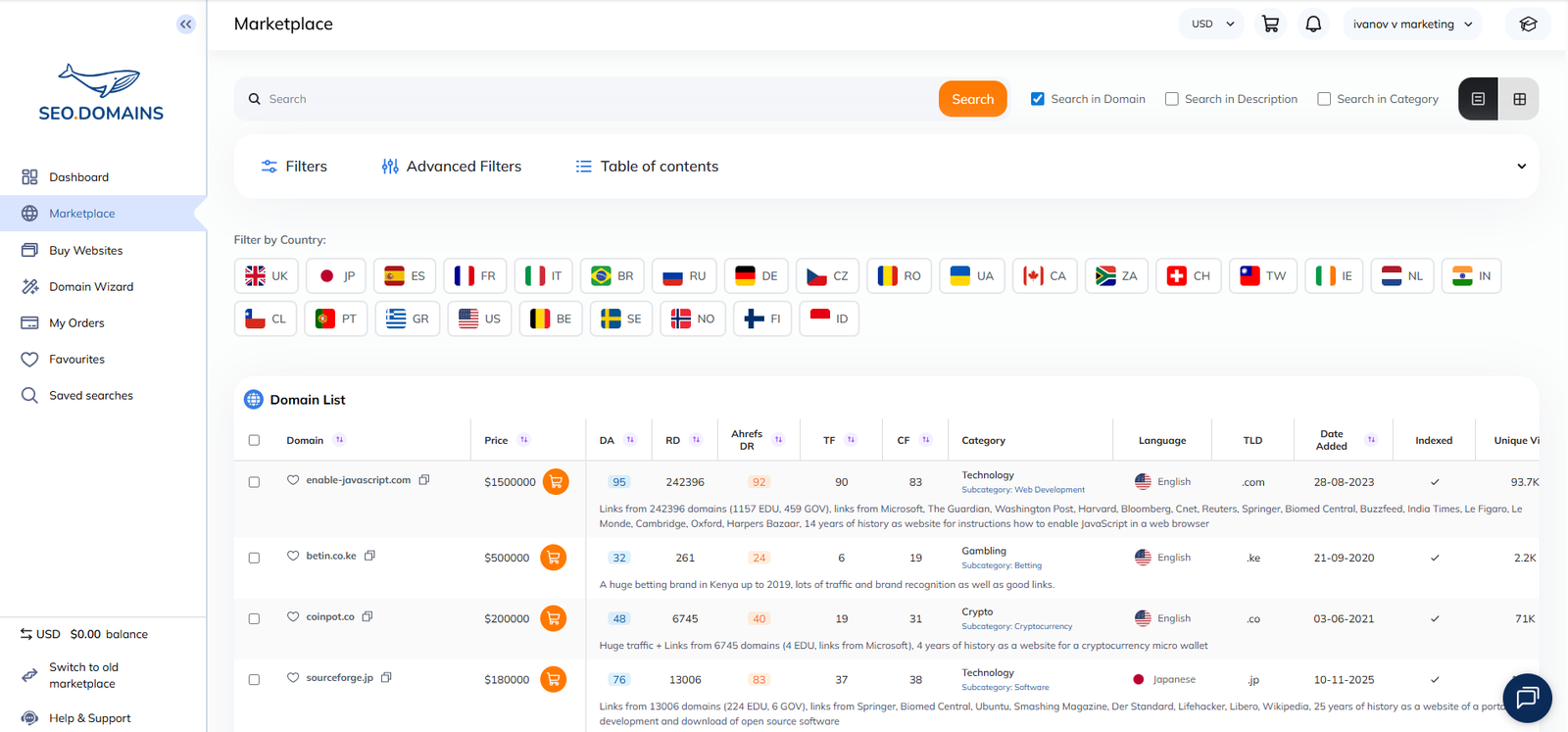
SEO Domains runs its own drop-catching system and holds 220,000+ expired domains in its portfolio.
The brand operates its own drop-catching system across the ICANN-accredited gTLD namespace.
The captured inventory currently totals over 220,000 expired aged domains documented in the marketplace catalogue, the largest curated source of expired aged domains in the aftermarket.
Buyers browse the catalogue by Domain Authority, referring domains, TLD, country, and topical category instead of competing at the daily registry release windows.
Aged domains with continuous registration represent the highest-value inventory tier.
A domain that has never lapsed past the auto-renew grace boundary carries an unbroken registration history.
Three continuity signals stay intact on an unbroken name:
- Backlinks accumulated across the active years remain unbroken in the search index.
- The host-age signal continues compounding.
- Prior-owner trust signals carry forward.
Aged domains in this tier command premium pricing across the aftermarket because the SEO continuity translates directly into faster ranking recovery when redeployed by the acquiring owner.
Each SEO Domains listing carries documented registration history and authority metrics.
Every aged-domain listing on SEO Domains carries published metadata drawn from WHOIS records and authoritative backlink databases:
- Registration age in years.
- Domain Authority and Domain Rating.
- Count of referring domains.
- TLD, country, and topical category.
Buyers filter the catalogue by these attributes and inspect the per-listing details before purchase. The transparency framing avoids the opacity of generic aftermarket auction batches.
The marketplace presents documented per-listing history instead of opaque auction batches.
The competing aftermarket auction model bundles expiring inventory into bidder pools without per-listing history disclosure.
A buyer at a competing auction house receives the domain name and a price; a buyer at SEO Domains receives the domain, the documented registration history, the authority and backlink metrics, and ICANN-accredited transfer mechanics at purchase.
The documentation framing aligns with the ICANN-accredited marketplace positioning the brand anchors its operations against.
Restoration during RGP preserves accumulated SEO equity.
A domain restored inside the 30-day RGP window retains its accumulated link equity and indexation history, because the registry returns the original record to active status instead of releasing it for re-registration.
The SEO Domains analytical desk tracks this continuity as a core value indicator. A recovery action before the redemption window closes preserves three assets the registrant has built across years of operation:
- The backlink graph.
- The indexed page count.
- The host-age signal.
The same continuity logic shapes the value premium that aged domains command in the curated SEO Domains catalogue.
SEO Domains completes every acquisition through ICANN-accredited transfer mechanics.
SEO Domains operates as an ICANN-accredited marketplace for aged and expired domains. Every purchase completes through the standard EPP transfer protocol that registries enforce under ICANN policy, with documented provenance handed to the buyer at closing.
The accreditation framework distinguishes the marketplace from generic aftermarket bidder pools that complete transfers without documented per-listing history.
Acquire from 220,000+ expired domains in the SEO Domains portfolio. Browse the largest curated catalogue in the aftermarket. Filter by Domain Authority, referring domains, TLD, country, and category.
Complete every purchase through ICANN-accredited transfer mechanics with documented provenance. Browse the SEO Domains marketplace →
